[Analysis] SIP, SWP and STP – How Each Works | Rupee-Cost Averaging | Loads and Tax on Transfers
- Blog|Company Law|
- 5 Min Read
SIP invests regularly, SWP withdraws regularly, STP moves money between schemes. Here’s how each works—with worked examples.
- By Taxmann
- |
- Last Updated on 16 November, 2026
Latest from Taxmann

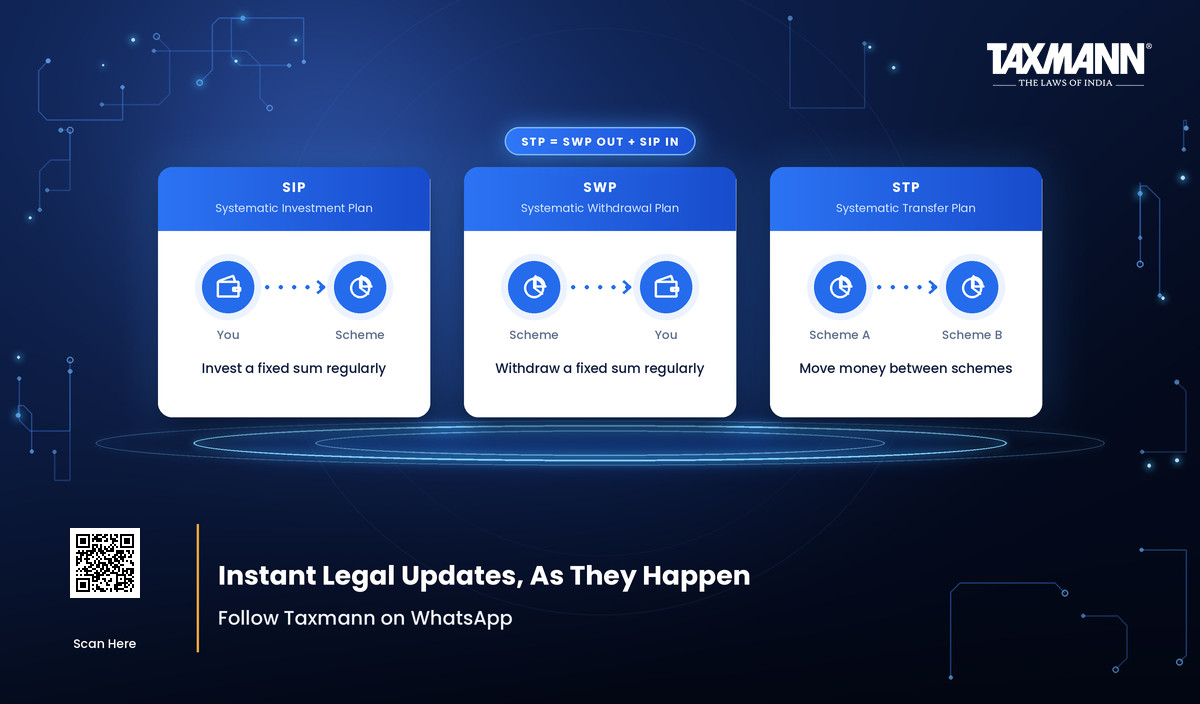
Table of Contents
- Why “systematic” matters
- SIP—Systematic Investment Plan
- SWP—Systematic Withdrawal Plan
- STP—Systematic Transfer Plan
- Switch vs STP—what’s the difference?
- The fourth facility: Dividend Transfer Plan (DTP)
- Which one do you need?
- Quick answers
1. Why “systematic” matters
Systematic facilities let investors align investing and withdrawing to their actual cash flows—the surplus they can spare, the income they need, or a rebalancing plan. Crucially, once registered, these transactions execute without the investor having to act each time, which protects the portfolio from investor inertia. That last point is underrated: most portfolio damage is done by not acting, or acting at the worst moment.
2. SIP—Systematic Investment Plan
An SIP invests a constant amount at regular intervals. Its central benefit, especially in volatile markets like equity, is that it averages your cost of acquisition—you automatically buy more units when prices fall and fewer when they rise.
Worked example—₹1,000 per month:
| Month | NAV | Units allotted (₹1,000 ÷ NAV) |
|---|---|---|
| 1 | ₹10 | 100.000 |
| 2 | ₹12 | 83.333 |
| 3 | ₹9 | 111.111 |
Over the period, the investor’s average acquisition cost works out lower than the average of the NAVs on the transaction dates. This is why the approach is called Rupee Cost Averaging—you buy into a volatile market over time at an average price, without having to predict market movements.
Practical points:
- SIPs can be funded via Post-Dated Cheques (PDCs), NACH or Standing Instructions.
- An SIP can start a fresh purchase and open a folio, or add to an existing folio.
- The initial investment to start an SIP is typically lower than for a lump-sum purchase—which is precisely why it suits investors who find small periodic amounts easier to generate than a large sum.
- An SIP can even be initiated during a New Fund Offer (NFO).
3. SWP—Systematic Withdrawal Plan
An SWP is the mirror image. Just as investors don’t want to buy everything at a market peak, they don’t want to redeem everything in a trough. An SWP offers units for repurchase at a constant value over time.
Worked example—withdrawing ₹1,000 per month: if the NAV in month 1 is ₹10, the holding reduces by 100 units (₹1,000 ÷ ₹10). If the NAV rises the next month, fewer units are consumed to deliver the same ₹1,000.
4. STP—Systematic Transfer Plan
An STP is a variation of an SWP. Instead of paying the withdrawn amount to the investor, it reinvests it into another scheme of the same mutual fund. So it works as an SWP out of the source scheme and an SIP into the target scheme.
Important: the transfer out of the source scheme is a redemption. That means exit loads and taxes apply, exactly as with any other redemption.
Worked example. An investor holds ₹10 lakh in a short-term debt fund and registers an STP of ₹1,00,000 per month for 10 instalments into a diversified equity scheme of the same mutual fund. The debt fund charges an exit load of 0.25% on redemption within three months of allotment, and nil thereafter.
| Instalment | Exit load | Amount transferred to equity scheme |
|---|---|---|
| 1–3 | 0.25% = ₹250 each | ₹99,750 each |
| 4–10 | Nil | ₹1,00,000 each |
Any return earned on the short-term debt fund is taxed as applicable.
Why not just do an SWP and an SIP separately? Because you would:
- wait for redemption proceeds and hold idle funds before reinvesting—during which the market can move against you; and
- do two sets of paperwork (redeem and purchase) every single period.
The STP is the cost-effective, convenient version. Note too that the mutual fund’s minimum investment and redemption limits do not apply to an STP, though the fund does specify which schemes can act as source and target.
5. Switch vs STP—what’s the difference?
| Switch | STP | |
|---|---|---|
| Transactions | One—a single tranche | Multiple tranches over a fixed period |
| Amount/date | One-off | Pre-defined amount on pre-defined dates |
| Typical use | Booking profits, changing view | Phasing into a market, rebalancing |
A switch is a redemption from one scheme and a purchase into another, combined into one transaction—for example, an investor who believes equity markets have peaked switching out of an equity scheme into a short-term debt fund. If that same movement happens in multiple pre-defined tranches, it is an STP.
6. The fourth facility: Dividend Transfer Plan (DTP)
The Transfer of IDCW plan (dividend transfer plan) invests the income earned in one scheme into another scheme of the same mutual fund. A low-risk investor can gain some diversification by routing debt-fund income into an equity fund; equally, equity-fund income can be moved into debt to rebalance.
Points to know:
- You must hold units in the IDCW option of the source scheme to register a DTP.
- Registering a DTP overrides any existing IDCW payout or reinvestment instruction.
- All units under the selected scheme, plan and option are covered.
- The target scheme’s minimum application amount does not apply; units in the target are held in the same folio.
- The fund may specify a minimum transferable income amount.
7. Which one do you need?
| Your situation | Facility |
|---|---|
| Investing a monthly surplus | SIP |
| Need regular income from a corpus | SWP |
| Have a lump sum, want to phase into equity | STP |
| Changing your view in one move | Switch |
| Want income redeployed, not paid out | DTP |
Systematic transactions are part of Chapter 9 (Investor Services) of the Mutual Fund Foundation workbook, the largest unit of the exam at 20%.
8. Quick answers
What is the full form of SIP, SWP and STP?
Systematic Investment Plan, Systematic Withdrawal Plan and Systematic Transfer Plan.
What is rupee cost averaging?
Buying a constant amount regularly, so you acquire more units when prices are low and fewer when high—lowering your average acquisition cost.
Does exit load apply to an STP?
Yes. The transfer out of the source scheme is a redemption, so exit loads and taxes apply as they would on any redemption.
What’s the difference between a switch and an STP?
A switch is a single transaction; an STP is multiple pre-defined tranches over a period.
Can I start an SIP during an NFO?
Yes.
Do minimum investment limits apply to an STP?
No—the fund’s minimum investment and redemption limits do not apply to STP transactions.
Law stated as on 16 November 2026. This article draws on Chapter 9 of the official NISM-Series-V-B Mutual Fund Foundation workbook (March 2026 Workbook Version), published exclusively by Taxmann, read with the law in force on that date. It is general information, not investment, tax or legal advice.
More in this series: What is a Mutual Fund · KYC for Mutual Fund Investors · Exit Load in Mutual Funds · ELSS and Section 123 (Old Section 80C) · How Mutual Fund Returns Are Calculated
Disclaimer: The content/information published on the website is only for general information of the user and shall not be construed as legal advice. While the Taxmann has exercised reasonable efforts to ensure the veracity of information/content published, Taxmann shall be under no liability in any manner whatsoever for incorrect information, if any.

Taxmann Publications has a dedicated in-house Research & Editorial Team. This team consists of a team of Chartered Accountants, Company Secretaries, and Lawyers. This team works under the guidance and supervision of editor-in-chief Mr Rakesh Bhargava.
The Research and Editorial Team is responsible for developing reliable and accurate content for the readers. The team follows the six-sigma approach to achieve the benchmark of zero error in its publications and research platforms. The team ensures that the following publication guidelines are thoroughly followed while developing the content:
- The statutory material is obtained only from the authorized and reliable sources
- All the latest developments in the judicial and legislative fields are covered
- Prepare the analytical write-ups on current, controversial, and important issues to help the readers to understand the concept and its implications
- Every content published by Taxmann is complete, accurate and lucid
- All evidence-based statements are supported with proper reference to Section, Circular No., Notification No. or citations
- The golden rules of grammar, style and consistency are thoroughly followed
- Font and size that’s easy to read and remain consistent across all imprint and digital publications are applied
Everything on Tax and Corporate Laws of India
To subscribe to our weekly newsletter please log in/register on Taxmann.com









 CA | CS | CMA


