[Analysis] Expense Ratio (TER) in Mutual Funds – Meaning | Direct vs Regular Plans | Separate NAVs
- Blog|Company Law|
- 3 Min Read
TER is what running the scheme costs you. Here’s why Direct and Regular plans have different NAVs—and where GST sits.
- By Taxmann
- |
- Last Updated on 16 November, 2026
Latest from Taxmann
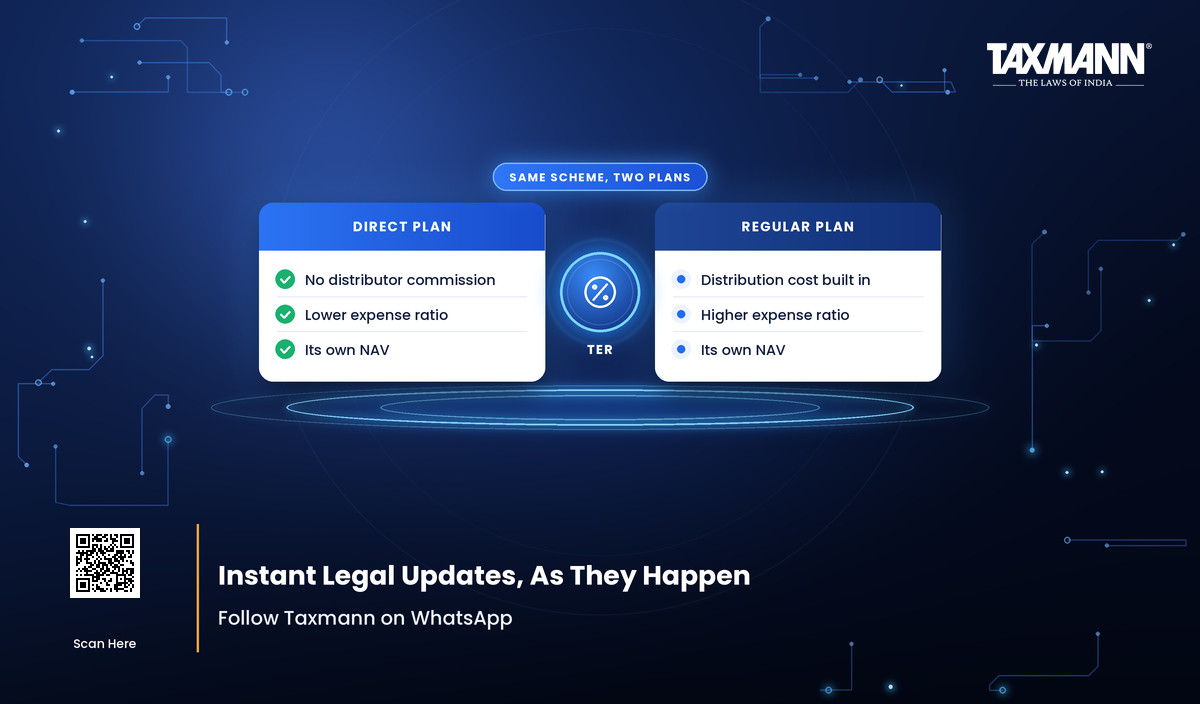
Table of Contents
- Why every investor should care
- Direct vs Regular—the clearest illustration of TER
- Where does GST fit?
- Quick answers
1. Why every investor should care
All investors’ money is pooled. The costs of managing the scheme are shared by all unit-holders in proportion to their holdings. The consequence is blunt: an individual investor has no control over the costs of a scheme. You can choose a cheaper scheme; you cannot negotiate a cheaper one.
Two things soften this:
- SEBI imposes limits on the expenses chargeable to a scheme. Those limits vary with the size of the assets and the nature of the scheme.
- Market forces push costs down. Many schemes operate at expenses well below the regulatory ceiling—which works in investors’ favour.
2. Direct vs Regular—the clearest illustration of TER
Every mutual fund must offer two plans:
| Regular Plan | Direct Plan | |
|---|---|---|
| Route | Through a distributor | Directly from the fund |
| Distribution expenses / commission | Included | Excluded—no commission is paid |
| TER | Higher | Lower |
| NAV | Separate | Separate |
The logic is fair: distribution is a service, and it costs something. An investor who goes direct has chosen not to use that service, so they need not bear its cost.
Two rules people get wrong:
- The Direct plan is only for investors who buy directly from the fund. If a purchase or repurchase is routed through a distributor, it is a Regular Plan investment.
- Apart from these two plans, an AMC cannot offer separate plans based on expense ratio.
3. Where does GST fit?
AMCs may charge GST as per applicable tax laws, within the limits prescribed under the SEBI (Mutual Funds) Regulations. Importantly, GST on investment management and advisory fees is charged to the scheme in addition to the overall TER limits.
SEBI’s expense limits and the GST position can be checked on Taxmann.com | Research. Chapters 2 and 9 of the Mutual Fund Foundation workbook cover costs and plan options.
4. Quick answers
What is the full form of TER?
Total Expense Ratio.
Do I pay the expense ratio separately?
No. It is charged to the scheme and is already reflected in the NAV.
Why do Direct and Regular plans have different NAVs?
Because they carry different TERs—the Direct plan excludes distribution expenses and commission.
Can I buy a Direct plan through a distributor?
No. If the transaction is routed through a distributor, it is a Regular Plan investment.
Is GST included within the TER limit?
GST on investment management and advisory fees is charged to the scheme over and above the TER limits.
SEBI’s slab-wise expense limits are covered in our note on total expense ratio slabs and base TER.
Law stated as on 16 November 2026. This article draws on Chapters 2, 8 and 9 of the official NISM-Series-V-B Mutual Fund Foundation workbook (March 2026 Workbook Version), published exclusively by Taxmann, read with the law in force on that date. It is general information, not investment, tax or legal advice.
More in this series: What is a Mutual Fund · Exit Load in Mutual Funds · NAV in Mutual Funds · Mutual Fund Distributor Commission · AUM in Mutual Funds
Disclaimer: The content/information published on the website is only for general information of the user and shall not be construed as legal advice. While the Taxmann has exercised reasonable efforts to ensure the veracity of information/content published, Taxmann shall be under no liability in any manner whatsoever for incorrect information, if any.

Taxmann Publications has a dedicated in-house Research & Editorial Team. This team consists of a team of Chartered Accountants, Company Secretaries, and Lawyers. This team works under the guidance and supervision of editor-in-chief Mr Rakesh Bhargava.
The Research and Editorial Team is responsible for developing reliable and accurate content for the readers. The team follows the six-sigma approach to achieve the benchmark of zero error in its publications and research platforms. The team ensures that the following publication guidelines are thoroughly followed while developing the content:
- The statutory material is obtained only from the authorized and reliable sources
- All the latest developments in the judicial and legislative fields are covered
- Prepare the analytical write-ups on current, controversial, and important issues to help the readers to understand the concept and its implications
- Every content published by Taxmann is complete, accurate and lucid
- All evidence-based statements are supported with proper reference to Section, Circular No., Notification No. or citations
- The golden rules of grammar, style and consistency are thoroughly followed
- Font and size that’s easy to read and remain consistent across all imprint and digital publications are applied
Everything on Tax and Corporate Laws of India
To subscribe to our weekly newsletter please log in/register on Taxmann.com









 CA | CS | CMA


