[Analysis] Mutual Fund Distributor Commission – Full Trail Model | Daily Calculation | Disclosure Rules
- Blog|Company Law|
- 4 Min Read
MFDs are paid trail commission only—calculated on daily balances, indexed to NAV, and payable for as long as the investor stays. Here’s the mechanics.
- By Taxmann
- |
- Last Updated on 16 November, 2026
Latest from Taxmann

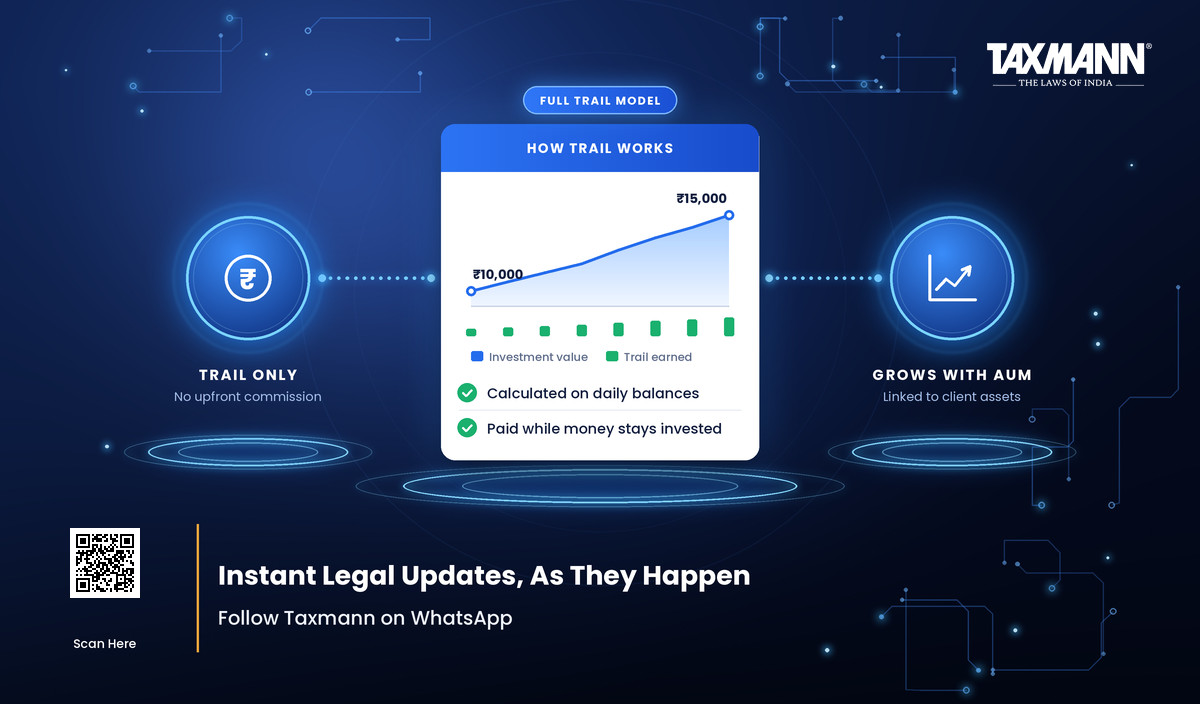
Table of Contents
- The rule: full trail, nothing else
- How trail is calculated—the mechanics
- Two features that make this unusual
- What about GST?
- Commission disclosure—who gets named
- The churn tripwire
- A note on empanelment economics
- Quick answers
1. The rule: full trail, nothing else
Under SEBI’s Master Circular for Mutual Funds dated 20 March 2026, AMCs must adopt a full trail model of commission in all schemes—with no upfront commission, and no upfronting of trail commission, whether directly or indirectly, in cash or in kind, through sponsorships or by any other route.
Read that carefully, because it closes every door: any incentive to a distributor that is not trail commission is not permitted. And trail commission can only be paid in monetary terms—not in kind.
The intent is to discourage mis-selling. If a distributor cannot earn a large payment at the point of sale, the incentive to churn a client’s portfolio largely evaporates.
Distributors earn commission on investments mobilised under the Regular Plan, from the AMCs with whom they are empanelled. (Direct plans pay no commission—which is exactly why their expense ratio is lower.)
2. How trail is calculated—the mechanics
Trail is a percentage of net assets, computed on daily balances, paid per the agreement with the AMC.
The crucial implication: because it is calculated on net assets, the distributor benefits when the market rises.
Worked example. An investor buys 1,000 units at ₹10 each—₹10,000 mobilised.
| Value trail is calculated on | |
|---|---|
| At the time of investment | 1,000 × ₹10 = ₹10,000 |
| After the NAV rises to ₹15 | 1,000 × ₹15 = ₹15,000 |
Trail is payable on ₹15,000—not on the ₹10,000 originally mobilised. In short, trail commission depends on the NAV.
3. Two features that make this unusual
- It is indexed to the current value of the investment. As the client’s wealth grows, so does the distributor’s income. Interests are aligned.
- There is no time limit. Unlike insurance, where agent commission is paid for a limited number of years, a mutual fund distributor is paid trail for as long as the investor’s money stays in the fund.
Together these are genuinely distinctive: an income that compounds with the client’s portfolio and never expires while the client stays invested. It rewards retention and service, not selling.
4. What about GST?
Distributor commission attracts GST as per applicable tax laws.
5. Commission disclosure—who gets named
SEBI mandates that mutual funds/AMCs disclose on their websites the total commission and expenses paid to distributors who meet one or more of these conditions, with respect to non-institutional (retail and HNI) investors:
| Trigger | Threshold |
|---|---|
| Multiple points of presence | More than 20 locations |
| AUM raised across the industry (non-institutional, including HNIs) | Over ₹100 crore |
| Commission received across the industry | Over ₹1 crore p.a. |
| Commission received from a single mutual fund/AMC | Over ₹50 lakh |
This data also goes to AMFI, which discloses consolidated figures on its website.
Beyond commission, AMCs must also disclose yearly, distributor-wise: gross inflows (flagging whether the distributor is an associate or group company of the sponsor), net inflows, average AUM, and the ratio of AUM to gross inflows.
6. The churn tripwire
Here’s the mechanism that catches mis-selling: if the data shows a distributor’s portfolio turnover ratio is excessive—more than two times the industry average—AMCs conduct an additional due diligence of that distributor.
SEBI has separately mandated AMCs to run a due diligence process for distributors qualifying on criteria such as multiple point presence (more than 20 locations), a requirement SEBI introduced by circular CIR/IMD/DF/13/2011 dated 22 August 2011.
7. A note on empanelment economics
Not every distributor gets empanelled directly. Some AMCs directly empanel only distributors likely to generate adequate business, asking others to work under an already-empanelled distributor. AMCs may also link commission levels to volumes generated—in which case a smaller agent may find it beneficial to work under an established distributor. AMCs also retain the power to terminate empanelment at any time, and there is no standard empanelment format—each AMC uses its own.
The GST position on commission can be checked on Taxmann.com | Research, and fact-specific questions taken to Taxmann Advisory. Distributor commission is covered in Chapter 6 of the Mutual Fund Foundation workbook.
8. Quick answers
How do mutual fund distributors earn?
Through trail commission only, on investments mobilised under Regular Plans.
Is upfront commission allowed?
No. SEBI has withdrawn upfront commission and transaction charges; AMCs must follow a full trail model with no upfronting by any route.
How is trail commission calculated?
As a percentage of net assets attributable to the units the distributor sold, computed on daily balances and paid periodically—typically monthly or quarterly.
Does trail commission rise if the market rises?
Yes. It is calculated on net assets, so it is indexed to NAV.
How long is trail commission paid?
For as long as the investor’s money remains in the fund—there is no time limit.
Can trail commission be paid in kind?
No. It can be paid only in monetary terms.
When must an AMC disclose my commission?
Where you cross any of the thresholds—over 20 locations, over ₹100 crore AUM, over ₹1 crore commission across the industry, or over ₹50 lakh from a single AMC.
GST on commission and the limits on what an AMC may pay are covered in our note on distributor commission, GST and limits.
Law stated as on 16 November 2026. This article draws on Chapter 6 of the official NISM-Series-V-B Mutual Fund Foundation workbook (March 2026 Workbook Version), published exclusively by Taxmann, read with the law in force on that date. It is general information, not investment, tax or legal advice.
More in this series: What is a Mutual Fund · How to Become a Mutual Fund Distributor · ARN, EUIN and KYD · Expense Ratio (TER) in Mutual Funds · NISM-Series-V-B Exam
Disclaimer: The content/information published on the website is only for general information of the user and shall not be construed as legal advice. While the Taxmann has exercised reasonable efforts to ensure the veracity of information/content published, Taxmann shall be under no liability in any manner whatsoever for incorrect information, if any.

Taxmann Publications has a dedicated in-house Research & Editorial Team. This team consists of a team of Chartered Accountants, Company Secretaries, and Lawyers. This team works under the guidance and supervision of editor-in-chief Mr Rakesh Bhargava.
The Research and Editorial Team is responsible for developing reliable and accurate content for the readers. The team follows the six-sigma approach to achieve the benchmark of zero error in its publications and research platforms. The team ensures that the following publication guidelines are thoroughly followed while developing the content:
- The statutory material is obtained only from the authorized and reliable sources
- All the latest developments in the judicial and legislative fields are covered
- Prepare the analytical write-ups on current, controversial, and important issues to help the readers to understand the concept and its implications
- Every content published by Taxmann is complete, accurate and lucid
- All evidence-based statements are supported with proper reference to Section, Circular No., Notification No. or citations
- The golden rules of grammar, style and consistency are thoroughly followed
- Font and size that’s easy to read and remain consistent across all imprint and digital publications are applied
Everything on Tax and Corporate Laws of India
To subscribe to our weekly newsletter please log in/register on Taxmann.com









 CA | CS | CMA


