[Analysis] NISM Full Form – What NISM Is | Its SEBI Mandate | Certification Domains
- Blog|Company Law|
- 3 Min Read
NISM stands for National Institute of Securities Markets—a capacity-building initiative of SEBI, established in 2006. Here’s what it does.
- By Taxmann
- |
- Last Updated on 16 November, 2026
Latest from Taxmann
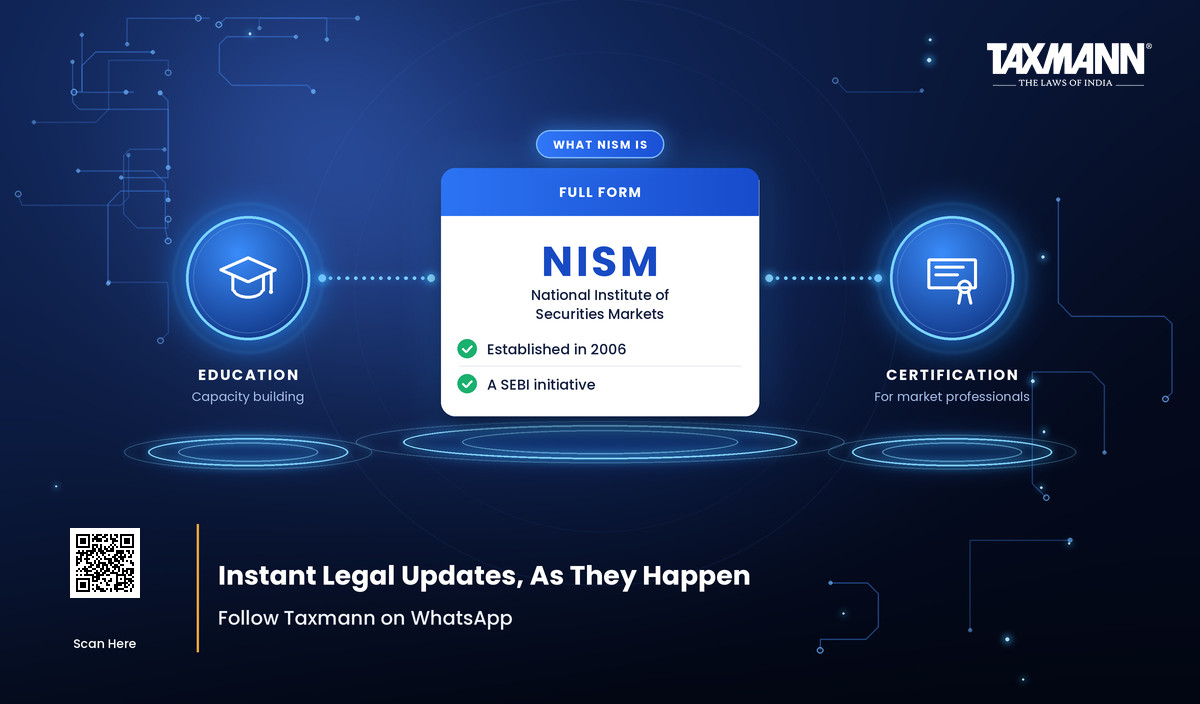
Table of Contents
- What NISM does
- Why it exists
- What NISM certifies
- Is NISM a regulator?
- Who does what—SEBI, NISM, AMFI
- If you want to distribute mutual funds
- Quick answers
1. What NISM does
NISM’s core function is to set and test a minimum common benchmark of functional knowledge for people working in the securities markets. It does this through:
- Certification Examinations, and
- Continuing Professional Education (CPE) Programmes
These are developed and administered as mandated under the SEBI (Certification of Associated Persons in the Securities Markets) Regulations, 2007. In other words, these certifications are not optional badges—they are a regulatory requirement for defined market roles.
2. Why it exists
The reasoning is straightforward. The skills, expertise and ethics of professionals in the securities markets are crucial—both to provide effective intermediation to investors, and to build investor confidence in market systems and processes. A certification regime is how a regulator ensures a floor.
The effect NISM aims for is twofold: create quality market professionals, and thereby catalyse greater investor participation in the markets. A useful by-product is that certifications provide structured career paths for students and job aspirants.
3. What NISM certifies
NISM certifications span the market’s product lines and functions, including:
Mutual Funds · Equities · Derivatives · Securities Operations · Compliance · Portfolio Management—among others.
Each certification serves a different intermediary and function.
4. Is NISM a regulator?
No—and the distinction is worth being precise about. SEBI is the regulator. NISM is SEBI’s capacity-building initiative: it builds and tests knowledge, and administers certifications mandated under SEBI’s regulations. It is not itself the rule-making authority for the mutual fund industry.
(For completeness, a third body causes confusion here: AMFI, the Association of Mutual Funds in India, is the industry association—and it is neither a regulator nor a Self-Regulatory Organisation.)
5. Who does what—SEBI, NISM, AMFI
| Body | Full form | Role |
|---|---|---|
| SEBI | Securities and Exchange Board of India | The regulator |
| NISM | National Institute of Securities Markets | SEBI’s capacity-building arm—certifications and CPE |
| AMFI | Association of Mutual Funds in India | Industry association—registers distributors (ARN); not a regulator |
6. If you want to distribute mutual funds
The relevant NISM certification depends on the route:
- NISM-Series-V-A: Mutual Fund Distributors—the general distributor certification, covering the full product range.
- NISM-Series-V-B: Mutual Fund Foundation—the foundation-level certification for SEBI’s ‘new cadre’ of distributors (postal agents; retired government, semi-government, teaching and banking professionals with at least 10 years of service; bank correspondents and similar persons notified by AMFI/AMC), covering a simpler, specified product set.
Taxmann publishes NISM’s certification workbooks. For the foundation-level mutual fund certification, the official title is the NISM-Series-V-B Mutual Fund Foundation workbook.
7. Quick answers
What is the full form of NISM?
National Institute of Securities Markets.
When was NISM established?
In 2006, pursuant to the Union Budget of 2005-06.
Is NISM a government body?
It is a capacity-building initiative of SEBI, the securities market regulator.
Is NISM the regulator of mutual funds?
No—SEBI is the regulator. NISM develops and administers certifications mandated under SEBI’s regulations.
Under which regulations are NISM certifications mandated?
The SEBI (Certification of Associated Persons in the Securities Markets) Regulations, 2007.
Which NISM certification do I need to sell mutual funds?
NISM-Series-V-A for general distribution; NISM-Series-V-B if you are part of SEBI’s new cadre.
Law stated as on 16 November 2026. This article draws on the relevant chapters of the official NISM-Series-V-B Mutual Fund Foundation workbook (March 2026 Workbook Version), published exclusively by Taxmann, read with the law in force on that date. Confirm current examination and certification requirements on NISM’s official website before registering. It is general information, not investment, tax or legal advice.
More in this series: What is a Mutual Fund · NISM-Series-V-B Exam · How to Become a Mutual Fund Distributor · ARN, EUIN and KYD · Who Regulates Mutual Funds in India
Disclaimer: The content/information published on the website is only for general information of the user and shall not be construed as legal advice. While the Taxmann has exercised reasonable efforts to ensure the veracity of information/content published, Taxmann shall be under no liability in any manner whatsoever for incorrect information, if any.

Taxmann Publications has a dedicated in-house Research & Editorial Team. This team consists of a team of Chartered Accountants, Company Secretaries, and Lawyers. This team works under the guidance and supervision of editor-in-chief Mr Rakesh Bhargava.
The Research and Editorial Team is responsible for developing reliable and accurate content for the readers. The team follows the six-sigma approach to achieve the benchmark of zero error in its publications and research platforms. The team ensures that the following publication guidelines are thoroughly followed while developing the content:
- The statutory material is obtained only from the authorized and reliable sources
- All the latest developments in the judicial and legislative fields are covered
- Prepare the analytical write-ups on current, controversial, and important issues to help the readers to understand the concept and its implications
- Every content published by Taxmann is complete, accurate and lucid
- All evidence-based statements are supported with proper reference to Section, Circular No., Notification No. or citations
- The golden rules of grammar, style and consistency are thoroughly followed
- Font and size that’s easy to read and remain consistent across all imprint and digital publications are applied
Everything on Tax and Corporate Laws of India
To subscribe to our weekly newsletter please log in/register on Taxmann.com









 CA | CS | CMA


