[Analysis] Who Regulates Mutual Funds in India – SEBI | AMFI | Trustees
- Blog|Company Law|
- 3 Min Read
SEBI regulates mutual funds in India. AMFI is not a regulator—here’s who does what, and the distinction most people get wrong.
- By Taxmann
- |
- Last Updated on 16 November, 2026
Latest from Taxmann
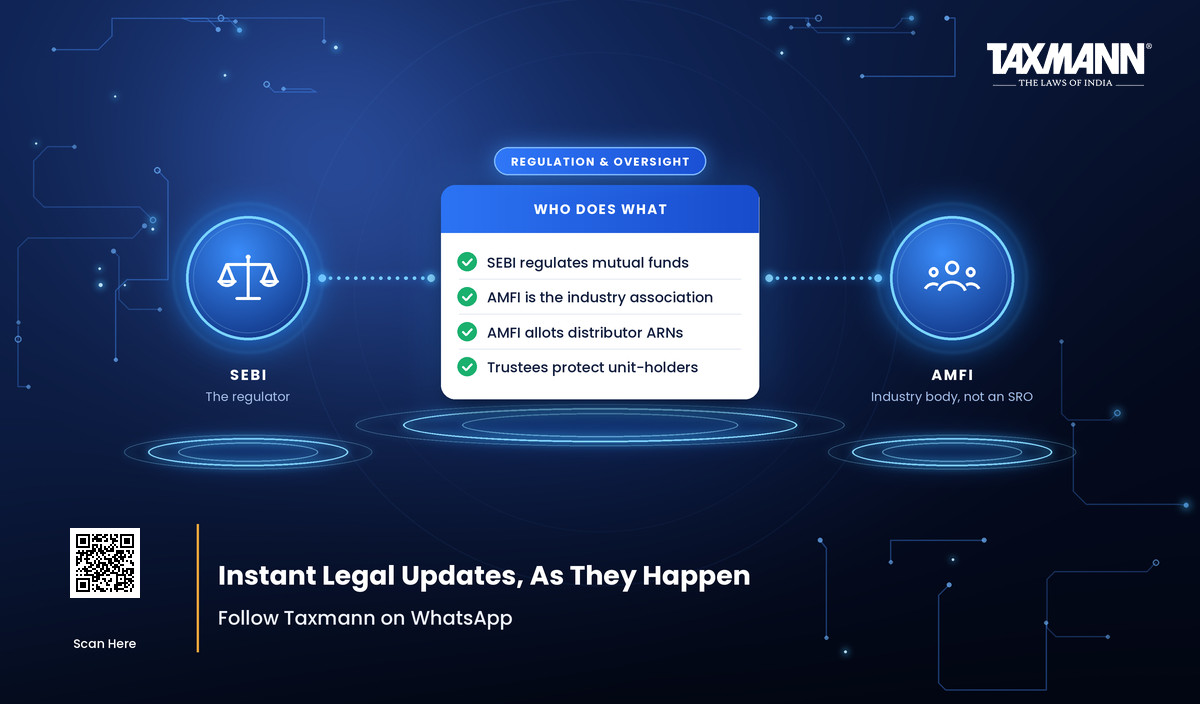
Table of Contents
- SEBI—the regulator
- AMFI—important, but not a regulator
- And the trustees
- Who does what—at a glance
- What if you have a complaint?
- Quick answers
1. SEBI—the regulator
SEBI’s role runs across the industry:
- It defines what a mutual fund is and stipulates the legal structure—a trust, with built-in checks and balances to protect investors.
- It sets the applicable guidelines through the SEBI (Mutual Funds) Regulations, 2026. (SEBI first issued mutual fund regulations in 1996. The 2026 Regulations replaced them with effect from 1 April 2026.)
- It prescribes investment restrictions for schemes.
- It runs the advertisement code—advertisements by mutual funds must be accurate, true and not misleading.
- It sets valuation norms, standardised across the industry.
- It requires AMCs to constitute a Unit Holder Protection Committee (UHPC).
- It has issued a Cyber Security and Cyber Resilience Framework (CSCRF) built around five resiliency goals: anticipate, withstand, contain, recover and evolve.
One nuance worth knowing: SEBI vets, it does not approve
Scheme documents are prepared in SEBI’s prescribed format and submitted to SEBI. SEBI does not approve or disapprove them—it issues observations, which the fund must incorporate. So the documents in the market are “vetted” by SEBI, not “approved” by SEBI. Anyone telling you a scheme is “SEBI approved” is misstating the position.
2. AMFI—important, but not a regulator
AMFI is the association of all registered AMCs. Its objectives include:
- defining and maintaining high professional and ethical standards across the industry;
- recommending and promoting best practices and a code of conduct;
- interacting with and representing to SEBI, and representing to the Government, the RBI and other bodies;
- running nationwide investor awareness programmes;
- disseminating information, and undertaking studies and research;
- regulating the conduct of distributors, including disciplinary action such as cancellation of the ARN for Code of Conduct violations; and
- protecting the interests of investors and unit-holders.
A major AMFI function is registering mutual fund distributors by allotting the AMFI Registration Number (ARN)—mandatory to be a distributor. AMFI also issues circulars recommending best practices.
But to be precise: AMFI is neither a regulatory body nor an SRO. It sets standards and can act on distributors’ ARNs; it does not regulate the industry.
3. And the trustees
Inside each fund, a third layer of protection operates. Because a mutual fund is a trust whose beneficiaries are the unit-holders, the trustees carry the legal role of protecting investors’ interests—appointing and, where needed, terminating the AMC. An AMC’s appointment can be ended by a majority of trustees, or by 75% of unit-holders, subject to SEBI’s prior approval.
4. Who does what—at a glance
| Body | Role | Regulator? |
|---|---|---|
| SEBI | Sets the regulations, structure, investment restrictions, advertisement code; vets scheme documents | Yes |
| AMFI | Industry association; standards, best practice, investor awareness, ARN registration and distributor discipline | No—not a regulator, not an SRO |
| Trustees | Hold the trust; protect unit-holders; appoint/terminate the AMC | Internal to each fund |
| AMC | Day-to-day management of schemes | No (a regulated entity) |
5. What if you have a complaint?
Investor grievance redressal is part of the framework, and scheme documents must state how to register a grievance. Investors’ rights and obligations are set out in the regulations.
The SEBI (Mutual Funds) Regulations, 2026 and SEBI’s Master Circular for Mutual Funds can be read on Taxmann.com | Research. Chapters 3 and 10 of the Mutual Fund Foundation workbook cover the structure and the regulatory environment.
6. Quick answers
Who regulates the mutual fund industry in India?
SEBI—the Securities and Exchange Board of India.
Is AMFI a regulator?
No. AMFI is neither a regulatory body nor a Self-Regulatory Organisation. It is the association of registered AMCs.
Can AMFI cancel a distributor’s ARN?
Yes—as disciplinary action for violations of the Code of Conduct.
Does SEBI approve mutual fund schemes?
No. SEBI issues observations on scheme documents which the fund must incorporate; the documents are vetted, not approved.
Who protects the interests of unit-holders inside a fund?
The trustees—unit-holders are the beneficiaries of the trust.
Law stated as on 16 November 2026. This article draws on Chapters 3, 5 and 10 of the official NISM-Series-V-B Mutual Fund Foundation workbook (March 2026 Workbook Version), published exclusively by Taxmann, read with the law in force on that date. It is general information, not investment, tax or legal advice.
More in this series: What is a Mutual Fund · AMC and Mutual Fund Structure · SID, SAI and KIM · ARN, EUIN and KYD · NISM Full Form
Disclaimer: The content/information published on the website is only for general information of the user and shall not be construed as legal advice. While the Taxmann has exercised reasonable efforts to ensure the veracity of information/content published, Taxmann shall be under no liability in any manner whatsoever for incorrect information, if any.

Taxmann Publications has a dedicated in-house Research & Editorial Team. This team consists of a team of Chartered Accountants, Company Secretaries, and Lawyers. This team works under the guidance and supervision of editor-in-chief Mr Rakesh Bhargava.
The Research and Editorial Team is responsible for developing reliable and accurate content for the readers. The team follows the six-sigma approach to achieve the benchmark of zero error in its publications and research platforms. The team ensures that the following publication guidelines are thoroughly followed while developing the content:
- The statutory material is obtained only from the authorized and reliable sources
- All the latest developments in the judicial and legislative fields are covered
- Prepare the analytical write-ups on current, controversial, and important issues to help the readers to understand the concept and its implications
- Every content published by Taxmann is complete, accurate and lucid
- All evidence-based statements are supported with proper reference to Section, Circular No., Notification No. or citations
- The golden rules of grammar, style and consistency are thoroughly followed
- Font and size that’s easy to read and remain consistent across all imprint and digital publications are applied
Everything on Tax and Corporate Laws of India
To subscribe to our weekly newsletter please log in/register on Taxmann.com









 CA | CS | CMA


