[Analysis] AMC and Mutual Fund Structure – Sponsor | Trustees | AMC and Custodian
- Blog|Company Law|
- 3 Min Read
An AMC runs the scheme day to day—but it doesn’t own your money or hold the assets. Here’s the three-tier structure and why it exists.
- By Taxmann
- |
- Last Updated on 16 November, 2026
Latest from Taxmann
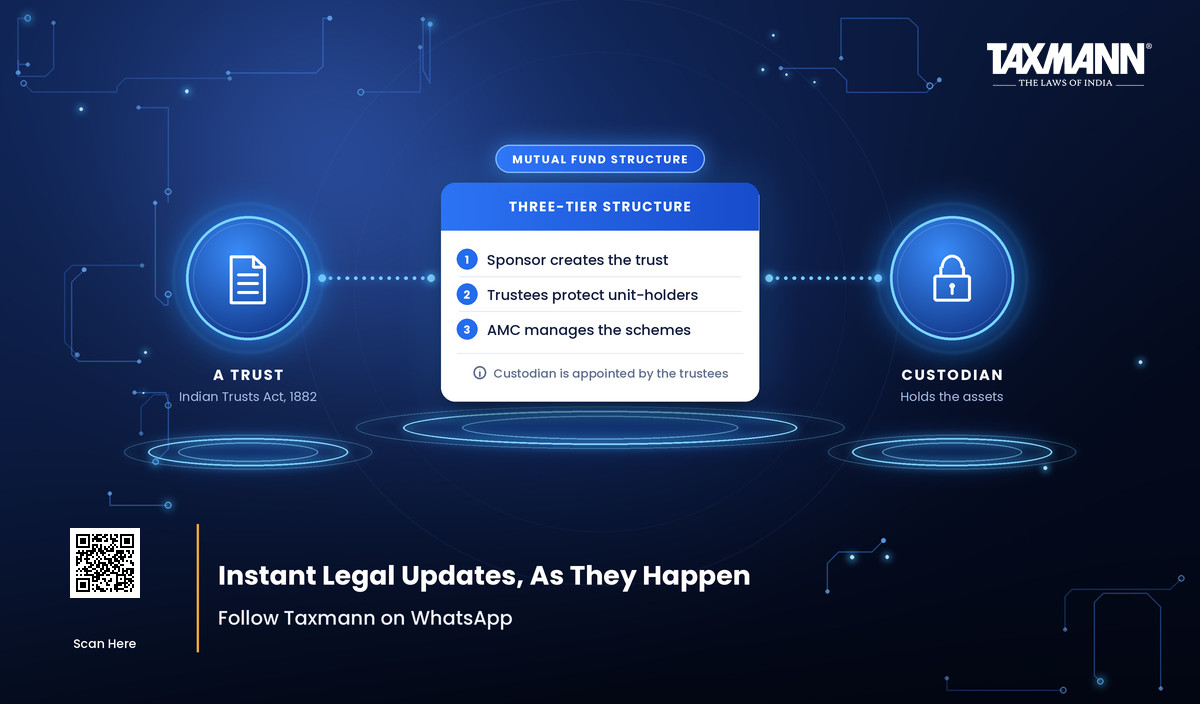
Table of Contents
- The three-tier structure—and why it exists
- Who can run an AMC?
- What does an AMC actually do?
- Can an AMC be sacked?
- The wider ecosystem
- Quick answers
1. The three-tier structure—and why it exists
Mutual funds in India are constituted as trusts, governed by the Indian Trusts Act, 1882. The structure has deliberate checks and balances:
| Tier | Who they are | What they do |
|---|---|---|
| Sponsor | The main persons behind the business | Apply to SEBI to register the fund; invest in the AMC’s capital |
| Trustee | Board of Trustees or a Trustee company | Hold the trust; protect the unit-holders’ interests |
| AMC | The asset manager | Run the schemes day to day |
How it fits together:
- The trust is created by the sponsor(s), and its operations are governed by a Trust Deed executed between sponsors and trustees. SEBI prescribes clauses that must be in it. The deed is registered under the Indian Registration Act, 1908.
- The beneficiaries of the trust are the investors—the unit-holders. That is a meaningful statement: the fund exists for them.
- The trust acts through its trustees, so protecting investors is legally the trustees’ job. The first trustees are named in the Trust Deed.
- The trustees execute an investment management agreement with the AMC, setting out its responsibilities.
- Custody of the scheme’s assets sits with a Custodian, appointed by the trustees—not with the AMC.
- Records of investors and unit-holdings are kept by the AMC itself or by a Registrar & Transfer Agent (RTA).
Read that again: the manager, the asset custodian and the protector of investors are three different parties. That is the investor protection.
2. Who can run an AMC?
SEBI sets the bar:
- Directors must have adequate professional experience in finance and financial services.
- Directors and key personnel must not have been found guilty of moral turpitude, convicted of an economic offence, or of violating securities laws.
- Key personnel must not have worked for an AMC, mutual fund or intermediary during a period when its registration was suspended or cancelled by SEBI.
- Prior approval of the trustees is required before anyone is appointed to the AMC’s board.
3. What does an AMC actually do?
It conducts the fund’s activities: arranging offices and infrastructure, engaging employees, providing software, handling advertising and sales promotion, and interacting with regulators and service providers. It must take all reasonable steps and exercise due diligence to ensure investments comply with the SEBI regulations and the trust deed.
Internally, an AMC is typically organised around compliance, fund management, operations and customer service, and sales and marketing functions.
4. Can an AMC be sacked?
Yes—and this is the fact most investors don’t know. The appointment of an AMC can be terminated by a majority of the trustees, or by 75% of the unit-holders. Any change in the AMC requires the prior approval of SEBI and the unit-holders.
5. The wider ecosystem
Around the three tiers sit the fund accountant, RTA, auditors, distributors, collecting bankers and payment aggregators, KYC Registration Agencies, valuation and credit-rating agencies, depositories and depository participants, and stock-exchange platforms.
The SEBI (Mutual Funds) Regulations, 2026 can be read in full on Taxmann.com | Research. Chapter 3 of the Mutual Fund Foundation workbook covers the legal structure.
6. Quick answers
What is the full form of AMC?
Asset Management Company.
Does the AMC hold my money?
No. Custody of the scheme’s assets is with a Custodian appointed by the trustees.
Who protects investors in a mutual fund?
The trustees—investors are the beneficiaries of the trust.
Can unit-holders remove an AMC?
Yes—75% of unit-holders can terminate the AMC’s appointment, as can a majority of the trustees. Any change needs SEBI’s prior approval.
Under which law is a mutual fund constituted?
As a trust, governed by the Indian Trusts Act, 1882.
Law stated as on 16 November 2026. This article draws on Chapter 3 of the official NISM-Series-V-B Mutual Fund Foundation workbook (March 2026 Workbook Version), published exclusively by Taxmann, read with the law in force on that date. It is general information, not investment, tax or legal advice.
More in this series: What is a Mutual Fund · Who Regulates Mutual Funds in India · Types of Mutual Funds · SID, SAI and KIM · Expense Ratio (TER) in Mutual Funds
Disclaimer: The content/information published on the website is only for general information of the user and shall not be construed as legal advice. While the Taxmann has exercised reasonable efforts to ensure the veracity of information/content published, Taxmann shall be under no liability in any manner whatsoever for incorrect information, if any.

Taxmann Publications has a dedicated in-house Research & Editorial Team. This team consists of a team of Chartered Accountants, Company Secretaries, and Lawyers. This team works under the guidance and supervision of editor-in-chief Mr Rakesh Bhargava.
The Research and Editorial Team is responsible for developing reliable and accurate content for the readers. The team follows the six-sigma approach to achieve the benchmark of zero error in its publications and research platforms. The team ensures that the following publication guidelines are thoroughly followed while developing the content:
- The statutory material is obtained only from the authorized and reliable sources
- All the latest developments in the judicial and legislative fields are covered
- Prepare the analytical write-ups on current, controversial, and important issues to help the readers to understand the concept and its implications
- Every content published by Taxmann is complete, accurate and lucid
- All evidence-based statements are supported with proper reference to Section, Circular No., Notification No. or citations
- The golden rules of grammar, style and consistency are thoroughly followed
- Font and size that’s easy to read and remain consistent across all imprint and digital publications are applied
Everything on Tax and Corporate Laws of India
To subscribe to our weekly newsletter please log in/register on Taxmann.com









 CA | CS | CMA


