[Analysis] Types of Mutual Funds – Structure | Active vs Passive | SEBI’s Five Scheme Groups
- Blog|Company Law|
- 4 Min Read
SEBI groups every scheme into five broad categories. Here’s the full map—with market-cap definitions and the multi-cap 25/25/25 rule.
- By Taxmann
- |
- Last Updated on 16 November, 2026
Latest from Taxmann

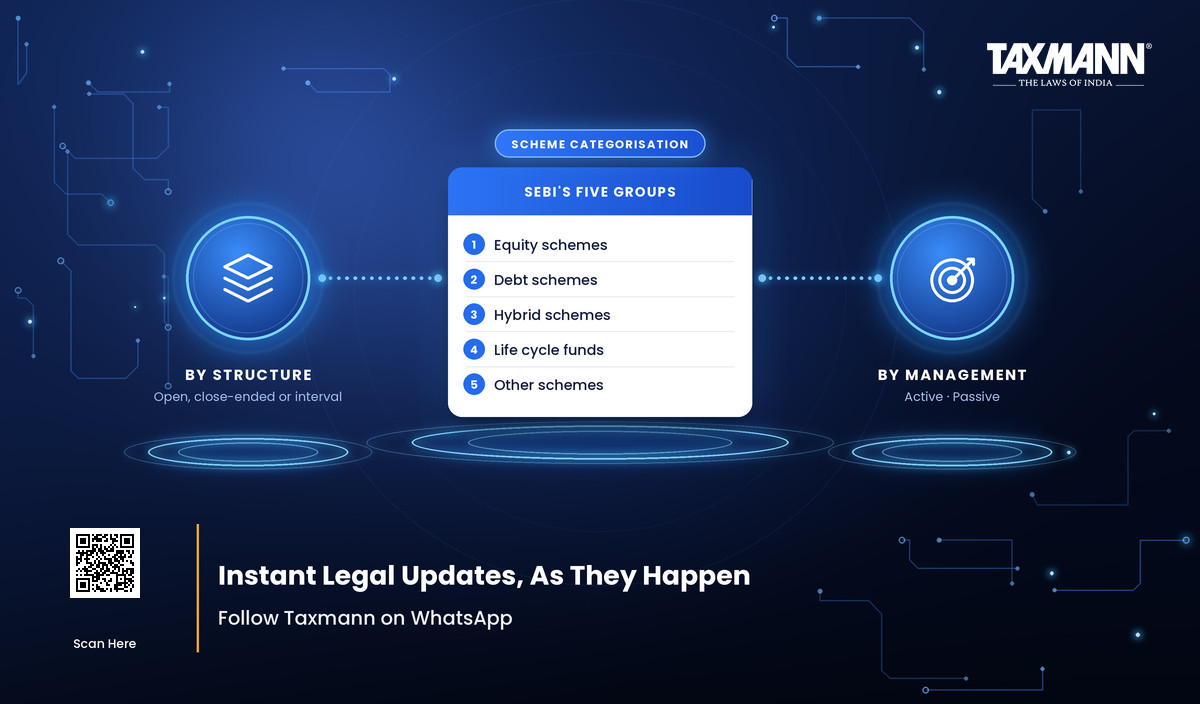
Table of Contents
- Classification 1—By structure
- Classification 2—By portfolio management
- Classification 3—By investment universe
- SEBI’s categorisation—the five groups
- The newer variants
- Quick answers
1. Classification 1—By structure
| Structure | Can you transact after the NFO? | Liquidity route |
|---|---|---|
| Open-ended | Yes, any time | Buy/redeem with the fund; unit capital keeps changing |
| Close-ended | No | Fixed maturity; units compulsorily listed on an exchange |
| Interval | Only in specified transaction periods | Largely close-ended; opens at pre-specified intervals |
A few details that matter:
- In an open-ended fund, units are created when you invest and cancelled when you exit—so unit capital changes constantly.
- In a close-ended fund, post-NFO you must find a buyer or seller on the exchange. Because the fund isn’t involved, the traded price can differ from NAV—and experience suggests units most often trade at a discount to NAV. Every close-ended scheme other than an ELSS must be listed on a recognised stock exchange.
- Interval funds open at pre-specified windows called transaction periods (minimum 2 days), separated by interval periods (maximum 15 days). No redemption is allowed outside the transaction period.
- ETFs address the liquidity problem: they trade on the exchange all day like a stock, so there are multiple prices to enter or exit at, and the market price tracks NAV closely.
2. Classification 2—By portfolio management
Actively managed funds give the fund manager discretion to choose the portfolio within the scheme’s objective. More manager involvement means higher running expenses—and the expectation of beating the market.
Passive funds track a specified index. A fund tracking a broad index holds exactly the index constituents, in exactly the index weights. Performance mirrors the index; these are not designed to beat the market, and because the index decides the portfolio, running costs are low. SEBI has also introduced a Mutual Fund Lite (MF Lite) framework for passively managed schemes.
3. Classification 3—By investment universe
Equity funds, fixed income funds, money market funds, gold funds, international funds—the name tells you where the money goes. It narrows further: within equity, large-cap and mid-cap funds; within debt, government securities and corporate debt funds.
4. SEBI’s categorisation—the five groups
| Group | Sub-categories |
|---|---|
| A. Equity Schemes | 13 |
| B. Debt Schemes | 17 |
| C. Hybrid Schemes | 7 |
| D. Life Cycle Funds | — |
| E. Other Schemes (Index Funds/ETFs, Fund of Funds) | 2 |
Only one scheme per category is permitted, with three exceptions: index funds and ETFs tracking different indices; fund of funds with different underlying schemes; and sector or thematic funds investing in different sectors or themes.
Market capitalisation—the definitions everything rests on
| Category | Definition (by full market capitalisation) |
|---|---|
| Large cap | 1st–100th company |
| Mid cap | 101st–250th company |
| Small cap | 251st company onward |
These definitions apply across scheme categories, not just equity funds.
The multi-cap 25/25/25 rule
Per the SEBI circular dated 26 February 2026, a multi-cap fund must invest a minimum of 75% of total assets in equity and equity-related instruments, allocated as:
- 25% minimum in large-cap companies
- 25% minimum in mid-cap companies
- 25% minimum in small-cap companies
For contrast, a large-cap fund must hold a minimum of 80% of total assets in large-cap equity; a mid-cap or small-cap fund a minimum of 65% in its respective segment; and a large & mid-cap fund at least 35% in each.
5. The newer variants
- ESG funds—invested per SEBI’s specifications, using strategies including exclusion, integration, best-in-class and positive screening, impact investing, sustainable objectives, and transition-related investments.
- Smart Beta funds—an extension of index funds/ETFs that change the basis of index exposure using alternative strategies (equal weighting, or other parameters) rather than pure market-cap weighting.
- Quant funds—rules-driven, model-based selection.
The categorisation circulars can be read on Taxmann.com | Research, and follow-up questions put to Taxmann AI. Chapter 2 of the Mutual Fund Foundation workbook sets out every category with its definition.
6. Quick answers
How many types of mutual funds are there in India?
SEBI’s framework has five broad groups—Equity (13 sub-categories), Debt (17), Hybrid (7), Life Cycle Funds, and Other Schemes (2).
What is the multi-cap 25/25/25 rule?
A multi-cap fund must invest at least 75% in equity, with a minimum 25% each in large-, mid- and small-cap companies.
How is a large-cap company defined?
The 1st to 100th company by full market capitalisation.
What is the difference between open-ended and close-ended funds?
Open-ended funds allow purchase and redemption with the fund at any time; close-ended funds have a fixed maturity and are traded on an exchange after the NFO.
Can a fund house launch two schemes in the same category?
Generally no—except for index funds/ETFs on different indices, fund of funds with different underlying schemes, and sector/thematic funds on different sectors.
Law stated as on 16 November 2026. This article draws on Chapter 2 of the official NISM-Series-V-B Mutual Fund Foundation workbook (March 2026 Workbook Version), published exclusively by Taxmann, read with the law in force on that date. It is general information, not investment, tax or legal advice.
More in this series: What is a Mutual Fund · AMC and Mutual Fund Structure · Who Regulates Mutual Funds in India · SID, SAI and KIM · ELSS and Section 123 (Old Section 80C)
Disclaimer: The content/information published on the website is only for general information of the user and shall not be construed as legal advice. While the Taxmann has exercised reasonable efforts to ensure the veracity of information/content published, Taxmann shall be under no liability in any manner whatsoever for incorrect information, if any.

Taxmann Publications has a dedicated in-house Research & Editorial Team. This team consists of a team of Chartered Accountants, Company Secretaries, and Lawyers. This team works under the guidance and supervision of editor-in-chief Mr Rakesh Bhargava.
The Research and Editorial Team is responsible for developing reliable and accurate content for the readers. The team follows the six-sigma approach to achieve the benchmark of zero error in its publications and research platforms. The team ensures that the following publication guidelines are thoroughly followed while developing the content:
- The statutory material is obtained only from the authorized and reliable sources
- All the latest developments in the judicial and legislative fields are covered
- Prepare the analytical write-ups on current, controversial, and important issues to help the readers to understand the concept and its implications
- Every content published by Taxmann is complete, accurate and lucid
- All evidence-based statements are supported with proper reference to Section, Circular No., Notification No. or citations
- The golden rules of grammar, style and consistency are thoroughly followed
- Font and size that’s easy to read and remain consistent across all imprint and digital publications are applied
Everything on Tax and Corporate Laws of India
To subscribe to our weekly newsletter please log in/register on Taxmann.com









 CA | CS | CMA


