[Analysis] ELSS and Section 123 (Old Section 80C) – Three-Year Lock-in | SIP Instalments | Old Regime Only
- Blog|Company Law|
- 3 Min Read
ELSS qualifies for the old Section 80C deduction, now section 123 of the Income-tax Act, 2025, only in the old regime. How the lock-in works for SIPs.
- By Taxmann
- |
- Last Updated on 16 November, 2026
Latest from Taxmann

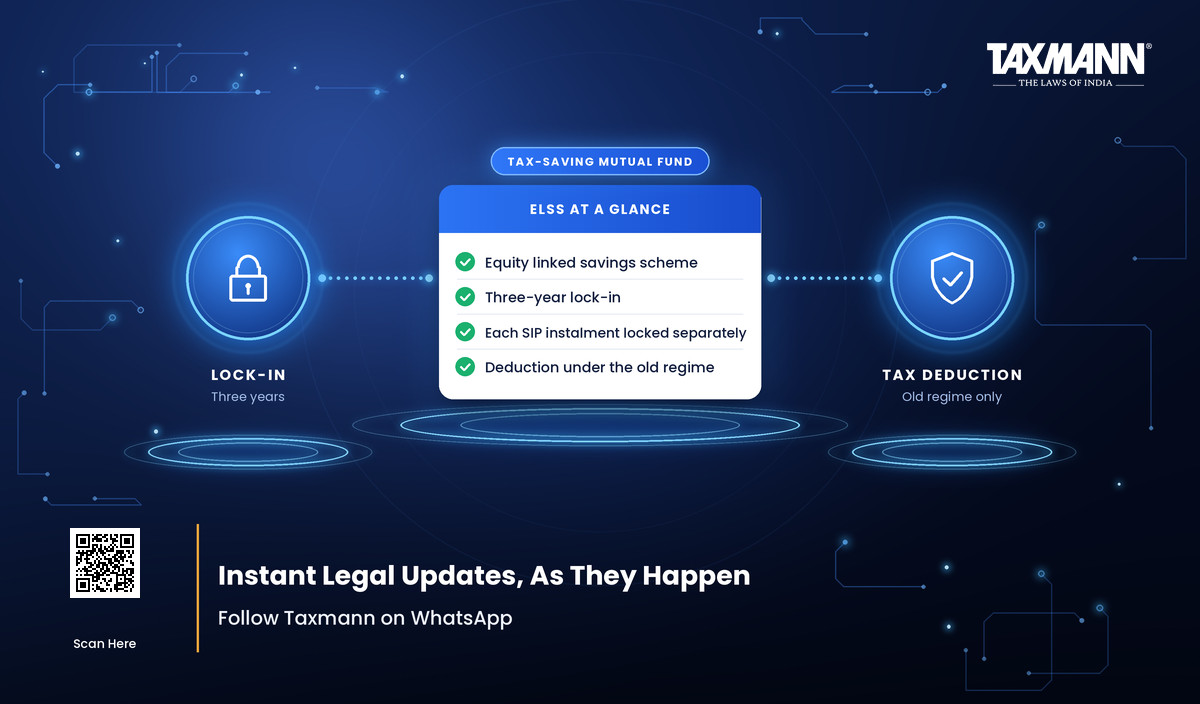
Table of Contents
- The basics
- Four nuances that catch people out
- The new regime catch
- Should you still consider ELSS?
- Quick answers
1. The basics
As the name says, an ELSS is equity-linked—it invests in equity shares. What distinguishes it is the deduction: the amount subscribed reduces your taxable income, which reduces your tax liability.
| Feature | Position |
|---|---|
| Deduction limit | ₹1.50 lakh per year per taxpayer |
| Eligible taxpayers | Individuals and HUFs |
| Lock-in | 3 years from the date of investment |
| Regime | Old tax regime only |
| Provision | Section 123 and Schedule XV, Income-tax Act, 2025 (earlier section 80C, Income-tax Act, 1961) |
2. Four nuances that catch people out
1. The ₹1.5 lakh limit is shared. The deduction covers many eligible investments, now listed in Schedule XV; the limit is shared across all of them. If you have already exhausted it elsewhere, an ELSS investment gets you no additional deduction—but the money is still locked in for three years. That is the worst of both worlds, and it is entirely avoidable with a moment’s arithmetic.
2. For SIPs, the lock-in applies per instalment. This is the most commonly misunderstood point. Each SIP instalment is locked in for three years from the date of that instalment. The lock-in on the whole amount does not end three years after your first instalment. A 12-month ELSS SIP finishes unlocking three years after the twelfth instalment.
3. IDCW reinvestment re-starts the clock. If you opt for the IDCW reinvestment plan, each reinvested distribution attracts a fresh 3-year lock-in. Because that produces a rolling, never-ending lock-in, most AMCs have done away with the reinvestment option for ELSS, offering only growth or IDCW payout.
4. In joint holdings, the benefit goes to the first holder.
3. The new regime catch
The Union Budget 2020 introduced a parallel tax structure: more slabs and lower rates, but most exemptions removed. Those in the new structure, the default regime since 2023-24, cannot claim this deduction.
So for a new-regime taxpayer, ELSS offers no tax deduction at all—it is just another equity-oriented scheme, with a three-year lock-in attached. Whether that lock-in is a feature (enforced discipline) or a bug (no liquidity) is a personal call, but it should be a conscious one.
4. Should you still consider ELSS?
That depends entirely on which regime you are in and whether your section 123 (old 80C) limit is already used. This post cannot answer it for you, and any content that claims to isn’t being honest.
Section 123 and Schedule XV of the Income-tax Act, 2025 are on Taxmann.com | Research. The Income Tax Calculator on Taxmann’s Tools gives a quick estimate of tax, and Taxmann Advisory can take up a fact-specific question. Chapter 8 of the Mutual Fund Foundation workbook covers the ELSS benefit.
5. Quick answers
What is the full form of ELSS?
Equity Linked Savings Scheme.
What is the ELSS lock-in period?
Three years from the date of investment.
How does the lock-in work for ELSS SIPs?
Each instalment is locked in for three years from its own date—not three years from the first instalment.
Is ELSS available under the new tax regime?
You can invest, but you get no deduction under the new regime.
What is the maximum ELSS deduction?
₹1.50 lakh per year, shared across all investments eligible under section 123 (old section 80C).
Why do most AMCs not offer IDCW reinvestment on ELSS?
Because each reinvestment would attract a fresh 3-year lock-in.
Law stated as on 16 November 2026. This article draws on Chapters 8 and 2 of the official NISM-Series-V-B Mutual Fund Foundation workbook (March 2026 Workbook Version), published exclusively by Taxmann, read with the law in force on that date. Tax figures are stated under the Income-tax Act, 2025. It is general information, not investment, tax or legal advice.
More in this series: What is a Mutual Fund · Mutual Fund Taxation in India · IDCW in Mutual Funds · SIP, SWP and STP · Types of Mutual Funds
Disclaimer: The content/information published on the website is only for general information of the user and shall not be construed as legal advice. While the Taxmann has exercised reasonable efforts to ensure the veracity of information/content published, Taxmann shall be under no liability in any manner whatsoever for incorrect information, if any.

Taxmann Publications has a dedicated in-house Research & Editorial Team. This team consists of a team of Chartered Accountants, Company Secretaries, and Lawyers. This team works under the guidance and supervision of editor-in-chief Mr Rakesh Bhargava.
The Research and Editorial Team is responsible for developing reliable and accurate content for the readers. The team follows the six-sigma approach to achieve the benchmark of zero error in its publications and research platforms. The team ensures that the following publication guidelines are thoroughly followed while developing the content:
- The statutory material is obtained only from the authorized and reliable sources
- All the latest developments in the judicial and legislative fields are covered
- Prepare the analytical write-ups on current, controversial, and important issues to help the readers to understand the concept and its implications
- Every content published by Taxmann is complete, accurate and lucid
- All evidence-based statements are supported with proper reference to Section, Circular No., Notification No. or citations
- The golden rules of grammar, style and consistency are thoroughly followed
- Font and size that’s easy to read and remain consistent across all imprint and digital publications are applied
Everything on Tax and Corporate Laws of India
To subscribe to our weekly newsletter please log in/register on Taxmann.com









 CA | CS | CMA


