[Analysis] Mutual Fund Taxation in India – Capital Gains | Holding Periods | STT and Stamp Duty
- Blog|Company Law|
- 5 Min Read
How mutual funds are taxed under the Income-tax Act, 2025: holding periods, capital gains rates, grandfathering, STT and stamp duty.
- By Taxmann
- |
- Last Updated on 16 November, 2026
Latest from Taxmann

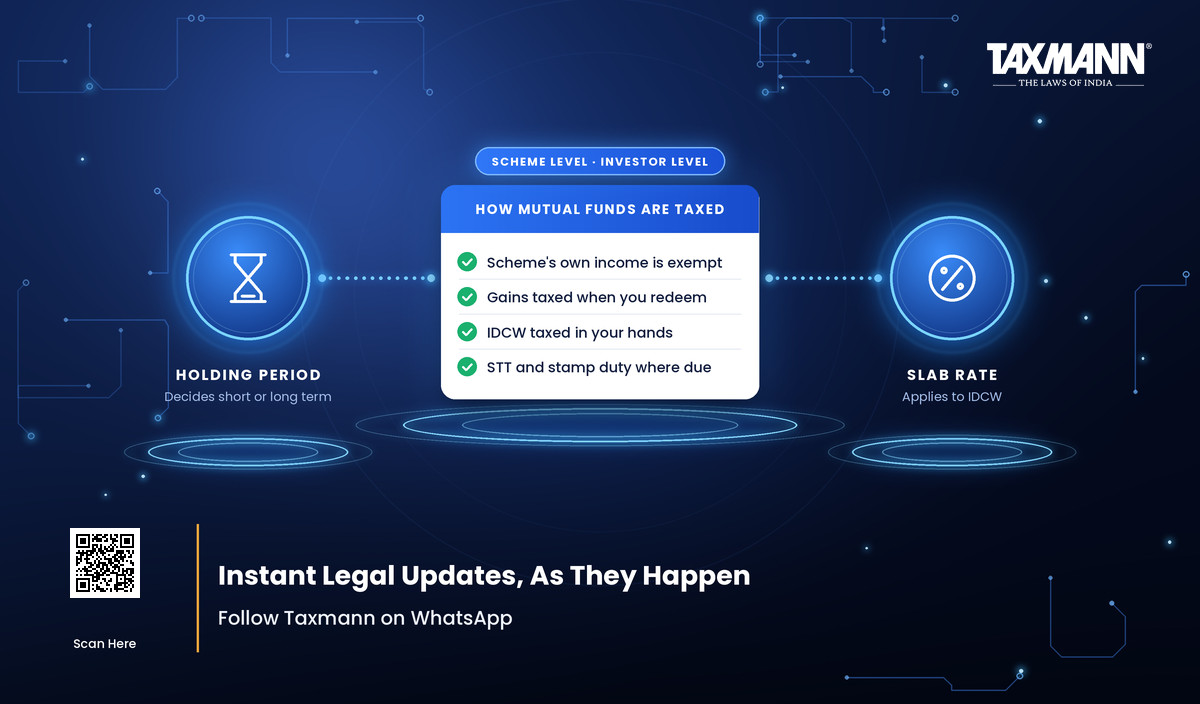
Table of Contents
- Level 1—the scheme’s income
- Level 2—the investor’s income
- Which Act applies: 1961 or 2025?
- Capital gains—the holding periods
- Capital gains—the rates
- Grandfathering—the 31 January 2018 rule
- Setting off capital losses
- Securities Transaction Tax (STT)
- Stamp duty on units
- Quick answers
1. Level 1—the scheme’s income
Schemes invest in shares and debentures, which generate dividend and interest, and they realise capital gains or losses on trading. All of it is exempt. Nothing is taxed at the fund level.
2. Level 2—the investor’s income
Two possible streams:
- IDCW option holders may receive income distributions and capital gains when they redeem.
- Growth option holders receive no distribution at all, regardless of the scheme’s profits—only capital gains (or losses) on redemption.
3. Which Act applies: 1961 or 2025?
The Income-tax Act, 2025 replaced the Income-tax Act, 1961 from 1 April 2026, so it governs transfers and payouts from tax year 2026-27 onwards. The rates, holding periods and the ₹1.25 lakh exemption below carried over unchanged; the section numbers changed. The 20% rate on short-term gains from equity-oriented funds is now in section 196 (earlier section 111A), the 12.5% rate on long-term gains in section 198 (earlier section 112A), and TDS on income from units in section 393(1) (earlier section 194K). Transfers made up to 31 March 2026 remain governed by the 1961 Act.
4. Capital gains—the holding periods
There are now only two holding periods for classifying assets as long- or short-term:
| Asset | Holding period for long-term |
|---|---|
| All listed securities and units of equity-oriented funds | 12 months |
| All other assets | 24 months |
5. Capital gains—the rates
| Investment asset | STCG | LTCG | Holding period / notes |
|---|---|---|---|
| Equity-oriented funds (incl. hybrids with >65% equity) | 20% | 12.5% | LTCG after 12 months; exemption of ₹1.25 lakh per tax year |
| Debt-oriented funds (incl. hybrids with >65% debt) | Marginal Slab Rate (MSR) | MSR | Taxed as short-term whatever the holding period |
| Hybrid funds with 35%–65% domestic equity | MSR | 12.5% | LTCG after 24 months |
| Other MFs (Fund of Funds, International Funds/FOFs) | MSR | 12.5% | LTCG after 24 months; a fund of funds investing 65% or more in debt-oriented funds is taxed like a debt fund |
| Equity ETFs (equity-oriented) | 20% | 12.5% | LTCG after 12 months; same ₹1.25 lakh exemption |
| Gold ETFs | MSR | 12.5% | LTCG after 12 months |
| Debt ETFs | MSR | MSR | Taxed as short-term whatever the holding period |
Timing point: the changes introduced by the July 2024 Budget took effect immediately. Units redeemed before 23 July 2024 attract the old rates; units redeemed on or after 23 July 2024 attract the new rates.
6. Grandfathering—the 31 January 2018 rule
Long-term capital gains on equity mutual funds were exempt until the 2018 Budget made them taxable from April 2018. Taxing gains already accrued would have been retrospective—so a grandfathering clause was introduced.
The effect: gains earned up to 31 January 2018 are not taxable. For equity mutual funds held from before that date, the valuation as on 31 January 2018 becomes the base point for computing taxable gains.
7. Setting off capital losses
The Income-tax Act taxes income under several heads, and set-off is restricted:
- Capital loss—short-term or long-term—cannot be set off against any other head of income (you cannot set it against salary).
- Short-term capital loss may be set off against short-term or long-term capital gain.
- Long-term capital loss may be set off only against long-term capital gain.
- Unabsorbed capital loss can be carried forward for up to 8 years.
Note the asymmetry: short-term losses are more flexible than long-term losses.
8. Securities Transaction Tax (STT)
STT applies only to equity-oriented mutual fund units—on redemption, on switching to another scheme, or on sale, whether on an exchange or otherwise. STT is not applicable on the purchase of units of an equity scheme, and not applicable to debt securities or debt mutual fund schemes at all.
| Transaction | Rate | Payable by |
|---|---|---|
| Purchase of units of an equity-oriented mutual fund | Nil | Purchaser |
| Sale of units of an equity-oriented mutual fund (delivery based) | 0.001% | Seller |
| Sale of equity shares / units of business trust / units of equity-oriented MF (non-delivery based) | 0.025% | Seller |
| Sale of units of an equity-oriented mutual fund to the mutual fund | 0.001% | Seller |
9. Stamp duty on units
Following amendments to the Indian Stamp Act, stamp duty applies to the issue and transfer of mutual fund units with effect from 1 July 2020:
- 0.005% of the amount invested, on the issue of units—for both physical and demat units.
- 0.015% on the transfer of units (such as transfers between demat accounts).
- Units are allotted on the amount remaining after deducting stamp duty.
It applies to all scheme inflows: purchase, additional purchase, IDCW reinvestment, SIP, STP, and the IDCW/dividend transfer plan (DTP)—including triggers from past SIP/STP registrations.
The provisions of the Income-tax Act, 2025 are on Taxmann.com | Research. The Income Tax Calculator on Taxmann’s Tools gives a quick estimate of overall tax, and Taxmann Advisory can take up a fact-specific question. Chapter 8 of the Mutual Fund Foundation workbook covers mutual fund taxation.
10. Quick answers
Is a mutual fund scheme’s income taxed?
No. It is exempt under section 10(23D) of the 1961 Act, an exemption the Income-tax Act, 2025 continues.
What is the holding period for long-term capital gains on equity funds?
12 months. For most other assets, 24 months.
What is the LTCG exemption for equity-oriented funds?
₹1.25 lakh per tax year.
What is grandfathering?
Gains up to 31 January 2018 on equity mutual funds are not taxable; the value as on that date is the base for computing gains.
Is STT charged when I buy mutual fund units?
No. STT applies on the sale/redemption/switch of equity-oriented fund units, not on purchase, and not on debt schemes.
How long can I carry forward a capital loss?
Up to 8 years.
A distributor’s brief on the same rules, with TDS and set-off, is in our note on mutual fund taxation for distributors.
Law stated as on 16 November 2026. This article draws on Chapter 8 of the official NISM-Series-V-B Mutual Fund Foundation workbook (March 2026 Workbook Version), published exclusively by Taxmann, read with the law in force on that date. Tax figures are stated under the Income-tax Act, 2025. It is general information, not investment, tax or legal advice.
More in this series: What is a Mutual Fund · IDCW in Mutual Funds · ELSS and Section 123 (Old Section 80C) · How Mutual Fund Returns Are Calculated · SIP, SWP and STP
Disclaimer: The content/information published on the website is only for general information of the user and shall not be construed as legal advice. While the Taxmann has exercised reasonable efforts to ensure the veracity of information/content published, Taxmann shall be under no liability in any manner whatsoever for incorrect information, if any.

Taxmann Publications has a dedicated in-house Research & Editorial Team. This team consists of a team of Chartered Accountants, Company Secretaries, and Lawyers. This team works under the guidance and supervision of editor-in-chief Mr Rakesh Bhargava.
The Research and Editorial Team is responsible for developing reliable and accurate content for the readers. The team follows the six-sigma approach to achieve the benchmark of zero error in its publications and research platforms. The team ensures that the following publication guidelines are thoroughly followed while developing the content:
- The statutory material is obtained only from the authorized and reliable sources
- All the latest developments in the judicial and legislative fields are covered
- Prepare the analytical write-ups on current, controversial, and important issues to help the readers to understand the concept and its implications
- Every content published by Taxmann is complete, accurate and lucid
- All evidence-based statements are supported with proper reference to Section, Circular No., Notification No. or citations
- The golden rules of grammar, style and consistency are thoroughly followed
- Font and size that’s easy to read and remain consistent across all imprint and digital publications are applied
Everything on Tax and Corporate Laws of India
To subscribe to our weekly newsletter please log in/register on Taxmann.com









 CA | CS | CMA


