[Analysis] NISM-Series-V-B Exam – Syllabus | Chapter Weightages | Exam Pattern
- Blog|Company Law|
- 3 Min Read
50 questions, 2 hours, 50% to pass, no negative marking. Here’s the full V-B syllabus with unit weightages and a study plan built around them.
- By Taxmann
- |
- Last Updated on 16 November, 2026
Latest from Taxmann
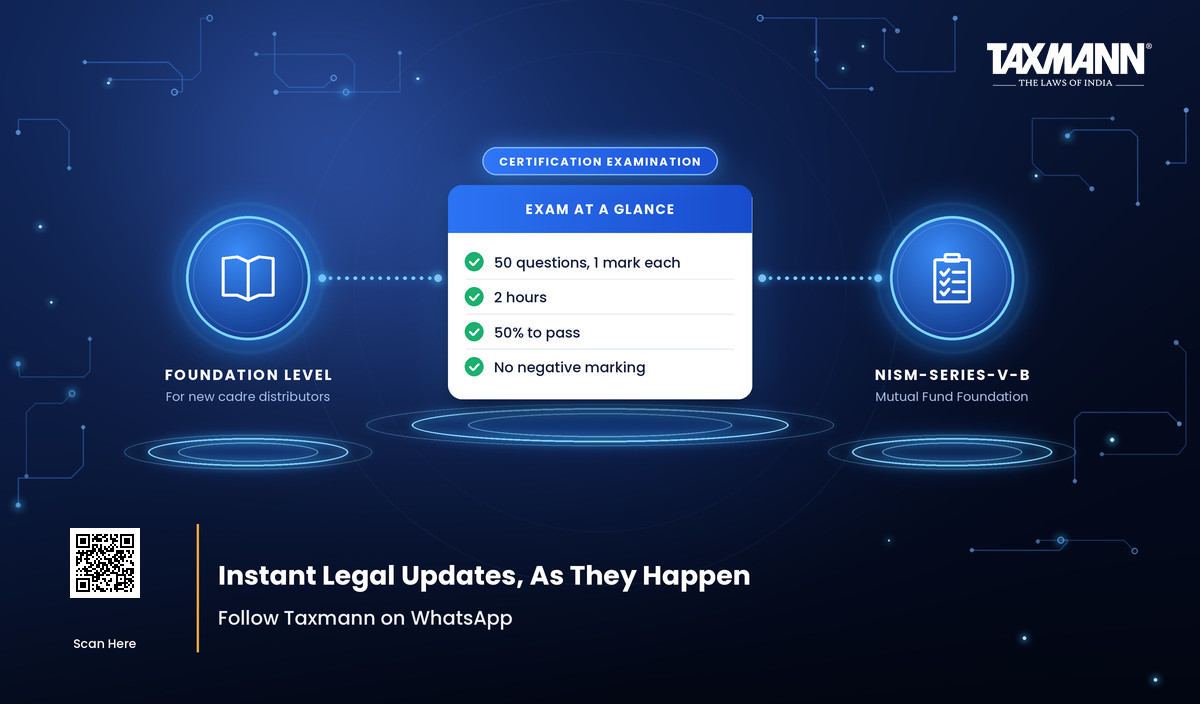
Table of Contents
- Exam at a glance
- The syllabus and its weightages
- How to use the weightages
- What about the numericals?
- Is the V-B exam tough?
- Quick answers
1. Exam at a glance
| Parameter | Detail |
|---|---|
| Questions | 50 (1 mark each) |
| Duration | 2 hours |
| Pass mark | 50% |
| Negative marking | None |
| Tools provided | MS Excel / LibreOffice Calc |
No negative marking matters strategically: never leave a question blank. An informed guess has positive expected value.
2. The syllabus and its weightages
This is the single most useful page for planning your preparation—the exam’s marks are not spread evenly.
| Unit | Chapter | Weightage |
|---|---|---|
| 9 | Investor Services | 20% |
| 2 | Concept and Role of a Mutual Fund | 12% |
| 5 | Scheme Related Information | 12% |
| 7 | Performance of Mutual Funds | 12% |
| 6 | Fund Distribution and Channel Management Practices | 10% |
| 3 | Legal Structure of Mutual Funds | 8% |
| 10 | Legal and Regulatory Environment | 8% |
| 1 | Investment Landscape | 6% |
| 4 | Mutual Fund Products for the New Cadre | 6% |
| 8 | Mutual Fund Taxation | 6% |
| Total | 100% |
3. How to use the weightages
Investor Services alone is 20%—one-fifth of the paper, roughly 10 of 50 questions. Together with Concept & Role, Scheme Related Information and Performance, four units account for 56% of the exam. A candidate who is genuinely secure in those four is most of the way to a pass before touching anything else.
A defensible study sequence:
- Chapter 9 (20%) first, while you’re freshest—NFO, plans and options, KYC, cut-off timing, SIP/SWP/STP, transmission.
- Chapters 2, 5, 7 (36% combined)—the concept, the documents, the numbers.
- Chapter 6 (10%)—distribution practice, which you’ll also use daily on the job.
- Chapters 3 and 10 (16%)—structure and regulation.
- Chapters 1, 4, 8 (18%)—shorter units; achievable late.
4. What about the numericals?
Chapter 7 is where candidates lose marks. Be fluent in: simple, annualised and compounded (CAGR) returns; total return; and exit-load-adjusted transaction pricing. Know the Sharpe Ratio and the Information Ratio—the latter being the only risk-adjusted measure AMCs must mandatorily disclose, computed against the scheme’s tier-1 benchmark.
Since the test centre gives you a spreadsheet, practise in a spreadsheet.
The official Mutual Fund Foundation workbook follows this syllabus chapter by chapter, with sample questions at the end of Chapters 1 to 9.
5. Is the V-B exam tough?
It is a foundation-level paper, deliberately designed for candidates who may be new to financial markets—it starts from the difference between saving and investing. With no negative marking and a 50% pass mark, the exam rewards steady coverage over brilliance. The workbook is the material the examination is largely based on, so disciplined study of it is the highest-yield preparation available.
6. Quick answers
How many questions are in the NISM V-B exam?
50, of 1 mark each.
Is there negative marking in NISM V-B?
No.
What is the passing score?
50%.
How long is the exam?
2 hours.
Which is the largest unit?
Investor Services, at 20%.
What’s the difference between V-A and V-B?
V-A is the full Mutual Fund Distributors certification; V-B is the foundation-level certification for SEBI’s new cadre, covering a simpler product set.
Law stated as on 16 November 2026. This article draws on the relevant chapters of the official NISM-Series-V-B Mutual Fund Foundation workbook (March 2026 Workbook Version), published exclusively by Taxmann, read with the law in force on that date. Confirm current examination and certification requirements on NISM’s official website before registering. It is general information, not investment, tax or legal advice.
More in this series: What is a Mutual Fund · How to Become a Mutual Fund Distributor · NISM Full Form · ARN, EUIN and KYD · Mutual Fund Distributor Commission
Disclaimer: The content/information published on the website is only for general information of the user and shall not be construed as legal advice. While the Taxmann has exercised reasonable efforts to ensure the veracity of information/content published, Taxmann shall be under no liability in any manner whatsoever for incorrect information, if any.

Taxmann Publications has a dedicated in-house Research & Editorial Team. This team consists of a team of Chartered Accountants, Company Secretaries, and Lawyers. This team works under the guidance and supervision of editor-in-chief Mr Rakesh Bhargava.
The Research and Editorial Team is responsible for developing reliable and accurate content for the readers. The team follows the six-sigma approach to achieve the benchmark of zero error in its publications and research platforms. The team ensures that the following publication guidelines are thoroughly followed while developing the content:
- The statutory material is obtained only from the authorized and reliable sources
- All the latest developments in the judicial and legislative fields are covered
- Prepare the analytical write-ups on current, controversial, and important issues to help the readers to understand the concept and its implications
- Every content published by Taxmann is complete, accurate and lucid
- All evidence-based statements are supported with proper reference to Section, Circular No., Notification No. or citations
- The golden rules of grammar, style and consistency are thoroughly followed
- Font and size that’s easy to read and remain consistent across all imprint and digital publications are applied
Everything on Tax and Corporate Laws of India
To subscribe to our weekly newsletter please log in/register on Taxmann.com









 CA | CS | CMA


