[Analysis] How to Draft a Legal Notice – Essentials | Forms of Notice | Service | Reply
- Other Laws|Blog|
- 10 Min Read
A valid legal notice states the facts, the breach and the action that will follow. Dr Medha Kolhatkar’s book also sets out its forms, the modes of service, the drafting points and the reply.
- By Taxmann
- |
- Last Updated on 16 November, 2026
Latest from Taxmann

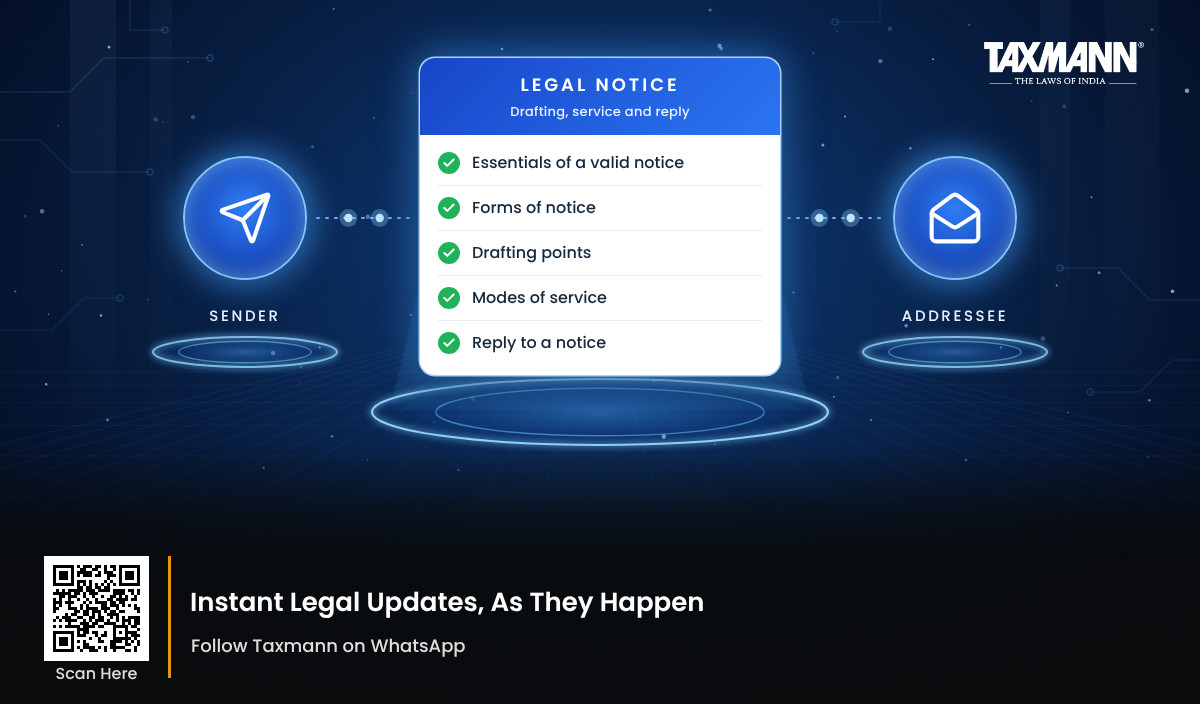
Table of Contents
- What is a legal notice?
- What makes a legal notice valid?
- What are the forms of notice?
- How to draft a legal notice: the drafting points
- What does a legal notice format look like?
- How is a legal notice served?
- How do you reply to a legal notice?
- Quick answers
1. What is a legal notice?
A legal notice is a communication through which one party tells another of a grievance and of the legal consequences that will follow if it is not addressed. The word “notice” itself means no more than an intimation of a particular fact. It also means “making something known to a person of which he was or might be ignorant”.
A notice can be given orally or in writing. Writing is the better choice, because a written notice is easy to prove and its contents are certain.
Through a legal notice, a party sets out its grievances and seeks a remedy from the receiver. The notice gives the receiver a chance to address those grievances and resolve the issue cordially, and so litigation can be avoided. Dr Kolhatkar cites a 2025 ruling, Kamala Nehru Memorial Trust and Anr v. U.P. State Industrial Development Corporation Ltd and Ors, 2025 INSC 791, for the point that “A legal notice is not a formality.”
2. What makes a legal notice valid?
Citing the same ruling, the chapter lists four essential components of a valid legal notice:
- A clear and concise set of facts that leads the reader to the relevant circumstances.
- An intimation of the legal obligation, or the breach, that the notice is about.
- The sender’s intention to hold the other party liable to legal action.
- A text that is unambiguous as a whole and neither misleads nor suppresses material information. A notice issued under a statute must also meet the requirements that statute prescribes.
3. What are the forms of notice?
Notices take several forms: statutory notices (mandatory or directory), public notices, personal or private notices, and actual and constructive notice.
| Form | What it means | Examples or notes |
|---|---|---|
| Statutory | A notice that a statute requires. It is either mandatory or directory. | See the next two rows |
| Mandatory | All mandatory notices are statutory, though not all statutory notices are mandatory. If a party bound to give one fails to do so, the legal action it starts also fails. | Section 80 of the CPC; section 138 of the Negotiable Instruments Act |
| Directory | Not a condition precedent to legal action, but failing to give it is detrimental to the interests of the party who should have given it. | Revocation or renunciation of agency under section 206 of the Indian Contract Act, 1872; notice of transfer of an actionable claim under section 131 of the Transfer of Property Act, 1882 |
| Public | Concerns matters likely to affect members of the public. It is generally published in newspapers or the Government Gazette. | Notice of sale or purchase of immovable property; auction of property; dissolution of a partnership firm; termination of an agent’s authority |
| Personal or private | Addressed directly to the party who has committed a breach or is likely to be affected. | Notice to appoint an arbitrator; landlord’s notice to a tenant to quit; notice of claim to a debtor; notice for compensation for defamation |
| Actual | Notice of a fact given to a person orally or in writing. It may be express or implied. | Express notice is established by direct evidence; implied notice by proof of circumstances from which it can be inferred |
| Constructive | Notice that the law presumes a person has, because of facts and circumstances that exist. | A registered deed; a pending suit; a lis pendens notice |
The difference between mandatory and directory notice decides what happens when a notice is missed. Missing a directory notice does not stop the action, though the consequences are detrimental to the interests of the party that should have given it. Under section 206 of the Indian Contract Act, for instance, the absence of notice of revocation of an agency “would merely penalise the defaulting party in the shape of damages to the other”. With a mandatory notice the case itself fails. Two illustrations show this. Under section 138 of the Negotiable Instruments Act, the Supreme Court reiterated that serving the statutory notice on the drawer is a mandatory requirement, and a complaint was dismissed where the notice was neither filed with it nor proved to have been served, as “an essential ingredient of the offence was absent”. Under the Insolvency and Bankruptcy Code, service of the demand notice under section 8 is a sine qua non of an application under section 9.

4. How to draft a legal notice: the drafting points
Drafting a legal notice starts before any writing. The chapter calls a notice “a foundation of any legal action/proceedings” and asks for “utmost care” in drafting it, and its drafting points begin with getting the facts and working out the legal issues:
- Get complete information about the facts or the transaction the notice concerns.
- Work out the legal issues, for example whether the contract is void or voidable, whether a right has been violated, and whether the client is entitled to damages.
- Understand what the client needs, and draft towards that objective.
- Arrange the facts in chronological order, in numbered paragraphs.
- Give the name and full description of the sender.
- Give the name and full description of the person to whom the notice is addressed.
- State and give the opposite party a reasonable time to comply with the demands.
- Bring out the object of the notice clearly, directing the party to comply with, or to refrain from, certain acts.
- Have the notice signed by or on behalf of the sender, which means by the advocate when the notice goes through one.
- State the date, the place and the mode of service.
- Where the law requires notice within a certain time, state those details in the notice.
As Chapter 1 of the book puts it, drafting “is not merely a mechanical exercise of filling in standard forms or precedents”; it calls for lucid thinking, judicious analysis of legal concepts and a command over the language of the draft.
5. What does a legal notice format look like?
Specimen No. VIII, a notice under section 138 of the Negotiable Instruments Act, shows the format part by part, from the heading and the mode of service, through the facts and the breach, to a demand with a time to comply:
| Part | What the specimen puts there |
|---|---|
| Heading | “NOTICE”, with the mode of service, speed post or courier, noted below it |
| Sender, date and addressee | “From” and “Date” lines, then “To” with blank lines for the addressee |
| Opening | The advocate writes on the instructions and authority of the client, who is named with his residence |
| Facts | Numbered paragraphs on the contract to supply cement bags, the delivery acknowledged on a challan, the bill raised, and the cheque issued against it with its number, bank and date |
| Breach | The cheque was presented and returned marked “Dishonoured for insufficiency of funds” |
| Liability alleged | The notice alleges that the addressee has committed an offence under section 138 and is also liable under the civil law |
| Demand | Payment within 15 days from receipt of the notice, failing which criminal and civil proceedings will follow at the addressee’s risk as to costs and consequences |
| Signature | Signed by the advocate |
The chapter’s other specimens, numbered up to XXIV, include notices for breach of a leave and licence agreement (No. I), eviction of a tenant (No. VI), dishonour of a cheque (No. VII), compensation for defamation (No. XIV), expulsion of a partner (No. XVI), trespass and damage to property (No. XVIII) and recovery of the price of furniture sold (No. XX), a notice to claim maintenance (No. XII) and a notice under section 80 of the CPC (No. XIX). Nos. XXI to XXIII are notice replies, and No. XXIV is a public notice for the purchase of immovable property.
6. How is a legal notice served?
The chapter lists five modes of service, and prefers a mode whose service can be easily proved.
| Mode | How it works |
|---|---|
| Personal service | The notice is served on the addressee personally. |
| Post | Speed post is one of the convenient and safer modes, because service can be proved, and the law presumes that a notice sent by speed post was duly served. |
| Statutory or prescribed mode | Where a statute prescribes the mode or manner of service, that mode must be followed, as with a notice under section 80 of the CPC. |
| Service by implication | The notice is sent through a bearer, a special messenger or the post, and the addressee refuses it. The notice is then presumed to have been served. |
| Special mode | For example, leaving the notice at a conspicuous part of the addressee’s premises. |
Besides these five, where the parties have agreed on a mode of service by contract, as in arbitration, partnership and other contracts, the notice must follow that mode.
A footnote in the chapter rests the presumption of service by post on section 119 of the Bharatiya Sakshya Adhiniyam, 2023 (section 114 of the Indian Evidence Act, 1872) and section 27 of the General Clauses Act, 1897. A note on the same page records that Registered Post Acknowledgement Due (R.P.A.D) has been discontinued and merged into speed post, and that a notice can be served by speed post or courier.
Refusing or not collecting a notice does not defeat service. A notice sent to the registered address and returned unclaimed is good service. In Priyanka Kumari v. Shailendra Kumar, the Supreme Court held that a notice returned “unclaimed” is deemed to be served, and that “refusal” can be read as synonymous with “unclaimed”. For digital proof, an online tracking tool can be used and the delivery certificate attached to the file.
7. How do you reply to a legal notice?
Every notice received should be replied to as promptly as possible. The reply is the basis of the written statement or reply to the complaint or proceedings, so it has to be drafted carefully.
Averments in the notice that are incorrect or fabricated should be denied generally and specifically, and then the facts and objections of the person replying should be set out. While making the denials, the reply should refer to the relevant documents and correspondence on which they are based. The reply, like the notice, should go by a mode whose service can be easily proved, preferably speed post or courier.
Specimen No. XXI, a reply to a landlord’s notice for eviction, shows the general and specific denials at work. It opens by acknowledging the notice and the date it was received. Its first paragraph says the notice is not legal or valid and is not admitted, and generally denies all the allegations except those specifically admitted. It then admits paragraphs 1 and 2 of the notice as substantially true and correct, answers each remaining allegation with the tenant’s own account of the facts, and closes by warning that if the landlord goes to court, he does so entirely at his own risk as to costs and consequences.
8. Quick answers
What is a legal notice?
A legal notice is a communication that tells the receiver of a grievance and of the legal action that will follow if it is not addressed. It can be oral or written, but writing is preferred because a written notice is easy to prove and its contents are certain.
Is a legal notice mandatory before filing a case?
Not always. A notice is mandatory where a statute makes it so, as with notices under section 80 of the CPC and section 138 of the Negotiable Instruments Act. Where a party bound to give a mandatory notice fails to do so, the legal action that party starts also fails.
What are the essentials of a valid legal notice?
A valid legal notice has four essentials: a clear and concise statement of facts, an intimation of the legal obligation or breach, the sender’s intention to hold the other party liable, and a text that is unambiguous and neither misleads nor suppresses material information. A notice under a statute must also meet that statute’s requirements.
How much time should a legal notice give the other side?
A legal notice should state and give the other side a reasonable time to comply with its demands. A specimen notice under section 138 of the Negotiable Instruments Act, for example, asks for payment within 15 days from receipt of the notice.
Who signs a legal notice?
A legal notice must be signed by or on behalf of the sender. Where it is sent through an advocate, the advocate signs it.
Which is the best mode of serving a legal notice?
Speed post is one of the convenient and safer modes, because service can be proved and the law presumes that a notice sent by speed post was duly served; courier can also be used. Where a statute prescribes the mode, as for a notice under section 80 of the CPC, or the parties have agreed on one by contract, that mode must be followed.
Is a notice returned unclaimed valid service?
Yes. A notice sent to the registered address and returned unclaimed is good service, and the Supreme Court has treated refusal as synonymous with unclaimed.
Should every legal notice be replied to?
Yes, as promptly as possible. The reply is the basis of the written statement or reply in any later proceedings, so it must be drafted carefully: incorrect averments are denied generally and specifically, with reference to the documents or correspondence on which the denials are based.
Chapter 2 of Drafting Pleading and Conveyancing by Dr Medha Kolhatkar (Third Edition, November 2026), available on Taxmann.com | Students, explains the forms of notice, the modes of service and the drafting points for notices and replies, with specimens numbered I to XXIV that include three notice replies and a public notice. Chapter 1 sets out the principles of legal drafting.
To read section 80 of the Code of Civil Procedure, 1908 or section 138 of the Negotiable Instruments Act, 1881 in full, Taxmann.com | Research, Indian Acts & Rules has both Acts section by section; the same module also carries Rules, Forms, circulars and notifications. Taxmann.com | Store has the Code of Civil Procedure [Bare Act with Section Notes]. On the receiving side, Taxmann AI includes a Draft Bot for tax and legal notices: you upload a notice or enter its details, and it separates the legal issues from the factual ones and prepares a draft response with the relevant provisions and case references.
Related reading: when a cheque-bounce complaint is premature after a legal notice reply · drafting legal documents and contracts.
More in this series: pleadings in CPC: plaint and written statement · affidavit format and drafting · sale deed format and the parts of a deed · general and special power of attorney.
Law stated as in the Third Edition (November 2026) of Drafting Pleading and Conveyancing.
Disclaimer: The content/information published on the website is only for general information of the user and shall not be construed as legal advice. While the Taxmann has exercised reasonable efforts to ensure the veracity of information/content published, Taxmann shall be under no liability in any manner whatsoever for incorrect information, if any.

Taxmann Publications has a dedicated in-house Research & Editorial Team. This team consists of a team of Chartered Accountants, Company Secretaries, and Lawyers. This team works under the guidance and supervision of editor-in-chief Mr Rakesh Bhargava.
The Research and Editorial Team is responsible for developing reliable and accurate content for the readers. The team follows the six-sigma approach to achieve the benchmark of zero error in its publications and research platforms. The team ensures that the following publication guidelines are thoroughly followed while developing the content:
- The statutory material is obtained only from the authorized and reliable sources
- All the latest developments in the judicial and legislative fields are covered
- Prepare the analytical write-ups on current, controversial, and important issues to help the readers to understand the concept and its implications
- Every content published by Taxmann is complete, accurate and lucid
- All evidence-based statements are supported with proper reference to Section, Circular No., Notification No. or citations
- The golden rules of grammar, style and consistency are thoroughly followed
- Font and size that’s easy to read and remain consistent across all imprint and digital publications are applied
Everything on Tax and Corporate Laws of India
To subscribe to our weekly newsletter please log in/register on Taxmann.com









 CA | CS | CMA


