[Analysis] Sale Deed Format – Parts of a Deed | Vendor and Purchaser | Stamp Duty and Registration
- Other Laws|Blog|
- 10 Min Read
A deed of sale is popularly called a deed of conveyance. Dr Medha Kolhatkar’s book sets out the parts of such a deed, attestation, stamping, registration and the vendor’s and purchaser’s duties.
- By Taxmann
- |
- Last Updated on 16 November, 2026
Latest from Taxmann

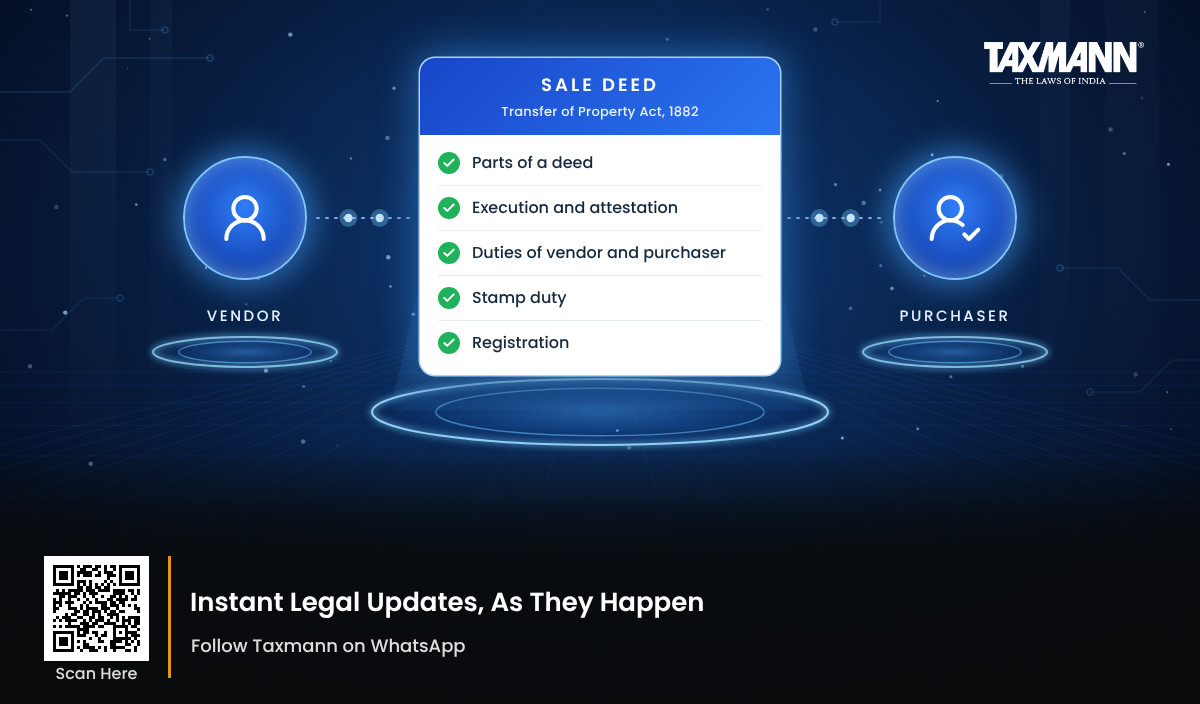
Table of Contents
- What is conveyancing, and what is a deed?
- What are the parts of a deed?
- How is a deed executed and attested?
- What is a sale deed, and how is it different from an agreement for sale?
- What are the duties and rights of the vendor and purchaser?
- What stamp duty applies, and what if a document is not stamped?
- Is a sale deed compulsorily registrable?
- Sale deed format: what does the specimen contain?
- Quick answers
1. What is conveyancing, and what is a deed?
Conveyancing is an art by which title to real estate is transferred from one person to another. It is also described as an art by which interests in property are created, transferred and extinguished. A conveyance is an act of conveying or voluntarily transferring property by a written instrument and other formalities. The law of conveyancing is the branch of law that governs the drafting of legal documents.
Section 2(14) of the Indian Stamp Act, 1899 defines an “instrument” to include every document that creates, transfers, limits, extends, extinguishes or records any right or liability, or purports to do so. A deed is an instrument by which a party makes or consents to an assurance of an interest in property (other than by a will), undertakes an obligation enforceable at law or in equity, or does some other act affecting the legal position of a party. The chapter quotes the saying that “deeds are instruments but all instruments are not deeds.”
Drafting a deed involves three components: the law that governs the parties, the effect of the transaction, and certainty and clarity in the words used. A deed of sale is popularly called a deed of conveyance (see the specimen sale deed format below).
2. What are the parts of a deed?
A deed of conveyance is generally drafted using ten components, which Dr Kolhatkar discusses in turn:
| Part | What it does |
|---|---|
| Name or title | Gives a clue to the nature of the transaction, though the contents, not the name, decide the nature of the document. |
| Date and place | When and where the deed is executed. Both must be stated very clearly, generally at the start. |
| Parties | A complete description of each party (for a company, partnership firm or HUF, details such as the name, registered office or karta), named by role, such as vendor and purchaser. |
| Recitals | The background and purpose of the document. Narrative recitals trace the present vendor’s title. Recitals should always be in chronological order, and their paragraphs generally begin with “whereas”. |
| Testatum | The main operative part. Testatum means witness, and the part begins “NOW THIS DEED WITNESSES AS FOLLOWS”. |
| Terms and conditions | The terms the parties have agreed, such as the transfer, the consideration and its payment, acknowledgement of payments, the covenant as to title, the nature of the interest transferred, possession, and incidental clauses such as easements. |
| Habendum | States the estate the purchaser takes. In it the transferor declares that the transferee is entitled “To Have and To Hold” the property. |
| Testimonium | Generally an “IN WITNESS WHEREOF” clause recording that the parties have signed on the day and year first written above. |
| Schedule of the property | A full description of the property, stating where it is situated, the area of the land in square metres, survey numbers, boundaries and so on, so that it can be identified. A deed may need more than one schedule. |
| Execution and attestation | The parties sign the deed and, where required, witnesses attest it. |
A deed relating to transfer of property binds the parties and also those claiming through them, so each party’s description is followed by words including “his heirs, executors, administrators and assigns” (for a corporate body, “their successors and assigns”).

3. How is a deed executed and attested?
A deed is executed by the parties. Where the law requires a document to be attested, it must be attested by at least two witnesses, who sign it with the intention to attest it. A document is of no legal consequence if it is not executed and attested as the law requires.
At execution, the parties put their signatures and initials on every page of the deed. An illiterate person’s thumb impression is taken. Execution is not mere signing: it means signing a document that has been written out, read over and understood, not signing a blank paper.
Under section 3 of the TPA, an instrument is “attested” when two or more witnesses have each signed it in the presence of the executant, and each of them has:
- seen the executant sign the instrument or affix his mark to it;
- seen another person sign it in the executant’s presence and by his direction; or
- received from the executant a “personal acknowledgement” of his signature or mark, or of that other person’s signature.
No particular form of attestation is necessary. The attesting witness need not actually see the executant sign, if he receives from the executant a personal acknowledgement of the signature or mark and signs in the executant’s presence. An attesting witness should sign only to attest, not in any other capacity.
4. What is a sale deed, and how is it different from an agreement for sale?
Section 54 of the TPA defines sale as “a transfer of ownership in exchange for a price paid or promised or part-paid or part-promised”. When one party sells immovable property to another, the document is generally called a sale deed or a deed of conveyance. From the definition, Dr Kolhatkar draws four ingredients: there should be a transfer; it must be of full ownership; it must be backed by consideration; and the consideration is the price, whether paid, promised, or partly paid and partly promised.
The terms and conditions of a sale are usually settled at an agreement for sale, whose contents include the date of execution of the sale deed.
| Point | Agreement for sale | Sale deed |
|---|---|---|
| Role | Settles the terms and conditions of the sale | Conveys the property: under section 55(1)(d) of the TPA, the vendor executes a conveyance on payment of the price |
| Ownership | Does not transfer ownership: a registered sale deed is mandatory for transferring ownership of property, and ownership cannot pass on an unregistered agreement of sale even where possession is claimed or the agreement is “revalidated” later | A registered sale deed alone can convey a valid title |
In Mahnoor Fatima Imran and Ors. v. M/s Visweswara Infrastructure Pvt. Ltd. and Ors. 2025 SCC Online SC 1062, it was held that a valid title can be conveyed only by a registered sale deed, and that later registration cannot cure defects that arise from an unregistered or fraudulent foundational agreement.
5. What are the duties and rights of the vendor and purchaser?
Section 55 of the TPA sets out the vendor’s and the purchaser’s duties, obligations and rights under an agreement for sale and under a sale; it applies only where there is no contract to the contrary. The vendor’s duties and obligations are to:
- disclose any material defect in the property or title that the seller knows of and the buyer does not, and could not discover with ordinary care;
- produce the title documents in his possession and power;
- answer all requisitions;
- on payment of the agreed price, execute a deed of conveyance in favour of the purchaser;
- take care of the property and title documents until possession is delivered;
- hand over possession on completion of the sale;
- pay all taxes, other outgoings and encumbrances until the date of sale;
- deliver the title deeds to the purchaser on completion; and
- give a covenant for title.
The vendor has the right to the rents until possession is delivered, to the price on completion of the sale, and to “a charge on the property for unpaid share/price”. The purchaser must disclose, where applicable, what he knows and the vendor does not about the extent or nature of the vendor’s interest; pay the price as agreed on completion; and pay the taxes and outgoings after completion. Once ownership has passed to him, the purchaser is entitled to the benefit of any improvement in the property or rise in its value, and to its rents and profits. He also has a charge on the property for the money he has paid to the vendor, should the vendor improperly fail to complete the sale.
6. What stamp duty applies, and what if a document is not stamped?
A sale deed is chargeable with stamp duty under Article 23 of the Indian Stamp Act, subject to State amendments. No transaction under a deed is complete without proper stamping. Practically every document except a will must be stamped, and section 17 of the Indian Stamp Act, 1899 requires stamping before or at execution. Many States have passed their own stamp laws, so the draftsman should know the stamp provisions that govern the parties.
A document that needs a stamp but is not stamped, or not adequately stamped, is inadmissible in evidence before anyone with authority to receive evidence, and can neither be acted upon nor registered (section 35 of the Indian Stamp Act, 1899). It cannot be admitted even for collateral purposes. Under the Indian Stamp Act, 1899, it is also liable to be impounded (section 33), and the person who executed it is liable to be prosecuted and fined (section 62).
7. Is a sale deed compulsorily registrable?
Yes. Section 17 of the Registration Act, 1908 requires a sale deed to be compulsorily registered. The section lists the documents whose registration is compulsory, among them instruments of gift of immovable property and other non-testamentary instruments that purport or operate to “create, declare, assign, limit or extinguish” any right, title or interest worth one hundred rupees or more in immovable property. Subject to sections 24, 25 and 26, a document other than a will must be lodged for registration within four months of the date on which it was executed.
Under section 49, a document that section 17 requires to be registered does not affect the immovable property comprised in it, and cannot be received as evidence of a transaction affecting that property, unless it has been registered. Under the proviso, it may still be received as evidence of a collateral transaction that need not be effected by a registered instrument, or, in a suit for specific performance, as evidence of a contract. A registered document takes effect from the date it was executed, not the date it was registered. It also carries a presumption that it was validly executed, so a party who challenges the genuineness of the transaction has to show that the transaction is invalid in law (Jamila Begum v. Shami Mohd, AIR 2019 SC 72).
8. Sale deed format: what does the specimen contain?
The chapter’s specimen sale deed (Specimen No. II), for a piece of land, is laid out like this:
| Part of the specimen | What it contains | Part of a deed |
|---|---|---|
| Opening | Names the document as a deed of sale and leaves blanks for the place and date of execution | Title, date and place |
| Parties | Describes the vendor and the purchaser, each by name, age, occupation, residence and PAN, with the heirs and assigns clause | Parties |
| “WHEREAS” and recitals (i) to (iv) | Recites that the vendor holds and possesses the land absolutely; that he bought it under a registered sale deed and his name was entered in the record of rights by mutation; that the parties have a registered agreement to sell; and that the purchaser has asked for the deed | Recitals ((i) and (ii) trace the vendor’s title) |
| “NOW THIS DEED WITNESSES AS FOLLOWS” | Opens the operative clauses | Testatum |
| Clause 1 | Provides that, pursuant to the agreement to sell and for the consideration paid, the vendor conveys the land, with its easements and all his estate, right, title and interest, followed by “TO HOLD” wording | Consideration, operative part, all estate clause, habendum |
| Clauses 2 to 6 | Record delivery of possession, acknowledged by the purchaser; the vendor’s assurances of no acquisition, requisition, dispute or pending litigation, of his authority to sell, and of a clean, clear and marketable title free from encumbrances; and the handing over of the earlier sale deed and tax receipts | Covenants, terms and conditions |
| Clause 7 | Provides that the purchaser bears the stamp duty, registration charges and incidental expenses | Stamp duty and registration |
| Schedule of the property | Describes the land by area in square metres, registration division and district, taluka and sub-division, corporation limits, and CTS and plot numbers | Description of the property |
| “IN WITNESS WHEREOF” and signatures | Ends with the signatures of the vendor and the purchaser in the presence of two witnesses | Testimonium, signatures, attestation |
Dr Kolhatkar’s own list for a sale deed or conveyance has sixteen items: description of the deed, date and place of execution, full description of the parties, recitals, testatum, consideration, receipt, operative part, description of the property, all estate clause, habendum, covenants (with obligations, terms and conditions), testimonium, signatures, attestation, and stamp duty and registration.
9. Quick answers
What is conveyancing?
Conveyancing is an art by which title to real estate is transferred from one person to another, and a conveyance is an act of conveying or voluntarily transferring property by a written instrument and other formalities.
What is the difference between a deed and an instrument?
An instrument, under section 2(14) of the Indian Stamp Act, 1899, includes “every document by which any right or liability is, or purports to be, created, transferred, limited, extended, extinguished or recorded”. A deed is one kind of instrument: “deeds are instruments but all instruments are not deeds”.
What are the parts of a deed?
A deed of conveyance generally has a name or title, the date and place, the parties, recitals, the testatum, terms and conditions, the habendum, the testimonium, a schedule of the property, and execution and attestation.
What is a sale deed?
The document by which one party sells immovable property to another is generally called a sale deed or a deed of conveyance. The Transfer of Property Act, 1882 defines sale in section 54 as “a transfer of ownership in exchange for a price paid or promised or part-paid or part-promised”.
What is the difference between a sale deed and an agreement to sell?
An agreement for sale settles the terms and conditions of the sale, including the date of execution of the sale deed, but it does not transfer ownership. A registered sale deed is mandatory to transfer ownership of immovable property; ownership cannot pass on an unregistered agreement of sale, even where possession is claimed or the agreement is “revalidated” later.
Is registration of a sale deed compulsory?
Yes. A sale deed is required to be compulsorily registered under section 17 of the Registration Act, 1908. Unless registered, it does not affect the immovable property comprised in it and cannot be received as evidence of a transaction affecting that property, though it may be received as evidence of a contract in a suit for specific performance, or of a collateral transaction not required to be effected by a registered instrument.
What happens if a document is not stamped?
A document that needs a stamp but is not stamped, or not adequately stamped, is inadmissible in evidence and can neither be acted upon nor registered (section 35 of the Indian Stamp Act, 1899). It cannot be admitted even for collateral purposes. It is liable to be impounded, and the person executing it is liable to be prosecuted and fined.
Chapter 17 of Drafting Pleading and Conveyancing by Dr Medha Kolhatkar (Third Edition, November 2026), available on Taxmann.com | Students, sets out the components of a deed, its interpretation, stamping and registration, and the investigation of title, then the duties and rights of the vendor and the purchaser, and gives two specimens for a sale: Specimen No. I, an agreement for sale, and Specimen No. II, a sale deed.
Taxmann.com | Research, Indian Acts & Rules has the Transfer of Property Act, 1882, the Registration Act, 1908 and the Indian Stamp Act, 1899 section by section; the same module also carries Rules, Forms, circulars and notifications. Taxmann.com | Store has the Transfer of Property Act [Bare Act with Section Notes] and the Registration Act [Bare Act with Section Notes].
Related reading: real estate documentation under RERA · a sale deed executed by a GPA holder after the owner’s death · business documents: deeds, agreements and contracts.
More in this series: gift deed format · general and special power of attorney · partnership deed format · will and codicil.
Law stated as in the Third Edition (November 2026) of Drafting Pleading and Conveyancing.
Disclaimer: The content/information published on the website is only for general information of the user and shall not be construed as legal advice. While the Taxmann has exercised reasonable efforts to ensure the veracity of information/content published, Taxmann shall be under no liability in any manner whatsoever for incorrect information, if any.

Taxmann Publications has a dedicated in-house Research & Editorial Team. This team consists of a team of Chartered Accountants, Company Secretaries, and Lawyers. This team works under the guidance and supervision of editor-in-chief Mr Rakesh Bhargava.
The Research and Editorial Team is responsible for developing reliable and accurate content for the readers. The team follows the six-sigma approach to achieve the benchmark of zero error in its publications and research platforms. The team ensures that the following publication guidelines are thoroughly followed while developing the content:
- The statutory material is obtained only from the authorized and reliable sources
- All the latest developments in the judicial and legislative fields are covered
- Prepare the analytical write-ups on current, controversial, and important issues to help the readers to understand the concept and its implications
- Every content published by Taxmann is complete, accurate and lucid
- All evidence-based statements are supported with proper reference to Section, Circular No., Notification No. or citations
- The golden rules of grammar, style and consistency are thoroughly followed
- Font and size that’s easy to read and remain consistent across all imprint and digital publications are applied
Everything on Tax and Corporate Laws of India
To subscribe to our weekly newsletter please log in/register on Taxmann.com









 CA | CS | CMA


