[Analysis] Power of Attorney Format – General vs Special | Irrevocable | Revocation | Stamp Duty
- Other Laws|Blog|
- 10 Min Read
Dr Medha Kolhatkar’s book explains what a power of attorney is, how a general power differs from a special one, when it ends, and how it is drafted, authenticated and stamped.
- By Taxmann
- |
- Last Updated on 16 November, 2026
Latest from Taxmann

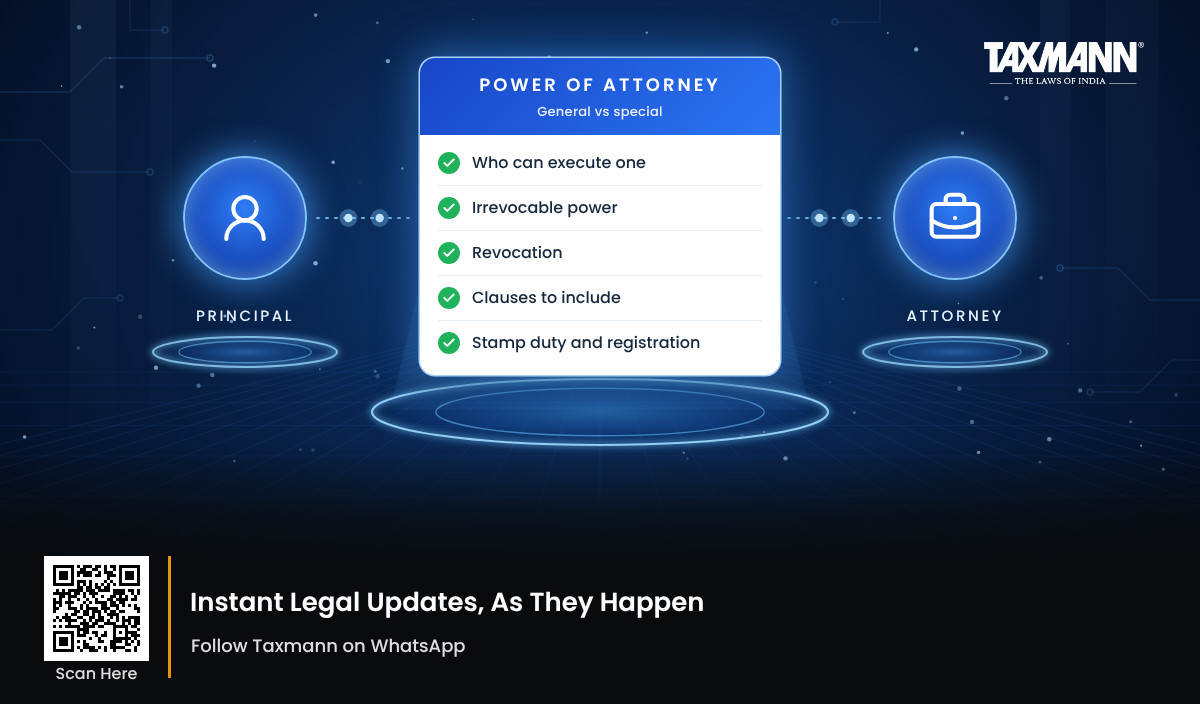
Table of Contents
- What is a power of attorney?
- What is the difference between a general and a special power of attorney?
- What is an irrevocable power of attorney?
- Who can execute a power of attorney, and how is it construed?
- How is a power of attorney revoked?
- Power of attorney format: what clauses must it have?
- How is a power of attorney executed and authenticated?
- Does a power of attorney need stamp duty and registration?
- Quick answers
1. What is a power of attorney?
A power of attorney is the document through which one person formally authorises another to act for him and in his name; it creates an agency. The person who grants the power is the principal, also called the grantor or donor. The person to whom it is granted is the attorney, also called the agent or donee.
An attorney’s duties are:
- to act for the donor, on his behalf and in his name;
- to perform acts and deeds in line with the terms of his authority;
- not to exceed that authority;
- to exercise due care and skill;
- not to delegate his powers unless duly authorised to do so;
- not to take advantage of his position for any benefit of his own;
- not to place himself where his duties as attorney would conflict with his own interest or with that of a third party.
The power of attorney format is set out clause by clause further below.
2. What is the difference between a general and a special power of attorney?
A general power of attorney extends to more than one subject matter. A special power of attorney is limited to one specific subject matter, though it may include several powers on that subject matter. The test is the subject matter for which the power is given: a power restricted to some specific matter is special, and any other power is general (Western India Theatres v. Ishwar Bhai, AIR 1959 Bom 386 : (1958) 60 Bom LR 1288 : ILR 1959 Bom 295).
| Point | General power of attorney | Special power of attorney |
|---|---|---|
| Subject matter | More than one subject matter | A specific subject matter, or some specific or particular act |
| Powers granted | Extensive powers | Only specific powers |
| What it needs to state | A list of all the powers granted to the attorney | The specific subject matter or act, stated clearly, and the time frame for doing it |
| When it ends | When it is revoked, or stands revoked (listed below) | Once the particular act is performed, besides the events of revocation listed below |
The chapter’s power of attorney specimens are No. I, a general power, and No. II, a special power. In No. I, a man about to leave India appoints his brother to deal with his bank accounts, investments and related claims, and to acquire, let and look after property for him.
Specimen No. II deals with one transaction. The owner recites that he has sold his property and executed a sale deed in the buyer’s favour, but that he cannot go to the office of the Registrar of Assurances to complete the registration, because he has to take his mother to hospital for surgery and treatment. The specimen gives the attorney power to present the sale deed for registration, admit its execution, comply with the other registration formalities, obtain certified copies of the registered deed, and do all acts necessary to carry out those powers. The owner agrees to ratify all acts and deeds the attorney does in this regard.

3. What is an irrevocable power of attorney?
A power of attorney is irrevocable when the principal cannot revoke it at will. A revocable power, by contrast, is one the principal has the right to revoke at any time, and once it is revoked the attorney can no longer act for him.
Calling a power irrevocable does not make it so: its nature turns on its subject matter, not on its title. Where a power is not coupled with interest, “no extraneous expression can make it irrevocable”; where a reading of the document shows that it is coupled with interest, it is irrevocable (M.S. Ananthamurthy v. J. Manjula [2025 INSC 273] : (2025) 10 SCC 596). Whether a power is revocable or irrevocable is decided by considering the whole document in its totality. Under section 202 of the Indian Contract Act, 1872, the principal cannot revoke the power where the attorney has an interest in its subject matter; revoking it in such a case needs the attorney’s consent.
Irrevocable powers are generally executed for business transactions with a commercial security purpose, and for property matters. An irrevocable power of attorney given as security for an interest may continue even after the principal’s death.
4. Who can execute a power of attorney, and how is it construed?
Anyone who is competent to contract may execute a power of attorney. A company’s power of attorney must conform to its Articles of Association.
Six principles govern how a power of attorney is construed:
- The recitals control the operative part of the deed.
- Where an authority to do particular acts is followed by general words, those general words are limited to what is necessary for performing the particular acts.
- General words do not confer general powers. They are confined to the purpose of the authority, and are read as enlarging the special powers only when that purpose requires it.
- A power is construed to include all incidental powers needed for its effective execution.
- No power, general or special, lets the donor delegate a function that relates to his status, such as the status of a trustee, or his professional work. Nor can he delegate the making of a will, or of an affidavit on oath.
- A power of attorney is an express authority, as it is in writing.
5. How is a power of attorney revoked?
A power of attorney is revoked, or stands revoked, in these circumstances:
- the principal revokes it, unless it is irrevocable;
- the principal dies, or he becomes of unsound mind;
- the donor’s business comes to an end;
- the principal is declared insolvent;
- time runs out (efflux of time).
A longer list in the chapter adds:
- express or implied revocation;
- the winding up or dissolution of a corporate donor or a corporate attorney;
- the attorney’s death, where he is the sole attorney or where he and others were appointed jointly (and not jointly and severally);
- the supervening mental incapacity of a sole attorney;
- fulfilment of the purpose;
- any event that renders the agency or its object illegal.
No right, title or interest in immovable property passes under a power of attorney, which is not an instrument of transfer. What it creates is an agency: the grantor authorises the grantee to do the acts it specifies on his behalf, and those acts, once done, bind the grantor as though he had done them. Even an irrevocable power of attorney does not transfer title to the grantee (Suraj Lamp and Industries Pvt. Ltd. v. State of Haryana, (2012) 1 SCC 656).
6. Power of attorney format: what clauses must it have?
Every power of attorney must contain these clauses:
- the identity of the principal and of the attorney;
- the purpose for granting the power, which must be legally valid;
- its duration or, if it has none, whether it is durable or non-durable;
- in a general power, a list of every power the attorney is given;
- in a special power, a clear statement of the specific subject matter or particular act for which the power is granted, and the time frame within which that act is to be done.
Durable and non-durable, the chapter notes, are terms “generally used internationally”.
Specimen No. I is the general power of attorney. Its main parts are as follows:
| Part | What the specimen puts there |
|---|---|
| Opening | The formal words “Know all men by these presents”, followed by the donor’s name, parentage, age, occupation and residence |
| Reason for the power | The donor recites that he is about to leave India for a stated purpose on a stated date and is unable to attend to all his property and other matters personally |
| Appointment | He nominates, constitutes and appoints his brother, identified by name, age, occupation and residence, as his true and lawful attorney to act for him, in his name and on his behalf |
| Banking and investments | Clauses 1 to 4 and 7 give powers to operate bank accounts and lockers, transfer securities, receive dividends and interest and sign receipts for them, invest his money, and draw, endorse and negotiate cheques, promissory notes and bills of exchange |
| Records, claims and courts | Clauses 5, 6 and 9 to 11 give powers to inspect records, pursue claims about investments, appear in civil, revenue and criminal courts and before other authorities in connection with the powers conferred, appoint and discharge advocates, and compromise, compound or withdraw suits and claims connected with those powers |
| Property | Clauses 12 to 16 give powers to buy lands, houses or flats, or take them on lease or otherwise acquire them, pay the stamp duty, registration charges and taxes on such a purchase, let, lease or license the property, keep it in good condition and repair, and collect rents and licence fees |
| Substitution | Clause 17 gives the attorney power to appoint one or more substitute attorneys or employees and to revoke their appointment |
| Ratification | Clause 18 records the donor’s agreement to ratify and confirm whatever the attorney lawfully does |
| Execution | The donor signs as executant, with the date and place, and a witness signs, stating that he knows the executant |
7. How is a power of attorney executed and authenticated?
Most commonly, a power of attorney is executed by signing it before a notary public, or before another officer such as a Judge, a Magistrate or a representative of the Central Government, who authenticates it. Dr Kolhatkar advises authentication so that the presumption under section 84 of the BSA (section 85 of the Indian Evidence Act, 1872) is available: a power of attorney executed in this way is presumed to have been validly executed.
Specimen No. I ends with the donor’s signature as executant, with the date and place, and a witness who states that he knows the executant.
8. Does a power of attorney need stamp duty and registration?
A power of attorney must be stamped under Article 48 of the Stamp Act. As a rule, its registration under the Registration Act, 1908 is not required, but there are exceptions.
One of them is a power of attorney that creates a charge in favour of the donee, that is, an interest in immovable property, which is required to be registered. The chapter also makes a separate point about a power of attorney given to present a document for registration, which is what Specimen No. II is. Where a power of attorney authorises the donee to sell an immovable property “and for consideration”, it must be fully stamped as a conveyance, though it need not be registered under the Registration Act, 1908. In Maharashtra, the Maharashtra Stamp Act, 1958 requires a power of attorney in favour of a promoter or builder for the development of property to be stamped as a conveyance, according to the property’s market value.
Dr Kolhatkar also notes that several States have amended the Registration Act, 1908 to make compulsorily registrable certain documents that the Act itself does not require to be registered.
9. Quick answers
What is the meaning of a power of attorney?
A power of attorney is “a document of agency”: through it one person, the principal (grantor or donor), authorises another, the attorney (agent or donee), to act for him and in his name. It is executed as a deed poll, which is generally drafted in the first person and signed by only one party.
What is the difference between a general and a special power of attorney?
A general power of attorney extends to more than one subject matter and grants extensive powers. A special power of attorney is limited to one specific subject matter, though it may include several powers on it; it grants only specific powers and comes to an end once the particular act is performed.
What is an irrevocable power of attorney?
A power of attorney that is not revocable at the will of the principal is an irrevocable power of attorney. Calling it irrevocable does not make it so: if it is not coupled with interest, no extraneous expression can make it irrevocable. Under section 202 of the Indian Contract Act, 1872, the principal cannot revoke it where the attorney has an interest in the subject matter.
Who can execute a power of attorney?
Anyone who is competent to contract may execute a power of attorney. A company’s power of attorney must conform to its Articles of Association.
When does a power of attorney come to an end?
The principal can revoke a power of attorney unless it is irrevocable. A power of attorney stands revoked if the principal dies, becomes of unsound mind or is declared insolvent, if the donor’s business comes to an end, or with the efflux of time. A special power also ends once its particular act is performed, while an irrevocable power given as security for an interest may continue after the principal’s death.
Is registration of a power of attorney compulsory?
Under the Registration Act, 1908, a power of attorney is not, as a rule, required to be registered, though it is required to be stamped as per Article 48 of the Stamp Act. The exceptions include a power of attorney that creates a charge in favour of the donee, that is, an interest in immovable property, and Dr Medha Kolhatkar’s chapter has a separate rule for a power given to present a document for registration.
Should a power of attorney be notarised?
It is better to have a power of attorney authenticated: one signed in the presence of a notary public, or another officer such as a Judge or a Magistrate, and authenticated by that person raises a presumption as to valid execution under section 84 of the Bharatiya Sakshya Adhiniyam, 2023 (section 85 of the Indian Evidence Act, 1872). This is also the most common method of execution.
Does a power of attorney transfer ownership of property?
No. A power of attorney creates an agency; it is not an instrument of transfer, and no right, title or interest in immovable property passes under it. Even an irrevocable power of attorney does not transfer title to the grantee.
Chapter 17 of Drafting Pleading and Conveyancing by Dr Medha Kolhatkar (Third Edition, November 2026), available on Taxmann.com | Students, deals with conveyancing practice and procedure. Its section on the power of attorney covers general and special, revocable and irrevocable powers, construction, revocation, drafting, execution, stamp duty and registration, and gives two specimens: No. I, a general power of attorney, and No. II, a special power of attorney.
Taxmann.com | Research, Indian Acts & Rules has the Indian Contract Act, 1872 and the Registration Act, 1908 section by section; the same module also carries Rules, Forms, circulars and notifications. Taxmann.com | Store has the Powers of Attorney Act [Bare Act with Section Notes].
Related reading: a sale deed executed by a GPA holder after the owner’s death · business documents: deeds, agreements and contracts.
More in this series: sale deed format and the parts of a deed · gift deed format · partnership deed format · affidavit format and drafting.
Law stated as in the Third Edition (November 2026) of Drafting Pleading and Conveyancing.
Disclaimer: The content/information published on the website is only for general information of the user and shall not be construed as legal advice. While the Taxmann has exercised reasonable efforts to ensure the veracity of information/content published, Taxmann shall be under no liability in any manner whatsoever for incorrect information, if any.

Taxmann Publications has a dedicated in-house Research & Editorial Team. This team consists of a team of Chartered Accountants, Company Secretaries, and Lawyers. This team works under the guidance and supervision of editor-in-chief Mr Rakesh Bhargava.
The Research and Editorial Team is responsible for developing reliable and accurate content for the readers. The team follows the six-sigma approach to achieve the benchmark of zero error in its publications and research platforms. The team ensures that the following publication guidelines are thoroughly followed while developing the content:
- The statutory material is obtained only from the authorized and reliable sources
- All the latest developments in the judicial and legislative fields are covered
- Prepare the analytical write-ups on current, controversial, and important issues to help the readers to understand the concept and its implications
- Every content published by Taxmann is complete, accurate and lucid
- All evidence-based statements are supported with proper reference to Section, Circular No., Notification No. or citations
- The golden rules of grammar, style and consistency are thoroughly followed
- Font and size that’s easy to read and remain consistent across all imprint and digital publications are applied
Everything on Tax and Corporate Laws of India
To subscribe to our weekly newsletter please log in/register on Taxmann.com









 CA | CS | CMA


