[Analysis] Affidavit Format – Meaning | CPC and BNSS Rules | Drafting Points | False Affidavit
- Other Laws|Blog|
- 10 Min Read
An affidavit is a solemn written declaration made on oath. Dr Medha Kolhatkar’s book sets out what it may contain, who administers the oath under the CPC and BNSS, and how it is drafted.
- By Taxmann
- |
- Last Updated on 16 November, 2026
Latest from Taxmann
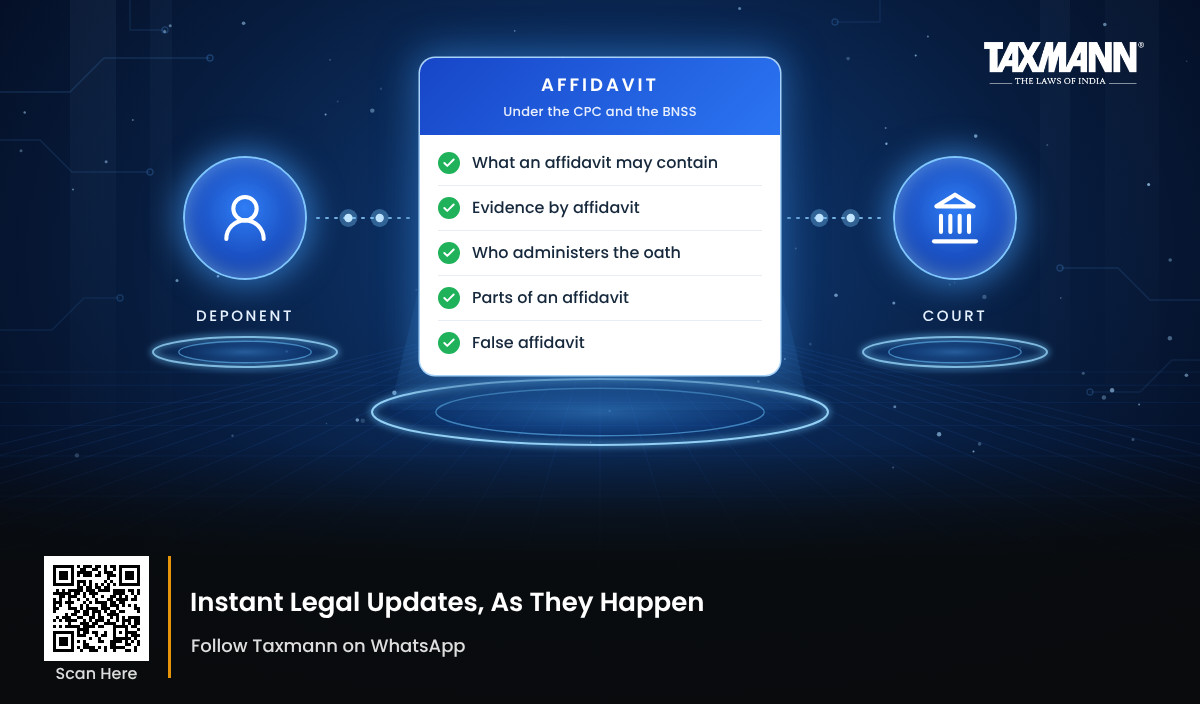
Table of Contents
- What is an affidavit?
- What can an affidavit contain?
- When can evidence be given by affidavit?
- Who can administer the oath for an affidavit?
- Affidavit format: the parts of an affidavit in order
- Can an affidavit be corrected or amended after it is sworn?
- What is the offence of a false affidavit?
- Quick answers
1. What is an affidavit?
An affidavit means “a solemn declaration of a statement made on oath”. It is written in the name of the person who makes it, called the deponent or affiant, and he signs it voluntarily. The deponent must swear or affirm, before an authority with power to administer an oath, that its contents are true and correct.
The General Clauses Act, 1897 says in section 3(3) that “affidavit” includes affirmation and declaration, for persons whom the law allows to affirm or declare instead of swearing.
An affidavit is generally drafted in the first person, so it is termed a deed poll document; Chapter 17, on conveyancing, gives that name to deeds made by only one party. Chapter 14’s specimens, numbered I to VII, show the affidavit format in use: most of their numbered paragraphs are in the first person, with lines such as “I say”, “I state” and “I hereby declare”.
Affidavits are sworn for court proceedings and for many other purposes, such as a change of name or surname, a birth certificate, a loan from a financial institution, admission to a university, a driving licence or a passport. They are also drafted for quasi-judicial bodies, tribunals, the registrar’s office, government bodies and the like. An affidavit made for a non-judicial purpose must be duly stamped and notarised.
In court, section 26(2) read with Order 6 Rule 15(4) of the CPC requires an affidavit supporting the factual base of the case to be filed with the plaint, and a plaint will not be entertained without one. Every petition for anticipatory bail should also be supported by an affidavit.
2. What can an affidavit contain?
Under Order 19 Rule 3(1) of the CPC, an affidavit is confined to the facts the deponent can prove from his own knowledge, except on interlocutory applications, where statements of his belief may be admitted if the grounds for them are stated. Rule 3(2) deals with costs: where an affidavit unnecessarily sets out matters of hearsay, argumentative matter or copied extracts from documents, the party who files it pays its costs, unless the court directs otherwise.
For affidavits used before a court under the BNSS, section 333(2) confines the affidavit to, and requires it to state separately, the facts the deponent can prove from his own knowledge and the facts he has reasonable ground to believe are true. For the second kind, he must clearly state the grounds of his belief.
Where the deponent deposes on information received from others, he must say so clearly, using specific words like “I am informed”. An affidavit cannot include information that is not correct.
For interim applications, Chapter 7 adds that a supporting affidavit must be properly verified and must not be vague. Where it is affirmed as true to knowledge, information or belief, it must say which portion is true to knowledge; it should disclose the source of the information and should state the grounds for the belief.
3. When can evidence be given by affidavit?
In a civil case, the court may order facts to be proved by affidavit, and evidence on an application may be given by affidavit. In a criminal case, evidence “of a formal character” may be given by affidavit.
Order 19 Rule 1 of the CPC lets any court, at any time and for sufficient reason, order that a particular fact or facts be proved by affidavit, or that a witness’s affidavit be read at the hearing. No order letting a witness’s evidence be given by affidavit may be made where it appears to the court both that either party bona fide wants that witness produced for cross-examination and that he can be produced. Rule 2 allows evidence to be given by affidavit on any application, but the court may, if either party asks, order the deponent to attend for cross-examination. When an affidavit is filed in reply to the applicant’s affidavit, it is called a counter affidavit. Dr Kolhatkar cites a ruling that once a court permits a fact to be proved by affidavit, it has a duty to permit the deponent’s cross-examination where any party bona fide wants the witness produced for it.
Evidence can be given by affidavit in criminal trials too. As Chapter 14 puts it, evidence “which is of a formal character and which does not require any further detailed enquiry” can be proved by affidavit. Section 332(1) of the BNSS allows evidence from any person whose evidence is “of a formal character” to be given by affidavit. Subject to all just exceptions, the affidavit may then be read in evidence at any inquiry, trial or other proceeding held under the Sanhita. Section 332(2) lets the court summon and examine that person on the facts in his affidavit if it thinks fit, and requires it to do so if the prosecution or the accused applies.

4. Who can administer the oath for an affidavit?
The oath is administered by an authority the statute names: section 139 lists them for affidavits under the CPC, and section 333(1) for affidavits used before a court under the BNSS. The chapter states that an affidavit under the CPC will be valid and legal only when one of the section 139 authorities administers the oath. Section 3 of the Oaths Act, 1969 provides for the administration of oaths.
| Provision | Which oaths or affidavits | Who may administer the oath or affirmation |
|---|---|---|
| Section 139 of the CPC | Any affidavit under the Code | A court or Magistrate; a notary appointed under the Notaries Act, 1952; an officer or other person appointed by a High Court for the purpose; an officer appointed by any other court that the State Government has empowered, generally or specially, for the purpose |
| Section 333(1) of the BNSS | Affidavits for use before any court under the Sanhita | A Judge, or a Judicial or Executive Magistrate; a Commissioner of Oaths whom a High Court or Court of Session has appointed; a notary appointed under the Notaries Act, 1952 |
| Section 3 of the Oaths Act, 1969 | Oaths and affirmations in the discharge of duties or the exercise of powers under the law (sub-section (1)); affidavits (sub-section (2)) | Under (1), courts and persons with authority, by law or by consent of parties, to receive evidence, among others. Under (2), any court, Judge, Magistrate or person empowered by the High Court (affidavits for judicial proceedings) or by the State Government (other affidavits) |
Drafting point (vii) adds that the affidavit must be sworn or affirmed “before a Magistrate or an authorised officer”, referring back to these provisions.
5. Affidavit format: the parts of an affidavit in order
Under the drafting points, an affidavit describes the deponent, states the facts in paragraphs and ends with the deponent’s signature. The parts, in order, as the drafting points and the specimens give them:
| Part | What goes in it |
|---|---|
| Title | Specimens No. I and II open with the court, the case number and the parties |
| Deponent | A full description, so that the deponent can be correctly identified; Specimens No. III and IV give his name, age, occupation and residence |
| Opening words | In all seven specimens, a statement that he solemnly affirms and says, or states on solemn affirmation, as follows |
| Facts | Paragraphs, numbered in the specimens, that state clearly the facts the affidavit is made about. Only facts that are true and correct should be stated |
| Closing statement | Specimens No. III, IV, V and VII close with a paragraph saying that what is stated is true and correct; Nos. IV and V add that no part of the affidavit is false and that nothing material has been concealed |
| Affirmation line | A line recording that the affidavit was solemnly affirmed on a stated day at a stated place; Specimens III to VII add the place and date below it |
| Signature | The deponent should sign the affidavit at the end; an illiterate deponent’s thumb mark is his valid signature. All seven specimens close with the line “I know the affiant” and the word “Affiant” |
| Swearing | It must be sworn or affirmed “before a Magistrate or an authorised officer”, under the provisions on who may administer the oath |
Specimen No. VI is an affidavit in support of a plaint. After the deponent’s name and residence and the opening affirmation, its first paragraph says that he has filed the suit, has full knowledge of its facts and has verified the plaint. The next three paragraphs take the plaint in blocks. They say that paras 1 to 3 of the plaint are a matter of record and true to his knowledge; that paras 4 to 9 state facts supported by documents filed with the plaint and are true to his knowledge and belief; and that paras 10 to 15, on the defendant’s breaches, and paras 16 to 19, on the plaintiff’s losses, are true and correct. The fifth paragraph asks that the prayer be granted, stating that grave injustice and loss will be caused if it is refused. The sixth affirms and verifies every averment in the plaint as true and correct “to the best of my knowledge, belief and information”, and says that no material has been concealed. The affirmation line, place, date and signature follow.
Besides the plaint affidavit (No. VI), the specimens include a bail affidavit for a sessions court (No. I), an affidavit in a writ petition made by a director of the petitioner company (No. II), affidavits supporting an interim application (No. III), a delay condonation application (No. IV) and a plaint, petition or complaint (No. V), and an affidavit for a lost deed of conveyance or sale deed (No. VII). That last one is made in connection with a sale: the owner recites the registered deed by which he bought the property, says it is lost and cannot be traced in spite of his best efforts, declares that he has neither deposited it as security nor given it to anybody, and undertakes to hand it over to the buyer if it is found.
6. Can an affidavit be corrected or amended after it is sworn?
Corrections should be made before the affidavit is sworn, not after. Clerical or typographical errors may be scratched out in ink, and the authority before whom the affidavit is sworn must sign or initial each correction.
No affidavit with an interlineation, alteration or erasure is to be filed in court unless the authority before which it is sworn has initialled the interlineation or alteration. Where there is an erasure, whatever words or figures were written over it must be rewritten in the margin and initialled by that authority.
A sworn affidavit cannot be amended. A new affidavit incorporating the amendment should be filed instead; it should not repeat all the facts, and only the matter to be amended should be stated in it. With a plaint, too, a fresh affidavit is required on amendment. Section 333(3) of the BNSS lets the court order any scandalous and irrelevant matter in an affidavit to be struck out or amended.
7. What is the offence of a false affidavit?
Section 227 of the BNS makes swearing a false affidavit an offence, and section 229 of the BNS states the punishment. For that reason, Dr Kolhatkar says, utmost care is needed when making an affidavit.
Of the affidavit filed with a plaint, the chapter adds that a party becomes bound by its contents and that it fixes an additional responsibility on the deponent for the truth of the facts stated.
8. Quick answers
What is an affidavit and who is the deponent?
An affidavit is a statement solemnly declared on oath. It is written in the name of the deponent, who signs it voluntarily and swears to it or affirms it before an authority with power to administer an oath. The deponent, also called the affiant, is the person who makes the affidavit.
Who can administer the oath for an affidavit?
Under the CPC, section 139 lets a court or Magistrate, a notary, or an officer or other person appointed for the purpose administer the oath. Under the BNSS, affidavits for court use may be sworn before a Judge, Magistrate, Commissioner of Oaths or notary. Section 3(2) of the Oaths Act, 1969 lets the High Court (for judicial proceedings) or the State Government (for other affidavits) authorise any court, Judge, Magistrate or person to administer oaths.
When can evidence be given by affidavit?
Under Order 19 of the CPC, a court may for sufficient reason order facts to be proved by affidavit, but not where either party bona fide wants the witness produced for cross-examination and he can be produced. Under section 332 of the BNSS, evidence from a person whose evidence is “of a formal character” may be given by affidavit, and the court must summon and examine him if the prosecution or the accused applies.
What must an affidavit contain?
An affidavit should give the deponent’s full description and must state the facts clearly in paragraphs; only facts that are true and correct should be stated, and it should end with his signature, or his thumb mark if he is illiterate. It must be sworn or affirmed “before a Magistrate or an authorised officer”, under the provisions on who may administer the oath.
Can an affidavit be corrected or amended after it is sworn?
Corrections should be made before an affidavit is sworn, and the authority before whom it is sworn must sign or initial each one. Once sworn, an affidavit cannot be amended; a new affidavit stating only the matter to be amended should be filed. Under section 333(3) of the BNSS, the court may order scandalous and irrelevant matter in an affidavit to be struck out or amended.
Is swearing a false affidavit an offence?
Yes. Section 227 of the Bharatiya Nyaya Sanhita, 2023 (BNS) makes swearing a false affidavit an offence, and section 229 of the BNS states the punishment.
Does an affidavit for a non-judicial purpose need stamping and notarisation?
Yes. An affidavit made for a non-judicial purpose must be duly stamped and notarised.
Why is an affidavit called a deed poll?
Chapter 14 of Drafting Pleading and Conveyancing says an affidavit is termed a deed poll document because it is generally drafted in the first person. Chapter 17 calls deeds made by only one party deed polls and says they are generally drafted in the first person.
Chapter 14 of Drafting Pleading and Conveyancing by Dr Medha Kolhatkar (Third Edition, November 2026), available on Taxmann.com | Students, covers affidavits under the Code of Civil Procedure and the Bharatiya Nagarik Suraksha Sanhita, the effect of swearing a false affidavit and the drafting of an affidavit, with specimens numbered I to VII that run from a bail affidavit under the BNSS to an affidavit for a lost sale deed. Chapters 7, 16 and 17 add points on affidavits in interim applications and anticipatory bail petitions, and on deed polls.
To read section 139 of the Code of Civil Procedure, 1908, sections 332 and 333 of the Bharatiya Nagarik Suraksha Sanhita, 2023 or section 227 of the Bharatiya Nyaya Sanhita, 2023 in full, Taxmann.com | Research, Indian Acts & Rules has all three Acts section by section; the same module also carries Rules, Forms, circulars and notifications. Taxmann.com | Store has the Code of Civil Procedure [Bare Act with Section Notes] and the Bharatiya Nagarik Suraksha Sanhita (BNSS) [Bare Act with Section Notes].
Related reading: drafting legal documents and contracts.
More in this series: how to draft a legal notice · pleadings in CPC: plaint and written statement · bail and anticipatory bail applications under the BNSS · succession certificate and probate.
Law stated as in the Third Edition (November 2026) of Drafting Pleading and Conveyancing.
Disclaimer: The content/information published on the website is only for general information of the user and shall not be construed as legal advice. While the Taxmann has exercised reasonable efforts to ensure the veracity of information/content published, Taxmann shall be under no liability in any manner whatsoever for incorrect information, if any.

Taxmann Publications has a dedicated in-house Research & Editorial Team. This team consists of a team of Chartered Accountants, Company Secretaries, and Lawyers. This team works under the guidance and supervision of editor-in-chief Mr Rakesh Bhargava.
The Research and Editorial Team is responsible for developing reliable and accurate content for the readers. The team follows the six-sigma approach to achieve the benchmark of zero error in its publications and research platforms. The team ensures that the following publication guidelines are thoroughly followed while developing the content:
- The statutory material is obtained only from the authorized and reliable sources
- All the latest developments in the judicial and legislative fields are covered
- Prepare the analytical write-ups on current, controversial, and important issues to help the readers to understand the concept and its implications
- Every content published by Taxmann is complete, accurate and lucid
- All evidence-based statements are supported with proper reference to Section, Circular No., Notification No. or citations
- The golden rules of grammar, style and consistency are thoroughly followed
- Font and size that’s easy to read and remain consistent across all imprint and digital publications are applied
Everything on Tax and Corporate Laws of India
To subscribe to our weekly newsletter please log in/register on Taxmann.com









 CA | CS | CMA


