[Analysis] Bail Application under BNSS – Sections 478 and 480 | Anticipatory Bail under Section 482 | Drafting
- Other Laws|Blog|
- 10 Min Read
Under the BNSS, bail is a right in a bailable offence and discretionary in a non-bailable one. Dr Medha Kolhatkar’s book also explains anticipatory bail and how a bail application is drafted.
- By Taxmann
- |
- Last Updated on 16 November, 2026
Latest from Taxmann

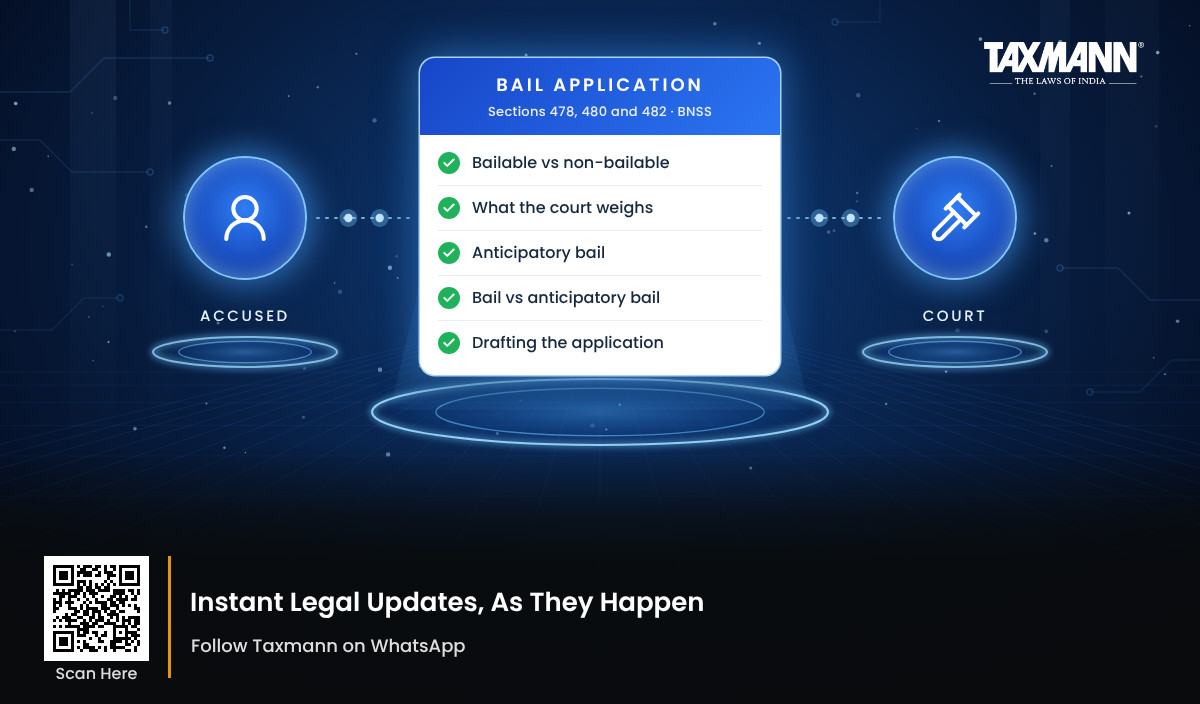
Table of Contents
- What is bail under the BNSS?
- Is bail a right? Bailable and non-bailable offences
- What does the court weigh before granting bail?
- What is anticipatory bail under section 482 of the BNSS?
- Which court grants anticipatory bail, and on what conditions?
- What is the difference between bail and anticipatory bail?
- How is a bail application under BNSS drafted?
- Quick answers
1. What is bail under the BNSS?
Section 2(1)(b) of the BNSS defines bail as the release from the custody of law of a person accused or suspected of committing an offence, on conditions that an officer or a court imposes, once that person executes a bond or a bail bond. A bail bond is “an undertaking for release with surety” (section 2(1)(d)), and a bond is “a personal bond or an undertaking for release without surety” (section 2(1)(e)).
Bail also connotes a process: obtaining the release of an accused charged with an offence by securing his future attendance in court for the trial and compelling him to stay within the court’s jurisdiction. Arrest and detention are primarily meant to secure the accused’s presence at the trial and, if he is found guilty, to make sure he can be punished according to the sentence. Where his presence at the trial could reasonably be secured without arresting and detaining him, it would be, in the book’s words, “unjust and unfair” to deprive him of his liberty while the criminal proceedings against him are pending.
A bail application under BNSS asks the court for that release; an application for anticipatory bail asks for a direction that, if the applicant is arrested, he be released on bail.
2. Is bail a right? Bailable and non-bailable offences
Bail is a right in a bailable offence but not in a non-bailable one. Section 2(1)(c) of the BNSS defines a bailable offence as one that the First Schedule shows as bailable, or that any other law in force makes bailable; any other offence is non-bailable.
Bailable offences are regarded as the less serious kind and non-bailable offences as the more serious. As a general statement, bailable offences are those for which the punishment is three years or less, though the rule has some exceptions. Being a member of an unlawful assembly is one example of a bailable offence. Non-bailable offences take in all serious offences, murder and rape among them.
| Point | Bailable offence | Non-bailable offence |
|---|---|---|
| Bail as of right | Yes. The accused can claim bail as a right under section 478 of the BNSS | No. Bail is only a privilege, which the court grants at its discretion after weighing the facts and circumstances of the case |
| How it is granted | The police officer in charge of the police station who has the accused in custody, or the court | At the discretion of the court (section 480 provides the conditions) |
| After arrest | If the accused produces proper surety and fulfils the other conditions, the investigating officer is bound to release him | Within 24 hours of the arrest, the investigating officer must produce the accused before the Judicial Magistrate or Judge, and the accused is then entitled to apply for bail |
| Examples | Being a member of an unlawful assembly | Murder, rape |

3. What does the court weigh before granting bail?
Dr Kolhatkar lists four grounds for the grant of bail:
- the nature and seriousness of the offence;
- the stage of investigation;
- a reasonable possibility that the accused’s presence will not be secured at the trial;
- a reasonable apprehension that evidence will be tampered with, or other circumstances brought to the court’s notice that might hamper proper investigation.
Explaining the principle behind bail, the Calcutta High Court said that the law of bails “has to dove tail two conflicting demands”: society’s need to be shielded from someone alleged to have committed a crime, and the presumption that an accused is innocent until he is found guilty. A person accused of a serious crime, the chapter adds, may be prone to abscond or jump bail so as to escape the trial and the sentence that would follow.
The Supreme Court has laid down guidelines on granting bail. In Satender Kumar Antil v. CBI it directed the lower courts to follow the principles governing bail strictly, to prevent arbitrary detention. As a “well settled principle of natural justice”, the victim must also be given an opportunity to be heard at every stage of the case, and the hearing of the accused on bail is no exception.
As to cancellation, the court “has power to cancel a bail granted at any stage”, and it “can cancel the bail granted by it under sections 480 and 483 of the BNSS”.
4. What is anticipatory bail under section 482 of the BNSS?
Anticipatory bail is bail granted before arrest to a person who fears arrest for a non-bailable offence. Section 482 of the BNSS lets anyone who “has reason to believe that he may be arrested” for such an offence apply for it, and the court grants it by directing that, if he is arrested, he is to be released on bail. The provision was section 438 of the Code of Criminal Procedure, 1973 (CrPC), which the BNSS replaces; the chapter writes it as “Section 438 (New Section 482)”.
Dr Kolhatkar gives the object of section 482 as protecting the applicant’s life and shielding him from “unnecessary trauma and defamation of frivolous and false charges and arrest”. Anticipatory bail is available for non-bailable offences, cognizable or non-cognizable. Section 482 does not require the offence to have been registered with the police, and filing an FIR is “not a condition precedent” to the exercise of the power.
The court, the book adds, is not to exercise its jurisdiction under section 482 freely without regard to matters that include the possible sentence that may finally be imposed, the risk of interference with the investigation or the witnesses, and the public interest.
5. Which court grants anticipatory bail, and on what conditions?
Either the High Court or the Court of Session can grant anticipatory bail. The Allahabad High Court has said that, although the two courts possess equal power, an applicant should ordinarily go to the Sessions Court first, “as a matter of judicial propriety and protocol”. Where compelling reasons exist, such as advocates’ strikes, closure of the Sessions Court or other extraordinary circumstances, the High Court can be approached directly. Dr Kolhatkar’s advice is that it is “always better” to go to the Sessions Court first, because if the application is rejected there, the applicant gets “a second chance” to approach the High Court.
Anticipatory bail may be granted on whatever conditions the court thinks fit and proper on the facts of the case in hand, including these:
- the person must make himself available for questioning by a police officer whenever required;
- he must not, directly or indirectly, induce, threaten or make a promise to anyone who knows the facts of the case in order to dissuade that person from disclosing them to the court or any police officer;
- he must not leave India without the court’s previous permission;
- any other condition that section 480(3) allows, as though the bail had been granted under that section.
In Sushila Aggarwal v. State (NCT of Delhi), the Supreme Court observed that such conditions must be “case specific and reasonable”, and must not be routinely imposed in a mechanical way that defeats the purpose of anticipatory bail. The same case allows the court granting anticipatory bail to put a time limit on the order where the circumstances warrant it, having regard in particular to the stage at which the application is moved: before the FIR is filed, after the FIR while the investigation is in progress, or once the investigation has been completed and the charge sheet filed. As a normal rule, though, the order should not be limited in time.
6. What is the difference between bail and anticipatory bail?
Ordinary bail comes after arrest; anticipatory bail comes before it. Bail granted after arrest means release from police custody, while anticipatory bail is granted in anticipation of arrest and takes effect “at the very moment of arrest”. The chapter cites Gurubaksh Singh Sibbia v. State of Punjab for this distinction.
| Point | Bail | Anticipatory bail |
|---|---|---|
| When it is granted | After arrest | In anticipation of arrest, before arrest is made |
| What it does | Releases the accused from police custody | Directs that the applicant be released on bail if he is arrested; takes effect at the very moment of arrest |
| Provision | Section 478 in bailable offences; section 480 provides the conditions in non-bailable offences. The chapter’s Sessions Court bail specimens (Nos. II and III) are headed under section 483, and its specimen for bail on conviction (No. IV) under section 430. | Section 482 |
| Offences | Bailable and non-bailable | Non-bailable offences, cognizable or non-cognizable |
| How it is granted | In a bailable offence, the officer in charge of the police station holding the accused, or the court; in a non-bailable offence, at the discretion of the court (section 480 provides the conditions) | The High Court or the Court of Session |
7. How is a bail application under BNSS drafted?
Each of the six bail specimens in Chapter 16, numbered I to VI, opens with the court, the case and the parties, sets out the facts and the grounds for release, and closes with a prayer, the place, the date and the advocate’s signature. They are:
- No. I: a first bail application under section 478, before the Magistrate, by an accused who says that the dispute, over the digging of a borewell, is of a civil nature;
- No. II and No. III: bail applications before the Sessions Court, headed under section 483;
- No. IV: a petition under section 430 for bail on conviction, by an accused who intends to appeal, made to the court that convicted him and stating that the offence is bailable and that he was on bail throughout the trial;
- No. V and No. VI: first applications for anticipatory bail under section 482, before the Sessions Judge.
Specimen No. V is laid out as follows:
| Part | What Specimen No. V puts there |
|---|---|
| Cause title | The Sessions Judge; the case under investigation with a named police chowki and police station; the applicant’s name, age, occupation and residence; the State and the Police Inspector as opponents |
| Heading | A first application for anticipatory bail, under section 482 of the BNSS |
| Facts | The applicant, a union leader, states that his remarks annoyed the managing committee and that he fears being falsely implicated in the stabbing of a company director. He says he was at a family wedding at the time, produces the card and photographs, and states that he has given information and documents at the police chowki |
| Apprehension | He states that the complaint attracts cognizable and non-bailable offences, and asks that the police be directed to release him on bail if he is arrested |
| Grounds | Grounds numbered i to xi, which plead among other things his innocence, the absence of incriminating circumstances, that custody is not needed for investigation, that there is no likelihood of tampering with witnesses or evidence, his readiness to furnish surety and accept conditions, his permanent residence and his dependants |
| Earlier applications | A statement that no other application for anticipatory bail has been filed before this court, the High Court or any other court |
| Prayer | Anticipatory bail, interim anticipatory bail until the application is finally decided, and any other just order |
An affidavit should support every petition for anticipatory bail. For bail after arrest, Chapter 14 gives Specimen No. I, an affidavit for a bail application filed in a sessions court. In it the accused deposes that he is not guilty and has been falsely implicated, that he was arrested but nothing was recovered from him, that he is unnecessarily detained, that he will provide sureties, abide by the bail conditions and not tamper with the evidence or the witnesses, and that no earlier bail application of his has been made or is pending.
Chapter 16 also covers complaints, applications for maintenance under section 144 of the BNSS, appeals and revisions.
8. Quick answers
What is bail under the BNSS?
Bail, as section 2(1)(b) of the BNSS defines it, is the release from the custody of law of a person accused or suspected of an offence, on conditions imposed by an officer or a court, once he executes a bond or a bail bond. A bail bond is “an undertaking for release with surety”; a bond is “a personal bond or an undertaking for release without surety”.
Is bail a right under the BNSS?
In a bailable offence, the accused can claim bail as a right under section 478 of the BNSS. In a non-bailable offence, bail is “not a matter of right but only a privilege”, granted at the court’s discretion after it weighs the facts and circumstances of the case, and section 480 provides the conditions.
Who can apply for anticipatory bail under section 482 of the BNSS?
Any person who “has reason to believe that he may be arrested” for a non-bailable offence, cognizable or non-cognizable, may apply for anticipatory bail under section 482 of the BNSS. The High Court or the Court of Session can grant it by directing that, if he is arrested, he be released on bail.
Which court should be approached first for anticipatory bail?
The Allahabad High Court has said that, although the Sessions Court and the High Court possess equal power to grant anticipatory bail, an applicant should ordinarily approach the Sessions Court first, and may go directly to the High Court where compelling reasons exist. If the Sessions Court rejects the application, the applicant gets a second chance before the High Court.
What conditions can be imposed on anticipatory bail?
A court granting anticipatory bail may impose the conditions it thinks fit and proper on the facts of the case, including that the person be available for police interrogation when required, make no inducement, threat or promise to dissuade anyone who knows the facts from disclosing them to the court or any police officer, and not leave India without the court’s previous permission. The Supreme Court has said they must be case specific and reasonable.
Is an FIR needed before applying for anticipatory bail?
No. For anticipatory bail under section 482 of the BNSS (section 438 of the Code of Criminal Procedure, 1973), the offence need not have been registered with the police, and filing an FIR is “not a condition precedent” to the exercise of the power.
What is the difference between bail and anticipatory bail?
Ordinary bail is granted after arrest and releases the person from police custody. Anticipatory bail is granted before arrest, in anticipation of it, and takes effect at the very moment of arrest.
Can bail be cancelled?
Yes. The court “has power to cancel a bail granted at any stage”, and it “can cancel the bail granted by it under sections 480 and 483 of the BNSS”.
Chapter 16 of Drafting Pleading and Conveyancing by Dr Medha Kolhatkar (Third Edition, November 2026), available on Taxmann.com | Students, explains bailable and non-bailable offences, the grounds for grant of bail, anticipatory bail, who can grant it and how it differs from bail, with bail specimens numbered I to VI that run from a first bail application under section 478 to two applications for anticipatory bail under section 482. Chapter 14 adds a specimen affidavit for a bail application.
Taxmann’s Act and Rule Comparator lets you open a section of the Code of Criminal Procedure, 1973 beside a section of the Bharatiya Nagarik Suraksha Sanhita, 2023 and compare the two side by side. Taxmann.com | Research, Indian Acts & Rules has the Bharatiya Nagarik Suraksha Sanhita, 2023 and the Bharatiya Nyaya Sanhita, 2023 section by section; the same module also carries Rules, Forms, circulars and notifications. Taxmann.com | Store has the Bharatiya Nagarik Suraksha Sanhita (BNSS) [Bare Act with Section Notes].
Related reading: the Bharatiya Nagarik Suraksha Sanhita · a tabular comparison of the BNSS and the CrPC · the new criminal laws in the AIBE.
More in this series: affidavit format and drafting · maintenance under section 144 of the BNSS · writ petition format and the five writs · how to draft a legal notice.
Law stated as in the Third Edition (November 2026) of Drafting Pleading and Conveyancing.
Disclaimer: The content/information published on the website is only for general information of the user and shall not be construed as legal advice. While the Taxmann has exercised reasonable efforts to ensure the veracity of information/content published, Taxmann shall be under no liability in any manner whatsoever for incorrect information, if any.

Taxmann Publications has a dedicated in-house Research & Editorial Team. This team consists of a team of Chartered Accountants, Company Secretaries, and Lawyers. This team works under the guidance and supervision of editor-in-chief Mr Rakesh Bhargava.
The Research and Editorial Team is responsible for developing reliable and accurate content for the readers. The team follows the six-sigma approach to achieve the benchmark of zero error in its publications and research platforms. The team ensures that the following publication guidelines are thoroughly followed while developing the content:
- The statutory material is obtained only from the authorized and reliable sources
- All the latest developments in the judicial and legislative fields are covered
- Prepare the analytical write-ups on current, controversial, and important issues to help the readers to understand the concept and its implications
- Every content published by Taxmann is complete, accurate and lucid
- All evidence-based statements are supported with proper reference to Section, Circular No., Notification No. or citations
- The golden rules of grammar, style and consistency are thoroughly followed
- Font and size that’s easy to read and remain consistent across all imprint and digital publications are applied
Everything on Tax and Corporate Laws of India
To subscribe to our weekly newsletter please log in/register on Taxmann.com









 CA | CS | CMA


