[Analysis] Writ Petition Format – Five Writs | Articles 32 and 226 | Drafting
- Other Laws|Blog|
- 10 Min Read
A writ petition prays for a writ under Article 32 or 226 of the Constitution of India. Learn when each of the five writs lies and how a specimen writ petition and a specimen affidavit are set out.
- By Taxmann
- |
- Last Updated on 16 November, 2026
Latest from Taxmann
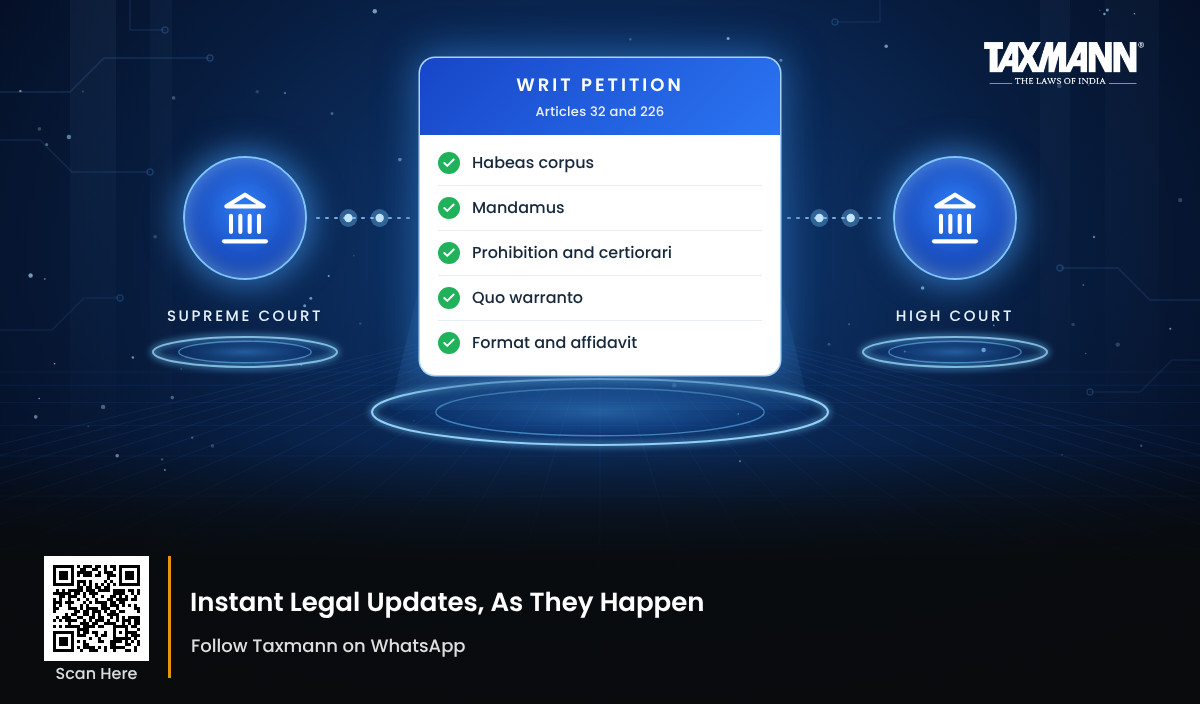
Table of Contents
- What is a writ petition?
- What are the five types of writs?
- When does a writ of habeas corpus lie?
- When does a writ of mandamus lie?
- When are writs of prohibition and certiorari issued?
- When does a writ of quo warranto lie?
- What does a writ petition format look like?
- Is an affidavit filed with a writ petition?
- Quick answers
1. What is a writ petition?
A writ petition is a petition to the Supreme Court or a High Court praying for a writ. The chapter defines a writ as “a written command, precept or formal order, issued by a court”, telling the person it is addressed to either to do a specified act or not to do it.
The Constitution of India provides for the issue of writs in Articles 32 and 226. Article 32 provides remedies for enforcing fundamental rights by the Supreme Court, while Article 226 confers on High Courts the power to issue writs for enforcing fundamental rights as well as other rights. Dr Kolhatkar gives a specimen petition for each writ, numbered I to V, and each is a petition to a High Court under Article 226.
2. What are the five types of writs?
Each of the five writs does a different job: one tests whether a detention is lawful, one enforces a public duty, one keeps inferior courts and tribunals within their jurisdiction, one corrects the errors of inferior courts and tribunals, and one tests a person’s right to hold a public office.
| Writ | What it does | Where it lies (as stated in Chapter 11) |
|---|---|---|
| Habeas corpus | Calls on the person who is confining someone to tell the court the legal justification for the detention, or else to release him | Every case of unlawful detention; for detention by a private person, only in the High Court |
| Mandamus | Commands the performance of a particular duty | To enforce a public duty in whose performance the petitioner has a sufficient legal interest, once he has demanded performance and been refused; under certain circumstances it might also lie against a private individual, if collusion between him and a public authority is established |
| Prohibition | Forbids an inferior court or tribunal to go on with a proceeding that lacks or exceeds jurisdiction, or is contrary to the law of the land | Inferior courts and tribunals; it will not lie once the proceedings have been disposed of and nothing remains to be done |
| Quo warranto | Calls on the holder of an office to show under what authority he holds it; if he holds it illegally, the court orders his ouster | A person who, according to the relator, has no right to hold an office of a public nature and is merely a usurper of it |
| Certiorari | Calls for the record of an inferior court’s proceedings for scrutiny and, if necessary, for quashing | Inferior courts, tribunals or authorities; it cannot lie against the legislature |

3. When does a writ of habeas corpus lie?
Habeas corpus lies in every case of unlawful detention. It is a judicial order of the Supreme Court or a High Court through which a person held in confinement may secure his release. If the detention is by a private person, the remedy lies only in the High Court. Under Article 21, nobody can be deprived of his liberty except by “procedure established by law”.
Through the writ, the court orders the person holding the prisoner to produce his body before it, so that the court can decide on the validity, jurisdiction or justification for the detention. The Supreme Court has issued the writ even on a postcard sent by a prisoner. The court looks at the legality of the detention as it stands at the time of the return, not when the proceedings were instituted.
In Specimen No. I, the detenu’s wife presents the petition as next friend because, the petition says, he is unable to present it personally. It alleges that he was remanded to police custody and then to judicial custody by orders passed without the relevant papers and without application of mind, and that he was not produced before the magistrate when the judicial custody ended. It prays for his production before the court and that he be set at liberty forthwith.
4. When does a writ of mandamus lie?
Mandamus lies where a public duty is to be enforced and the petitioner has a sufficient legal interest in its performance, but he must show that he demanded performance and was refused. The writ takes its name from the Latin word meaning “we command”. It issues so that justice may be done wherever there is a specific legal right but no specific legal remedy.
The legal right to enforce the duty must belong to the applicant himself, and the duty must, among other things, be of a public nature, created by the Constitution, by a statute or by some rule of common law. Mandamus does not issue as of course or as of right; as a rule, it is discretionary. Under certain circumstances, it might lie against a private individual where collusion between him and a public authority is established. It is not available to enforce a contract inter parties, though it will lie where the State interferes with a contractual right that the petitioner holds with a third party.
A pure question of law may be raised at any stage of the proceedings. A question of fact, however, cannot be agitated in the writ petition if it needs investigation and inquiry and a party laid no factual foundation for it before the court or tribunal below. If, for some compelling circumstances, the writ court wishes to entertain a new factual plea, it must give the opposite party due opportunity to controvert it and to lead evidence substantiating its pleadings.
5. When are writs of prohibition and certiorari issued?
A writ of prohibition is issued so that judicial tribunals and courts stay within the limits of their jurisdiction, and a writ of certiorari is issued for an error of law or a breach of the principles of natural justice. By a writ of prohibition, the Supreme Court under Article 32, or a High Court under Article 226, forbids an inferior court or tribunal to continue a proceeding on the ground that it is “without or in excess of jurisdiction or contrary to law of the land”. Prohibition is a preventive remedy, not a corrective one: it issues only to prevent a future act, not to undo an act already done. So once the proceedings have been disposed of, with nothing left for the court or the parties to do, prohibition will not lie.
In Specimen No. III, the petitioner was added as accused No. 3 in a criminal case before a Judicial Magistrate First Class. He alleges that the magistrate has no jurisdiction to try him, and prays for a writ in the nature of prohibition restraining the respondents from proceeding against him.
By a writ of certiorari, a superior court may require the record of an inferior court’s proceedings to be sent to it, to be dealt with there. It is issued to correct errors of jurisdiction made by an inferior court or tribunal that has acted without jurisdiction, in excess of its jurisdiction, or in flagrant disregard of law or of the rules of procedure; Dr Kolhatkar cites Surya Devi Rai v. Ram Chander Rai, AIR 2003 SC 3044, for these grounds. Certiorari cannot lie against the legislature, and it cannot be issued to declare an Act or an ordinance unconstitutional or void. Nor will it be granted where the applicant’s negligence or omission in asserting his right, along with lapse of time and other circumstances, prejudices the adverse party.
Specimen No. V is an employee’s petition against a Labour Court’s order approving his dismissal. He alleges that the order was made in breach of the principles of natural justice, and prays for a writ in the nature of certiorari calling for the record and quashing the order, with a direction to reinstate him with back wages.
6. When does a writ of quo warranto lie?
Quo warranto lies against anyone who, according to the relator, has no right to hold an office of a public nature and is merely a usurper of it. The case cited for this is B.R. Kapur v. State of Tamil Nadu & Anr (2001) 7 SCC 231. The writ aims to stop someone who has wrongfully usurped an office from staying in it. It calls on the holder to show the court by what authority he holds the office, and if the court decides that he holds it illegally, it orders his ouster.
A citizen who claims the writ must satisfy the court that the office is a public one and that a usurper holds it without legal authority. The writ may be refused where it results from malice or ill will. Where quo warranto has been prayed for, the doctrine of delay and laches is not applied.
Specimen No. IV is a petition by a resident and voter of a municipality challenging the nomination of a member to its municipal board. He relies on a provision of the Municipality Act which, the petition says, bars the nomination of a person who contested the previous general election and was not elected, and states that the member was such a candidate. The prayer is for a writ of quo warranto declaring the nomination invalid and illegal and declaring that the member has no right to hold the office.
7. What does a writ petition format look like?
Specimen No. II, a petition for a writ of mandamus by residents of a city against their municipal corporation, sets out its parts in this order:
| Part | What the specimen puts there |
|---|---|
| Heading | The High Court of Judicature, the writ petition number and the district |
| Cause title | Two petitioners, each with age, occupation and residence, against the municipal corporation, through a named person, as respondent |
| Address | To the Chief Justice and the other puisne judges of the High Court, then the opening words “most respectfully showeth as under” |
| The petitioners | A statement that they are residents, taxpayers and citizens, filing on behalf of everyone living in the city and of the people of the villages proposed for inclusion within its limits |
| Facts | The Urban Development Authority’s notification proposing to increase the corporation’s limits, annexed as Exhibit-A, and the petitioners’ representations, to which, the petition says, the corporation paid no heed |
| Grounds | Lettered grounds (A) to (Q), objecting, among other things, to the burden on water supply, waste disposal and civic amenities |
| Formal statements | Statements that proper court fee stamp is paid, that the cause of action arose inside the court’s territorial jurisdiction, that there is no other remedy as efficacious and expeditious, that no other writ petition, appeal or application has been filed on this cause of action, that the petition is filed without laches and within limitation, and that no notice of any caveat has been received |
| Prayer | A writ of mandamus, or another appropriate writ, order or direction under Article 226, in respect of the notification; ad interim relief; directions to the respondent to take steps to set up a separate municipal body for the proposed villages; costs; and any other just and equitable order |
| Close | A note that a supporting affidavit is filed with the petition, then lines for the petitioners and their advocate, with the date and place |
8. Is an affidavit filed with a writ petition?
In Chapter 11’s five specimen petitions, yes: after the prayer, each records that a supporting affidavit is filed with it. Chapter 14 gives, as its Specimen No. II, an affidavit in a writ petition before a High Court. Its deponent, a director of the petitioner company, states on solemn affirmation that he is fully familiar with the facts and duly authorised to swear the affidavit; that the statements and contentions in the petition are true and correct “to the best of my knowledge, belief and information”; that the company has brought no other petition or legal proceedings in any other court for the same reliefs; and that no material fact has been suppressed or concealed.
9. Quick answers
What is a writ petition?
A writ petition is a petition to the Supreme Court or a High Court praying for a writ, that is, “a written command, precept or formal order, issued by a court” directing a person to do or refrain from doing a specified act.
Under which Articles of the Constitution are writs issued?
Writs are issued under Articles 32 and 226 of the Constitution of India. Article 32 provides remedies for enforcing fundamental rights by the Supreme Court, and Article 226 gives High Courts power to issue writs for enforcing fundamental rights as well as other rights.
What are the five types of writs?
The five types of writs are habeas corpus, mandamus, prohibition, quo warranto and certiorari. They deal with unlawful detention, the failure to perform a public duty, stopping an inferior court’s or tribunal’s proceeding that lacks or exceeds jurisdiction or is contrary to law, a public office held by a usurper without legal authority, and correcting an inferior court’s or tribunal’s errors of jurisdiction or of law, or breaches of natural justice.
Can a writ of habeas corpus be filed against a private person?
A writ of habeas corpus lies in every case of unlawful detention, but if the detention is by a private person, the remedy lies only in the High Court.
Does a writ of mandamus lie against a private individual?
A writ of mandamus is available to enforce a public duty. Under certain circumstances it might lie against a private individual, where it is established that he acted in collusion with a public authority. It is not available to enforce a contract inter parties, though it will lie where the State interferes with a contractual right that the petitioner holds with a third party.
What must be shown to claim a writ of quo warranto?
A citizen who claims a writ of quo warranto must satisfy the court that the office is a public one and that a usurper holds it without legal authority. The writ may be refused where it results from malice or ill will.
What does a writ petition contain?
In Specimen No. II of Chapter 11 of Drafting Pleading and Conveyancing, a petition for mandamus, the parts run from the heading, cause title and address to the judges, through the facts, lettered grounds and formal statements on court fee, jurisdiction, alternative remedy, other proceedings, limitation and caveat, to the prayer and a statement that an affidavit in support is filed.
Is an affidavit filed with a writ petition?
Each of the five specimen writ petitions in Chapter 11 of Drafting Pleading and Conveyancing records that a supporting affidavit is filed with it, and Chapter 14 gives a specimen affidavit made in a writ petition.
Chapter 11 of Drafting Pleading and Conveyancing by Dr Medha Kolhatkar (Third Edition, November 2026), available on Taxmann.com | Students, explains the five categories of writs, citing case law on each, and gives specimen writ petitions numbered I to V, one for each writ. Chapter 14 adds an affidavit in a writ petition as its Specimen No. II.
To read Articles 21, 32 and 226 in full, Taxmann.com | Research, Indian Acts & Rules has the Constitution of India article by article; the same module also carries Rules, Forms, circulars and notifications. Taxmann.com | Store has the Constitution of India | Bare Act without Comments | AIBE XXII (22).
More in this series: pleadings in CPC: plaint and written statement · affidavit format and drafting · bail and anticipatory bail applications under the BNSS · how to draft a legal notice.
Law stated as in the Third Edition (November 2026) of Drafting Pleading and Conveyancing.
Disclaimer: The content/information published on the website is only for general information of the user and shall not be construed as legal advice. While the Taxmann has exercised reasonable efforts to ensure the veracity of information/content published, Taxmann shall be under no liability in any manner whatsoever for incorrect information, if any.

Taxmann Publications has a dedicated in-house Research & Editorial Team. This team consists of a team of Chartered Accountants, Company Secretaries, and Lawyers. This team works under the guidance and supervision of editor-in-chief Mr Rakesh Bhargava.
The Research and Editorial Team is responsible for developing reliable and accurate content for the readers. The team follows the six-sigma approach to achieve the benchmark of zero error in its publications and research platforms. The team ensures that the following publication guidelines are thoroughly followed while developing the content:
- The statutory material is obtained only from the authorized and reliable sources
- All the latest developments in the judicial and legislative fields are covered
- Prepare the analytical write-ups on current, controversial, and important issues to help the readers to understand the concept and its implications
- Every content published by Taxmann is complete, accurate and lucid
- All evidence-based statements are supported with proper reference to Section, Circular No., Notification No. or citations
- The golden rules of grammar, style and consistency are thoroughly followed
- Font and size that’s easy to read and remain consistent across all imprint and digital publications are applied
Everything on Tax and Corporate Laws of India
To subscribe to our weekly newsletter please log in/register on Taxmann.com









 CA | CS | CMA


