[Analysis] Maintenance under BNSS – Section 144 | Interim Maintenance | Alteration | Enforcement
- Other Laws|Blog|
- 10 Min Read
Under section 144 of the BNSS, a wife, parent or, in set cases, child unable to maintain themselves may claim an allowance from a person of sufficient means who neglects or refuses to maintain them.
- By Taxmann
- |
- Last Updated on 16 November, 2026
Latest from Taxmann

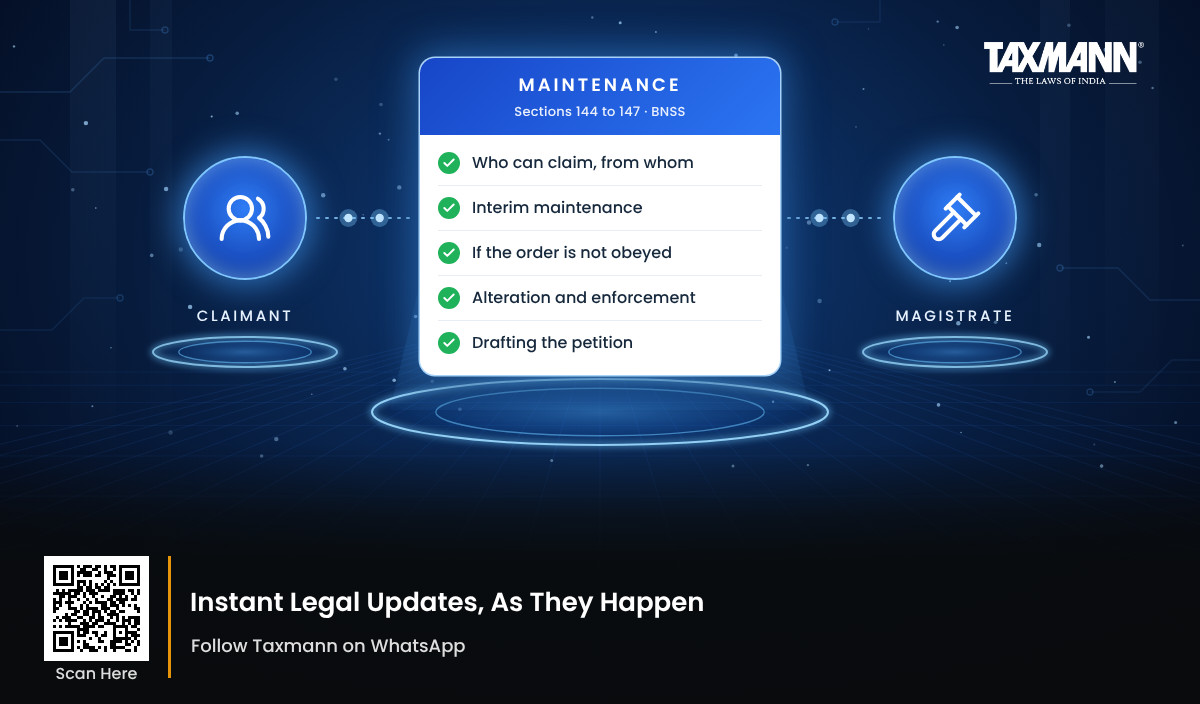
Table of Contents
- What is maintenance under the BNSS?
- Who can claim maintenance under section 144, and from whom?
- What is interim maintenance, and from when is maintenance payable?
- What happens if the maintenance order is not obeyed?
- When is a wife not entitled to maintenance?
- Can a maintenance order be altered or enforced?
- How is a petition for maintenance under BNSS drafted?
- Quick answers
1. What is maintenance under the BNSS?
Maintenance under BNSS is a monthly allowance that a Magistrate of the first class may order, under section 144, on proof that a person who has sufficient means has neglected or refused to maintain his wife, his father or mother, or his child in the cases the section sets out, where the claimant cannot maintain himself or herself. The term “maintenance” is not defined, but the chapter says it “undoubtedly” includes food, clothing and shelter, medical expenses, and other expenses “related to the normal pursuit of life”.
Dr Kolhatkar describes section 144 as a measure of social justice and a special law to protect women and children, which comes within the constitutional sweep of Article 15(3) of the Constitution of India, reinforced by Article 39. The provisions give a speedy remedy to people in distress. Section 144 gives effect to a man’s “natural and fundamental duty” to maintain his wife, children and parents while they are unable to maintain themselves. The provisions apply, and can be enforced, whatever personal law governs the persons concerned.
Proceedings under section 144 are civil in nature and are to be dealt with summarily. The BNSS replaces the Code of Criminal Procedure, 1973 (CrPC). The chapter refers to the “Right to maintenance under section 125 in the Code of Criminal Procedure (Section 144, BNSS)”, and adds that this right is a legal and moral duty the husband owes, not a benefit the wife receives.
2. Who can claim maintenance under section 144, and from whom?
A wife, a child in the cases section 144(1) sets out, or a father or mother, who cannot maintain himself or herself, can claim maintenance from a person having sufficient means who neglects or refuses to maintain them. The four clauses of section 144(1) are these:
| Claimant | Condition in section 144(1) |
|---|---|
| His wife (clause (a)) | Unable to maintain herself. The Explanation says “wife” includes a divorced woman who has not remarried, whether her husband divorced her or she obtained the divorce |
| His child (clauses (b) and (c)) | Unable to maintain itself, in the cases the section sets out. One such case, under clause (c), is a legitimate or illegitimate child, other than a married daughter, who has attained majority and is unable to maintain itself owing to any physical or mental abnormality or injury |
| His father or mother (clause (d)) | Unable to maintain himself or herself |
On proof of the neglect or refusal, a Magistrate of the first class may order a monthly allowance at whatever monthly rate he thinks fit, paid to whoever he directs from time to time. The first proviso lets him order the father of a female child under clause (b) to pay the allowance until she attains her majority, if he is satisfied that her husband, where she is married, does not have sufficient means.

3. What is interim maintenance, and from when is maintenance payable?
Interim maintenance is a monthly allowance the Magistrate may order while the proceeding for maintenance is still pending. The second proviso to section 144(1) lets him order the person to pay a monthly allowance for the interim maintenance of the wife, child, father or mother concerned, together with the expenses of the proceeding that he considers reasonable. The third proviso adds that an application for interim maintenance and expenses is, “as far as possible”, to be disposed of within sixty days from the date on which notice of the application is served on that person.
Section 144(2) makes the allowance for maintenance, or for interim maintenance and expenses, payable from the date of the order, unless the Magistrate directs that it be paid from the date of the application.
The chapter says the object of maintenance is to give a deserted wife a speedy remedy for food, clothing and shelter, and to prevent “vagrancy and destitution”.
4. What happens if the maintenance order is not obeyed?
If a person ordered to pay maintenance fails to comply with the order without sufficient cause, section 144(3) lets the Magistrate issue a warrant for every breach, so that the amount due is levied in the way fines are levied. For each month’s allowance, or interim maintenance and expenses, left wholly or partly unpaid after the warrant is executed, he may sentence the defaulter to imprisonment for up to one month, or “until payment if sooner made”.
The first proviso to section 144(3) sets a time limit. No warrant is to be issued to recover an amount due unless the application to levy it is made to the court within one year of the date on which it fell due.
Section 144(3) also deals with a husband who offers to maintain his wife on condition that she lives with him. If she refuses, the Magistrate may consider any grounds of refusal she gives, and may still make an order despite the offer if he is satisfied that there is “just ground” for doing so. The Explanation adds that if a husband has married another woman or keeps a mistress, that “shall be considered to be just ground” for her refusal to live with him.
5. When is a wife not entitled to maintenance?
A wife is not entitled to maintenance from her husband if she is living in adultery, if she refuses to live with him without any sufficient reason, or if the two live apart by mutual consent. Section 144(4) applies this bar both to the allowance for maintenance and to the allowance for interim maintenance and expenses. Where a wife already has an order in her favour and any of these grounds is proved, section 144(5) says the Magistrate shall cancel the order.
Section 146(3) deals separately with an order under section 144 in favour of a divorced woman, whether her husband divorced her or she obtained the divorce from him. The Magistrate shall cancel the order if he is satisfied that:
- she has remarried since the divorce, in which case the order is cancelled from the date of her remarriage;
- her husband divorced her and she has received, before or after the order, the whole of the sum that was payable on the divorce under whatever customary or personal law applies to the parties. If the sum was paid before the order, the order is cancelled from the date it was made; in any other case, from the end of the period, if any, for which the husband has actually paid her maintenance;
- she obtained a divorce from her husband and had voluntarily given up her rights to maintenance or interim maintenance after her divorce, in which case the order is cancelled “from the date thereof”.
6. Can a maintenance order be altered or enforced?
A maintenance order can be altered under section 146 of the BNSS and enforced under section 147. Section 146 gives the court power to modify, alter or amend a maintenance order made under section 144. A party who wants the order modified may apply to the court, and must plead the relevant change of circumstances in the application. Once a change in the circumstances of the person receiving a monthly allowance for maintenance or interim maintenance, or of the person ordered to pay it, is proved, the Magistrate may alter the allowance as he thinks fit. Dr Kolhatkar’s example is a wife who starts earning after the order is passed, in which case the husband can seek modification.
Specimen II, an application for enhancement of maintenance, pleads such a change. The petitioner states that the respondent has been paying her and her daughter a monthly sum under the court’s order; that the daughter was an infant when the order was made and the amount is now very low for her growing needs; and that the respondent’s financial status has grown, as he now works as a manager in a bank. She prays that the maintenance be enhanced.
If the party ordered fails to pay, the order can be enforced under section 147, as the book explains. Section 147 entitles the person in whose favour the order is made, or his guardian if any, or the person to whom the allowance is to be paid, to a copy, without payment, of the order of maintenance or of interim maintenance and expenses. Any Magistrate can enforce the order wherever the person against whom it was made may be, once satisfied about who the parties are and that the allowance or expenses due have not been paid. The warrant and imprisonment that section 144(3) allows are described in part 4 above. Specimen III, a petition under section 147, states that the court’s order directed the respondent to pay a monthly sum, that he has failed and neglected to pay in spite of the order and the petitioner’s repeated demands, and that the petitioner faces serious hardship; a copy of the order is annexed.
7. How is a petition for maintenance under BNSS drafted?
Specimen I pleads the marriage, the separation, the wife’s lack of means, the husband’s means and his neglect, and then asks for a monthly sum. It is set out in this order:
| Part | What Specimen I puts there |
|---|---|
| Cause title | The court and place, the petition number, and the petitioner or applicant against the opponent or respondent |
| Heading | Petition for maintenance under section 144 of the BNSS |
| Marriage | The petitioner states that the parties are Hindus married as per Hindu Vedic rites and ceremonies, and that she moved to her matrimonial home to live with her husband |
| Cruelty and separation | She states that he was habituated to drinking, picked quarrels, came home drunk and beat her, and that because of this mental and physical cruelty she had to leave the matrimonial home against her wishes; she now lives with her parents |
| Her means | She states that her father works in a flour mill and must also look after his two sons and his wife, and that she is unable to maintain herself |
| His means | She states that he works as a senior clerk on a stated monthly salary, that he has no other financial responsibilities and that his parents are not alive |
| Neglect | She states that she called on him by letter to pay her maintenance and that he has neither replied nor provided any money |
| Prayer | She prays that the opponent be directed to pay a stated sum per month, that the costs of the application be awarded to her, and for any other order the court thinks fit |
| Close | A note that an affidavit in support is filed, the place and date, and lines for the petitioner and her advocate |
Specimens II and III also end with the note that an affidavit in support is filed.
Chapter 2 has a specimen notice to claim maintenance, Specimen No. XII. It recites the marriage and the son born of it, alleges that the husband has failed to provide maintenance, states the wife’s meagre earnings as a domestic help and the husband’s salary, and calls on him to pay a monthly amount for her and her son, failing which legal proceedings will be initiated.
8. Quick answers
What is maintenance under section 144 of the BNSS?
Section 144 of the BNSS lets a Magistrate of the first class order a person of sufficient means to pay a monthly allowance on proof that he neglects or refuses to maintain his wife, father or mother, or child in the cases it sets out, who cannot maintain himself or herself. “Maintenance” is not defined, but it undoubtedly includes food, clothing and shelter, medical expenses, and other expenses “related to the normal pursuit of life”.
Who can claim maintenance under the BNSS?
A wife, a father or mother, or a child in the cases section 144 of the BNSS sets out, if unable to maintain themselves, may claim maintenance from a person of sufficient means who neglects or refuses to maintain them. One such case is an adult child, other than a married daughter, unable to maintain itself because of physical or mental abnormality or injury. “Wife” includes a divorced wife who has not remarried.
What is interim maintenance under the BNSS?
Interim maintenance under section 144 of the BNSS is a monthly allowance, with the expenses of the proceeding that the Magistrate considers reasonable, which the Magistrate may order a person to pay while the proceeding for maintenance is pending. An application for it is, as far as possible, to be decided within sixty days from the date on which notice of the application is served on that person.
From when is maintenance payable under the BNSS?
An allowance for maintenance, or for interim maintenance and the expenses of the proceeding, is payable under section 144(2) of the BNSS from the date of the order, unless the Magistrate directs that it be paid from the date of the application.
What happens if maintenance ordered under the BNSS is not paid?
If a person ordered to pay maintenance under section 144 of the BNSS fails without sufficient cause to comply, the Magistrate may issue a warrant for every breach and, for each month’s allowance still unpaid after the warrant is executed, sentence him to imprisonment for up to one month, or “until payment if sooner made”. No warrant issues unless the application to levy is made within one year of the amount falling due.
When is a wife not entitled to maintenance under the BNSS?
A wife is not entitled under section 144 of the BNSS to maintenance, or interim maintenance and expenses, from her husband if she is living in adultery, refuses to live with him without any sufficient reason, or they are living separately by mutual consent; on proof of any of these, the Magistrate shall cancel an order in her favour. Section 146(3) adds grounds for cancelling an order for a divorced woman, such as her remarriage.
Can a maintenance order under the BNSS be altered or enforced?
Yes. Section 146 of the BNSS lets the Magistrate alter the allowance once a change is proved in the circumstances of the person receiving it or the person ordered to pay it. Section 147 lets any Magistrate enforce the order wherever the person against whom it was made may be, once satisfied about who the parties are and that the allowance or expenses due have not been paid.
Is section 125 of the CrPC now section 144 of the BNSS?
Yes. Dr Kolhatkar describes the right to maintenance as a right “under section 125 in the Code of Criminal Procedure (Section 144, BNSS)”, and the BNSS replaces the Code of Criminal Procedure, 1973.
Chapter 16 of Drafting Pleading and Conveyancing by Dr Medha Kolhatkar (Third Edition, November 2026), available on Taxmann.com | Students, sets out maintenance under section 144 of the Bharatiya Nagarik Suraksha Sanhita, alteration of the allowance under section 146 and enforcement under section 147. Its maintenance section gives three specimens, numbered I to III: a petition for maintenance, an application for enhancement of maintenance and a petition for enforcement of an order of maintenance. Chapter 2 adds a specimen notice to claim maintenance.
Taxmann.com | Learning has a one-hour webinar, “Bharatiya Nagarik Suraksha Sanhita 2023 An Overview”, by Prof. (Dr.) S.D. Sharma. Taxmann’s Act and Rule Comparator lets you open a section of the Code of Criminal Procedure, 1973 beside a section of the Bharatiya Nagarik Suraksha Sanhita, 2023 and compare the two side by side. Taxmann.com | Store has the Bharatiya Nagarik Suraksha Sanhita (BNSS) [Bare Act with Section Notes].
Related reading: the Bharatiya Nagarik Suraksha Sanhita · a tabular comparison of the BNSS and the CrPC · the Hindu Marriage Act, 1955.
More in this series: bail and anticipatory bail applications under the BNSS · affidavit format and drafting · how to draft a legal notice · succession certificate and probate.
Law stated as in the Third Edition (November 2026) of Drafting Pleading and Conveyancing.
Disclaimer: The content/information published on the website is only for general information of the user and shall not be construed as legal advice. While the Taxmann has exercised reasonable efforts to ensure the veracity of information/content published, Taxmann shall be under no liability in any manner whatsoever for incorrect information, if any.

Taxmann Publications has a dedicated in-house Research & Editorial Team. This team consists of a team of Chartered Accountants, Company Secretaries, and Lawyers. This team works under the guidance and supervision of editor-in-chief Mr Rakesh Bhargava.
The Research and Editorial Team is responsible for developing reliable and accurate content for the readers. The team follows the six-sigma approach to achieve the benchmark of zero error in its publications and research platforms. The team ensures that the following publication guidelines are thoroughly followed while developing the content:
- The statutory material is obtained only from the authorized and reliable sources
- All the latest developments in the judicial and legislative fields are covered
- Prepare the analytical write-ups on current, controversial, and important issues to help the readers to understand the concept and its implications
- Every content published by Taxmann is complete, accurate and lucid
- All evidence-based statements are supported with proper reference to Section, Circular No., Notification No. or citations
- The golden rules of grammar, style and consistency are thoroughly followed
- Font and size that’s easy to read and remain consistent across all imprint and digital publications are applied
Everything on Tax and Corporate Laws of India
To subscribe to our weekly newsletter please log in/register on Taxmann.com









 CA | CS | CMA


