[Analysis] KYC for Mutual Fund Investors – Documents | KRAs and CKYC | PAN Exemptions
- Blog|Company Law|
- 4 Min Read
Every mutual fund investor must be KYC compliant, whatever the amount. Here are the documents, the KRA process and the PAN exemptions.
- By Taxmann
- |
- Last Updated on 16 November, 2026
Latest from Taxmann
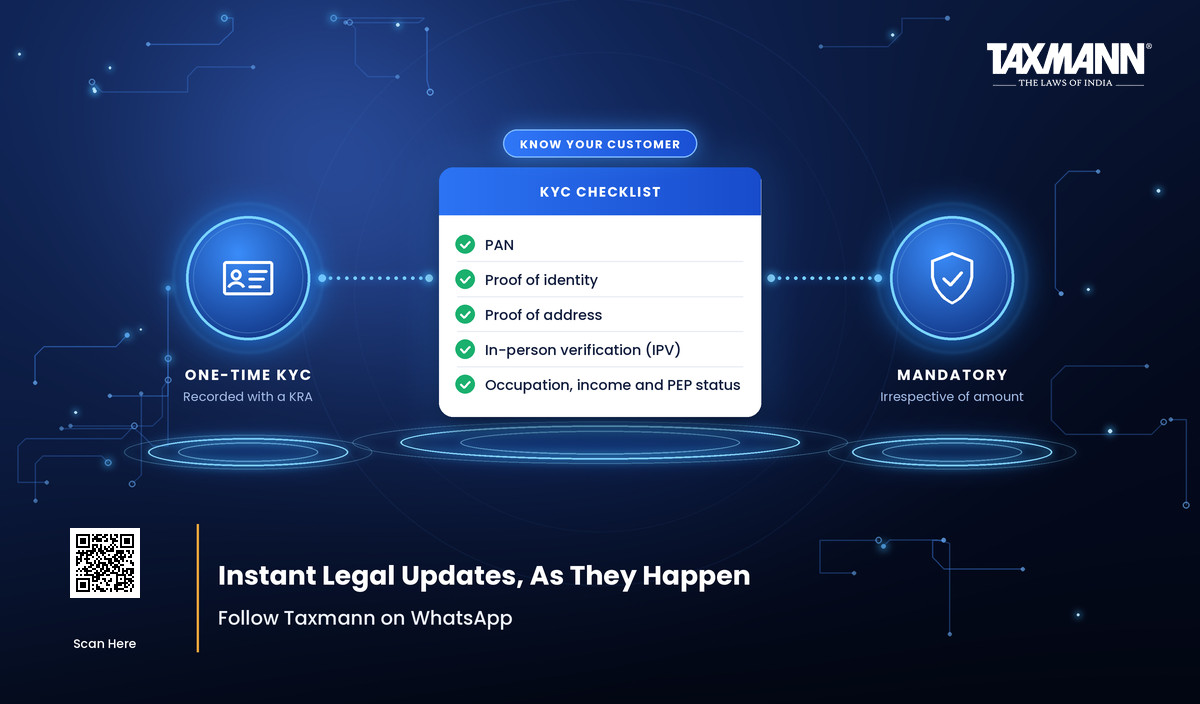
Table of Contents
- When is KYC required?
- The documents
- Who is exempt from PAN?
- KRAs and the centralised KYC
- Central KYC Registry (cKYCR)
- Aadhaar e-KYC and other routes
- The extra details you must provide
- The process, step by step
- Quick answers
1. When is KYC required?
For new and additional purchases, switch transactions, and new registrations of SIPs and micro-SIPs, STPs and IDCW/dividend transfer plans (DTPs) from the effective date.
2. The documents
Proof of identity—PAN. A PAN card with photograph is mandatory for all applicants except those specifically exempt. To ease verification, SEBI permits market intermediaries to verify PAN online at the Income Tax website without insisting on the original card—provided the client has presented a proof-of-identity document other than the PAN card.
Proof of address. Passport, Voter’s ID, Ration card, Driving Licence, bank account statement, utility bill and other specified documents. If the communication address and permanent address differ, documentary proof is needed for both. Proof of address in the name of the spouse may be accepted.
Attestation. Copies must be self-attested with originals produced for verification. If originals aren’t produced, copies must be attested by persons authorised to do so—a Notary Public, a Gazetted Officer, or the Manager of a Scheduled Commercial Bank.
3. Who is exempt from PAN?
| Exempt category | Note |
|---|---|
| Transactions on behalf of the Central/State government, and by officials appointed by the court | — |
| Investors residing in the state of Sikkim | — |
| UN entities / multilateral agencies exempt from paying tax or filing returns in India | — |
| Investments (including SIPs and lump sums) up to ₹50,000 per investor, per year, per mutual fund | The Micro-SIP exemption |
Micro-SIP defined: an SIP where the annual investment—measured on a 12-month rolling basis or over the April–March financial year—does not exceed ₹50,000.
Exempt investors must still provide an alternate photo-identity document: Aadhaar, Passport, Voter’s ID, Driving Licence or another photo-identity card.
4. KRAs and the centralised KYC
This is the part that saves investors real effort. SEBI instituted a centralised KYC process for the capital market. Once you complete KYC with one capital market intermediary, you can invest across the capital market—not just in mutual funds.
How it works: an intermediary performs In-Person Verification (IPV), completes the documentation, and uploads your data to a KRA’s database. From that point the KYC is valid across the capital market.
A standard Account Opening Form (AOF) applies—Part I holds the basic KYC details used by all SEBI-registered intermediaries; Part II holds additional information specific to dealing on the stock exchanges.
5. Central KYC Registry (cKYCR)
By a Government notification dated 26 November 2015, CERSAI was authorised to act as the Central KYC Record Registry under the PML Rules, 2005—receiving, storing, safeguarding and retrieving KYC records in digital form across the financial sector.
Registered intermediaries must use the CERSAI-finalised template as Part I of the AOF for individuals, and upload KYC data to the cKYCR for all individual accounts opened on or after 1 August 2016.
6. Aadhaar e-KYC and other routes
- Aadhaar e-KYC: entities registered with UIDAI as a KYC User Agency (KUA) allow SEBI-registered intermediaries and mutual fund distributors to perform Aadhaar authentication. Intermediaries wishing to use this enter an agreement with a KUA and register with UIDAI as sub-KUAs.
- Via a Depository Participant: if you hold units in demat form or invest through the stock exchange infrastructure, the KYC performed by the DP is treated as compliant.
7. The extra details you must provide
Beyond identity and address, mutual funds capture—mandatorily, for individuals and non-individuals alike—your occupation, Gross Annual Income or Net worth, and Politically Exposed Person (PEP) status.
8. The process, step by step
- Complete the form and attach supporting identity and address documents.
- The documents are verified against the originals—or you provide a True Copy attested by a Notary Public, Gazetted Officer or Manager of a Scheduled Commercial Bank.
- Originals are returned after verification.
- The forms and supporting documents are uploaded to a centralised KRA’s server.
Mutual funds, depositories, RTAs, KYD-compliant mutual fund distributors and brokers are all authorised to facilitate investor KYC documentation.
The KYC and anti-money-laundering rules can be read on Taxmann.com | Research, and entity-specific questions taken to Taxmann Advisory. KYC sits in Chapter 9 of the Mutual Fund Foundation workbook, the exam’s largest unit at 20%.
9. Quick answers
Is KYC mandatory for small mutual fund investments?
Yes—KYC is required irrespective of the investment value.
Is PAN mandatory for mutual fund investments?
Yes, except for specified exempt categories—including investments up to ₹50,000 per investor per year per mutual fund (micro-SIPs).
What is a micro-SIP?
An SIP where annual investment (12-month rolling, or April–March) does not exceed ₹50,000—exempt from PAN.
Do I need separate KYC for each mutual fund?
No. Once KYC is completed with one capital market intermediary and uploaded to a KRA, it is valid across the capital market.
What is IPV?
In-Person Verification—carried out by the intermediary before uploading your data to a KRA.
What extra information must I give beyond ID and address?
Occupation, Gross Annual Income or Net worth, and PEP status—all mandatory.
Law stated as on 16 November 2026. This article draws on Chapter 9 of the official NISM-Series-V-B Mutual Fund Foundation workbook (March 2026 Workbook Version), published exclusively by Taxmann, read with the law in force on that date. It is general information, not investment, tax or legal advice.
More in this series: What is a Mutual Fund · SIP, SWP and STP · NFO in Mutual Funds · ARN, EUIN and KYD · IDCW in Mutual Funds
Disclaimer: The content/information published on the website is only for general information of the user and shall not be construed as legal advice. While the Taxmann has exercised reasonable efforts to ensure the veracity of information/content published, Taxmann shall be under no liability in any manner whatsoever for incorrect information, if any.

Taxmann Publications has a dedicated in-house Research & Editorial Team. This team consists of a team of Chartered Accountants, Company Secretaries, and Lawyers. This team works under the guidance and supervision of editor-in-chief Mr Rakesh Bhargava.
The Research and Editorial Team is responsible for developing reliable and accurate content for the readers. The team follows the six-sigma approach to achieve the benchmark of zero error in its publications and research platforms. The team ensures that the following publication guidelines are thoroughly followed while developing the content:
- The statutory material is obtained only from the authorized and reliable sources
- All the latest developments in the judicial and legislative fields are covered
- Prepare the analytical write-ups on current, controversial, and important issues to help the readers to understand the concept and its implications
- Every content published by Taxmann is complete, accurate and lucid
- All evidence-based statements are supported with proper reference to Section, Circular No., Notification No. or citations
- The golden rules of grammar, style and consistency are thoroughly followed
- Font and size that’s easy to read and remain consistent across all imprint and digital publications are applied
Everything on Tax and Corporate Laws of India
To subscribe to our weekly newsletter please log in/register on Taxmann.com









 CA | CS | CMA


