[Analysis] RNOR and Deemed Resident – Sections 6(13) and 6(7) | Not Ordinarily Resident | Stateless Person
- Blog|Income Tax|
- 12 Min Read
RNOR status under section 6(13) and deemed residency under section 6(7): the three limbs, what RNOR is worth, the karta problem, withholding and the TRC.
- By Taxmann
- |
- Last Updated on 18 November, 2026
Latest from Taxmann

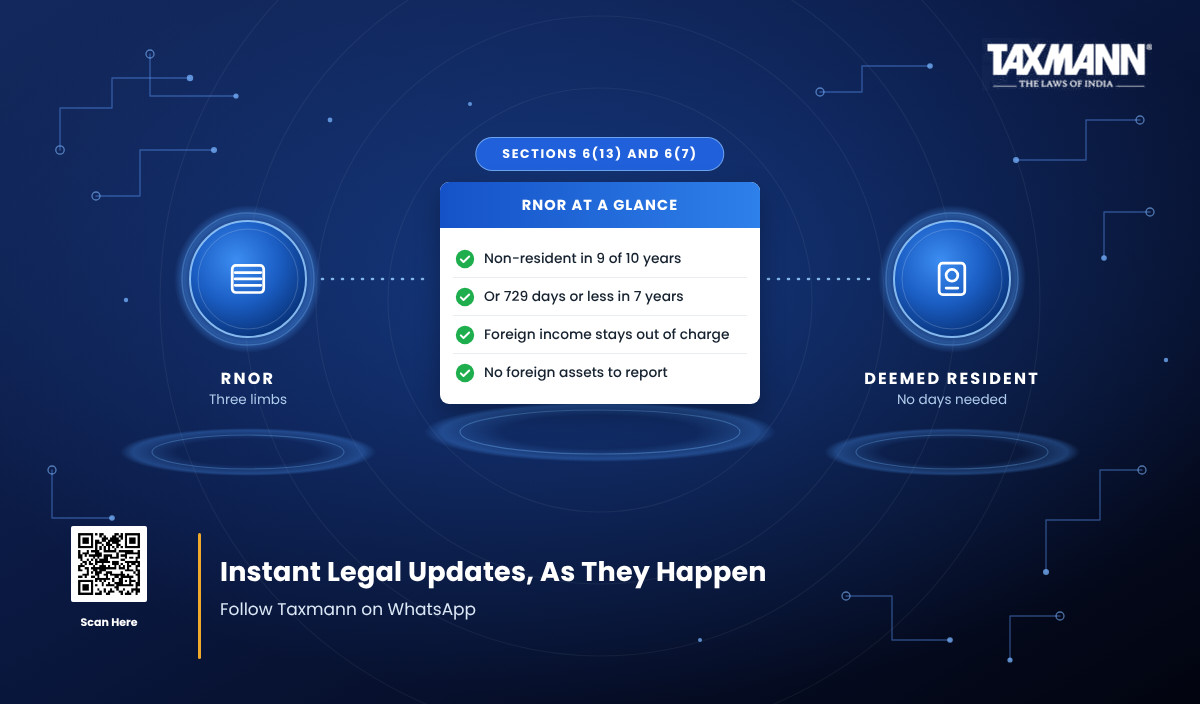
Table of Contents
- What is a resident but not ordinarily resident (RNOR)? [Section 6(13)]
- The three limbs of section 6(13)
- What the RNOR status is worth [Section 5(1)(c)]
- How long does RNOR status last?
- RNOR for a Hindu undivided family, and the karta problem
- The deemed resident and the stateless person [Section 6(7)]
- ‘Liable to tax’: what the phrase requires [Section 2(66)]
- Can a deemed resident claim a treaty?
- The payer’s problem: withholding on a payment to a deemed resident [Section 393]
- Can a deemed resident obtain a Tax Residency Certificate?
- Quick answers
1. What is a resident but not ordinarily resident (RNOR)? [Section 6(13)]
A resident but not ordinarily resident is a person who is resident in India under section 6 but whose foreign income stays outside the scope of total income. Section 6(13) of the Income-tax Act 2025 [corresponding to section 6(6) of the Income-tax Act 1961] draws the line. The category applies to individuals and Hindu undivided families only.
The reason for it is economic, not technical. Presence in India for a single year can make a person resident, and residence would otherwise pull worldwide income into charge. The legislature accepted that such a person may not yet have enough economic connection with India to justify that, and section 6(13) matches liability to the degree of integration. For a returning Indian or a newly arrived resident it operates as a transitional status.
2. The three limbs of section 6(13)
A resident is not ordinarily resident if any one of three limbs is satisfied. They are alternatives, and the limbs do not overlap in the way people often assume.
| Limb | Who it covers | Condition |
|---|---|---|
| Section 6(13)(a) | An individual, or an HUF whose manager qualifies | Non-resident in India in nine out of the ten tax years preceding that year, or in India cumulatively for 729 days or less in the seven tax years preceding that year |
| Section 6(13)(b) | A citizen of India or a person of Indian origin | Total income excluding income from foreign sources exceeds Rs. 15,00,000 in the tax year, and presence in India of 120 days or more but less than 182 days in that year |
| Section 6(13)(c) [corresponding to section 6(6)(d) of the Income-tax Act 1961] |
A citizen of India | Deemed to be resident in India under section 6(7) |
Within the first limb, satisfying either test is enough. To be ordinarily resident an individual must fail both.
Two illustrations make the arithmetic concrete. A foreign national who comes to India for the first time and spends 300 days here in each of two consecutive years is resident in both under section 6(2)(a); having never visited before, he was a non-resident in nine of the ten preceding years, so he is not ordinarily resident. A foreign national, not of Indian origin, who has spent 100 days in India in every year for the last fifteen years has been resident under section 6(2)(b) in each of the last ten, the relaxation in section 6(4) not being available to him, and so fails the first test; but his presence over the seven preceding years totals 700 days, under the 729-day ceiling, and he is not ordinarily resident on the second.
The third limb stands apart. Where section 6(13)(c) applies, section 6(13)(a) and section 6(13)(b) are not tested at all. Section 6(7) operates on a person who is not resident under sections 6(2) to 6(6) in the first place, so there is no overlap to resolve.
3. What the RNOR status is worth [Section 5(1)(c)]
Foreign income falls outside total income. Section 5(1)(c) provides that income accruing or arising outside India to a person not ordinarily resident within the meaning of section 6(13) is included only where it is derived from a business controlled in India or a profession set up in India. There is a second, quieter benefit: a person in this category is not required to give details of foreign assets in the return.
The relief is real money in a common fact pattern. In CIT v. Anant Jain [2012] 21 taxmann.com 19 (Delhi), payments received by an assessee who was not ordinarily resident in the relevant year, by way of retirement, severance and vacation entitlements from a former United States employer on termination of that employment, were held not to fall within the deeming provision.
The status also has to be claimed correctly. In Pradip J. Mehta v. CIT [2002] 123 Taxman 1118 (Gujarat), the question was the length of residence in India: an individual resident in India for a number of years such that he is not a non-resident in nine of the ten preceding years, and has been in India for 730 days or more in the preceding seven years, is not a resident but not ordinarily resident, and the exemption under section 5(1)(c) is unavailable to him.
One definitional quirk is worth carrying: section 2(72) [corresponding to section 2(30) of the Income-tax Act 1961] defines a non-resident as a person who is not a resident, and for the purposes of sections 161, 174 and 312 it includes a person who is not ordinarily resident within the meaning of section 6(13). For those three sections only, the two categories are treated alike.
4. How long does RNOR status last?
Two years, in the ordinary case. A person coming to India for the first time will remain not ordinarily resident for the first two years, and a person who has been outside India long enough to be a non-resident for the ten preceding years will be not ordinarily resident for two years on his return.
The reason lies in the first limb. Claiming the status under it requires only that residence in India has not been established in nine of the ten preceding years; two years of residence is enough to break that, and the second test, the 729-day ceiling over seven years, will usually have been breached by then as well. Nothing about the two-year rule of thumb is in the section, and it should be checked against the actual counts rather than assumed.
5. RNOR for a Hindu undivided family, and the karta problem
An HUF is resident under section 6(9) if the control and management of its affairs is situated wholly or partly in India, and non-resident only if that control and management is wholly outside India. Once it is resident, section 6(13) decides whether it is ordinarily resident, and the test is applied to the manager: the HUF is not ordinarily resident if its manager has been a non-resident in nine of the ten preceding years, or has been in India for 729 days or less in the seven preceding years.
The two tests do not sit comfortably together. Residence turns on control and management; the ordinarily-resident question turns on the manager’s own presence. Section 6(9) does not mention the manager at all, and the criteria in the two provisions are not aligned.
What “control and management” requires was settled long ago in Sri Raja K.V. Narasimha Rao Bahadur v. CIT [1950] 18 ITR 181 (Madras), decided under the 1922 Act. Not every casual act of management in India locates control and management here. Management implies continuous oversight of the family’s affairs with some degree of permanence, and the manager’s presence must be such as to make India practically the seat of control. Stray acts, or occasional visits about family property, do not bring control and management into India.
Then there is the change of karta. When a karta dies or steps down, the family is not dissolved and the eldest surviving coparcener, male or female, becomes the new karta; the HUF keeps its permanent account number and only the karta’s details change. The difficulty is that the section 6(13)(a) tests look back at one person’s residence over nine or ten years and one person’s presence over seven, and a change of manager during the year leaves it unclear whose history is to be counted. The Act does not answer it.
6. The deemed resident and the stateless person [Section 6(7)]
Section 6(7) makes an individual resident in India irrespective of the number of days spent here. It applies where the individual is a citizen of India, is not liable to tax in any other country or territory by reason of domicile, residence or criteria of a similar nature, and has total income exceeding Rs. 15,00,000 during the tax year other than income from foreign sources. It operates notwithstanding sub-sections (2) to (6).
The person may not have set foot in India during the year.
This is an anti-abuse provision, carried forward from section 6(1A) of the Income-tax Act 1961, which the Finance Act 2020 inserted with effect from 1 April 2021. The budget memorandum to the Finance Bill 2020 named the target: individuals, high net worth individuals in particular, who arrange their affairs so as to be liable to tax nowhere, at a time when the international effort was directed at closing off double non-taxation. The deeming fiction attaches residence to citizenship alone.
Its reach was narrowed almost immediately, and the narrowing matters. A CBDT press release dated 2 February 2020, issued the day after the Bill, stated that the provision was not intended to bring bona fide workers in other countries into the tax net, and clarified that in the case of an Indian citizen who becomes a deemed resident, income earned outside India would not be taxed in India unless derived from an Indian business or profession.
7. ‘Liable to tax’: what the phrase requires [Section 2(66)]
Liability, not payment. Section 2(66) [corresponding to section 2(29A) of the Income-tax Act 1961, inserted by the Finance Act 2021 with effect from 1 April 2021] defines “liable to tax” in relation to a person and a country as meaning that there is an income-tax liability on that person under the law of that country for the time being in force, and it includes a person subsequently exempted from that liability under that country’s law.
The distinction from “subject to tax” is the whole of the point. A person with losses or allowances that reduce his tax to nil is still liable to tax; so is a person who enjoys a specific exemption, because if the exemption were withdrawn he would fall back into comprehensive taxation. In Universal Radiators v. CIT [1993] 68 Taxman 45 (SC) the charge to tax was distinguished from the liability to pay it, and in Union of India v. Azadi Bachao Andolan [2003] 132 Taxman 373 (SC) the position was put in treaty terms: a person liable to tax need not actually pay tax. A person who cannot be a taxpayer under the present law of a State, by contrast, is not liable to tax there.
The catch-all in the section, “criteria of a similar nature”, reaches beyond physical presence and permanent home to any legal or administrative connection under which a foreign country excuses the individual from tax. Domicile itself is distinct from residence: a person may be resident in more than one country in a year but can be domiciled in only one, domicile being bodily presence coupled with the intention to make the place a permanent home. The point was made in Arvind Kumar v. State of UP, Writ – C No. 21674 of 2011.
8. Can a deemed resident claim a treaty?
On CA Sachin Sinha’s analysis, generally not, and the reason is structural rather than discretionary. Article 4(1) of the OECD Model defines a resident of a Contracting State as a person who, under the laws of that State, is liable to tax there by reason of domicile, residence, place of management or any other criterion of a similar nature. A person made resident by section 6(7) is resident by deeming fiction, not by reason of domicile or residence, and by definition is not liable to tax elsewhere on those grounds either. Article 4(2), the individual tie-breaker, applies only where a person is resident of both States on those criteria. It has nothing to bite on here.
Foreign tax credit falls away with it, though for a different reason. Section 6(13)(c) makes the deemed resident not ordinarily resident, so his foreign income is outside total income unless derived from a business controlled in or a profession set up in India. Income that India does not tax cannot generate a credit. The narrow case in which the question becomes live is the one where the income does come from a business controlled in or a profession set up in India, and double taxation can then arise.
Take a travel writer, a citizen of India, who spends no more than 50 days in any one country and is therefore resident nowhere, with foreign income of Rs. 20,00,000 and income other than from foreign sources of Rs. 25,00,000. Section 6(7) makes him resident in India; section 6(13)(c) makes him not ordinarily resident; and his foreign income is taxable in India only if it is derived from a business controlled in or a profession set up in India.
9. The payer’s problem: withholding on a payment to a deemed resident [Section 393]
A deemed resident is a resident, so a payer must withhold under the resident table. Fees for technical services paid to a person who is resident by virtue of section 6(7) fall under section 393(1), Table Sl. No. 6(iii) [corresponding to section 194J of the Income-tax Act 1961]. Were the payee a non-resident, the payer would withhold under section 393(2), Table Sl. No. 17 [corresponding to section 195(1)]. Where each old section now sits is mapped in our post on section 393 of the Income-tax Act 2025.
The difficulty is one of timing, and it has no clean answer in the Act. Whether section 6(7) applies depends on the payee’s total income other than foreign-source income exceeding Rs. 15,00,000 for the year, which cannot be known until the year has ended. At the moment of payment the payer does not have the information the section requires. The Act does not oblige the payee to declare anything. As a safeguard, obtain a declaration from the payee confirming whether he is a deemed resident under section 6(7), and keep it on the file with the deduction record. Where that volume of declarations and deductions has to be tracked and reconciled across a year, Taxmann’s eTDS Returns is built for the reconciliation and filing side of it.
One related trap, on gifts. Section 9(8) [corresponding to section 9(1)(viii) of the Income-tax Act 1961] deems a sum referred to in section 2(49)(u), paid by a person resident in India to a non-resident other than a company, a foreign company or a person not ordinarily resident under section 6(13), to accrue or arise in India. So a gift of that description from a resident to a person who is not ordinarily resident is taxable in India, reaching total income through the “deemed to accrue or arise in India” limb of section 5(1)(b) rather than through section 5(1)(c). No withholding obligation arises on a payment to a person not ordinarily resident, though section 393(2), Table Sl. No. 17 applies where the recipient is a non-resident.
Filing follows from the same threshold. A deemed resident’s total income other than foreign-source income exceeds Rs. 15,00,000 by definition, which puts it above the maximum amount not chargeable to tax, so he is required to furnish a return under section 263(1)(a)(iii).

10. Can a deemed resident obtain a Tax Residency Certificate?
Yes, and it will not do what he wants it to do. Nothing in the Act excludes a person from obtaining a Tax Residency Certificate merely because his residence arises under a deeming provision, and there is no bar to applying in Form 42 under Rule 75(3) of the Income-tax Rules 2026 [corresponding to Form 10FA under Rule 21AB(3) of the Income-tax Rules 1962].
What the certificate proves is narrower than what it is usually offered for. It certifies residence in India under Indian law for the relevant period. It does not certify that the holder is a treaty resident under any particular Double Taxation Avoidance Agreement, because a treaty asks whether the person is liable to tax in the State by reason of domicile, residence or a criterion of a similar nature. The CBDT’s FAQ on Form 42, at question 2, describes the form as being for any resident claiming tax residency in India who needs a certificate to claim treaty benefits or to satisfy requirements in another country.
For the section text, the circulars and the case law on each of these limbs, see the Income-tax module on Taxmann.com | Research.
11. Quick answers
What is the difference between a resident and a resident but not ordinarily resident?
Both are residents. A resident and ordinarily resident is taxed on worldwide income. A resident but not ordinarily resident is not taxed on income accruing or arising outside India unless it is derived from a business controlled in India or a profession set up in India, under section 5(1)(c).
For how many years can a person be RNOR?
Ordinarily two. A person arriving in India for the first time, and a person returning after being non-resident for the ten preceding years, will usually be not ordinarily resident for two years. The section prescribes no fixed period, so the counts under section 6(13)(a) have to be worked each year.
Does an RNOR have to report foreign assets in the return?
No. A person who is not ordinarily resident is not required to give details of foreign assets in the income tax return.
Can a person be a deemed resident without visiting India?
Yes. Section 6(7) applies irrespective of days spent in India, provided the individual is a citizen of India, is not liable to tax in any other country or territory by reason of domicile, residence or similar criteria, and has non-foreign-source total income above Rs. 15,00,000.
Does ‘not liable to tax’ mean paying no tax abroad?
No. Section 2(66) defines liability by reference to the existence of an income-tax liability under that country’s law, and includes a person later exempted from it. Someone whose tax abroad computes to nil because of losses or allowances is still liable to tax there.
Can a deemed resident claim benefits under a Double Taxation Avoidance Agreement?
Generally not, on the reasoning that residence under section 6(7) does not arise by reason of domicile, residence or a similar criterion, so Article 4(2) has nothing to resolve. The exception is income derived from a business controlled in or a profession set up in India, where the deemed resident may suffer double taxation.
This article draws on Chapters 6 and 7 of Taxmann’s Residential Status under Income-tax Act 2025 by CA Sachin Sinha (1st Edition, 2026), which treat the deemed resident and the not-ordinarily-resident tests in full, with the 1961 counterpart mapped alongside each provision. The law is stated as updated till August 2026.
Income-tax Acts and Rules, case laws, circulars and notifications are available on Taxmann.com | Research under Income Tax.
More in this series: Residential status in income tax · The 182-day test and how days are counted · The Tax Residency Certificate after Tiger Global · NRIs and section 115H under the Income-tax Act 2025
Disclaimer: The content/information published on the website is only for general information of the user and shall not be construed as legal advice. While the Taxmann has exercised reasonable efforts to ensure the veracity of information/content published, Taxmann shall be under no liability in any manner whatsoever for incorrect information, if any.

Taxmann Publications has a dedicated in-house Research & Editorial Team. This team consists of a team of Chartered Accountants, Company Secretaries, and Lawyers. This team works under the guidance and supervision of editor-in-chief Mr Rakesh Bhargava.
The Research and Editorial Team is responsible for developing reliable and accurate content for the readers. The team follows the six-sigma approach to achieve the benchmark of zero error in its publications and research platforms. The team ensures that the following publication guidelines are thoroughly followed while developing the content:
- The statutory material is obtained only from the authorized and reliable sources
- All the latest developments in the judicial and legislative fields are covered
- Prepare the analytical write-ups on current, controversial, and important issues to help the readers to understand the concept and its implications
- Every content published by Taxmann is complete, accurate and lucid
- All evidence-based statements are supported with proper reference to Section, Circular No., Notification No. or citations
- The golden rules of grammar, style and consistency are thoroughly followed
- Font and size that’s easy to read and remain consistent across all imprint and digital publications are applied
Everything on Tax and Corporate Laws of India
To subscribe to our weekly newsletter please log in/register on Taxmann.com









 CA | CS | CMA


