[Analysis] Tax Residency Certificate – Section 159(8) | What It Proves After Tiger Global | Rule 75 and Form 41
- Blog|Income Tax|
- 8 Min Read
Tax residency certificate under section 159(8): what it proves after Tiger Global (SC, 15 January 2026), and why Rule 75 now needs Form 41 in every claim.
- By Taxmann
- |
- Last Updated on 18 November, 2026
Latest from Taxmann

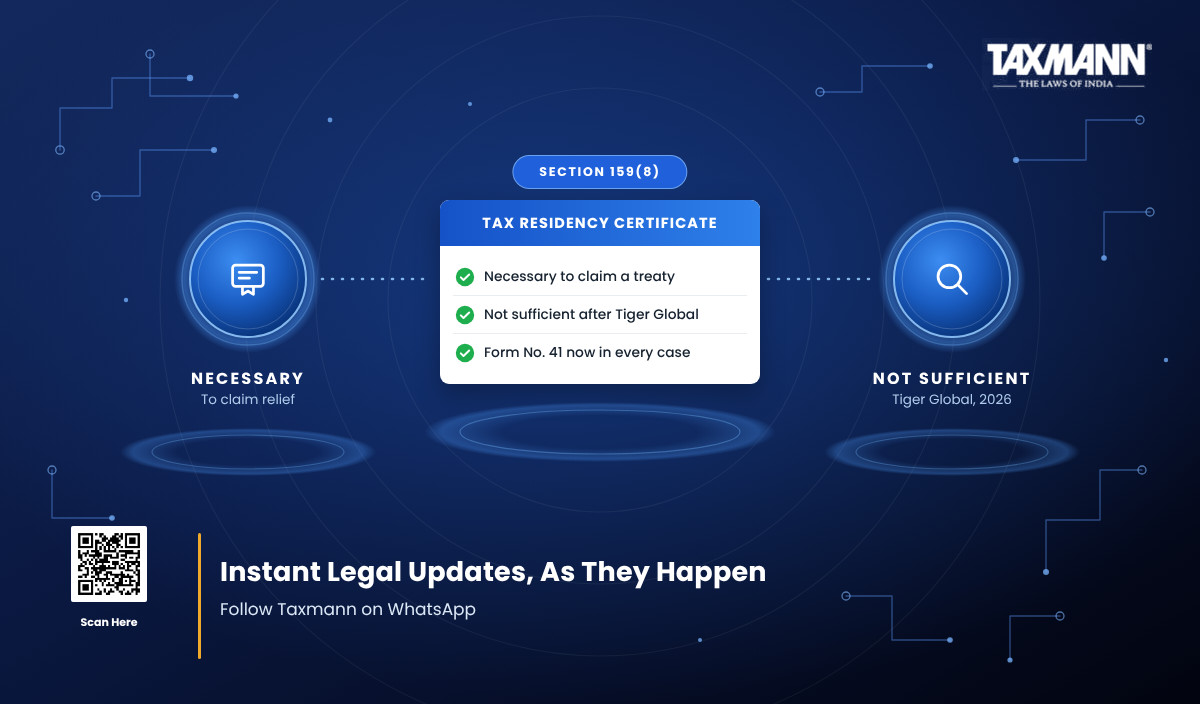
Table of Contents
- What is a Tax Residency Certificate, and what does section 159(8) require?
- Why the certificate was made mandatory
- The decade of Circular No. 789 and Azadi Bachao Andolan
- Blackstone: the revenue cannot go behind a valid certificate
- Tiger Global: what changed on 15 January 2026
- Is Circular No. 789 still binding?
- Rule 75 and Form No. 41: the relaxation that has gone
- Form 42 and Form 43: obtaining a certificate in India
- What a certificate is worth now
- Quick answers
1. What is a Tax Residency Certificate, and what does section 159(8) require?
A Tax Residency Certificate is a certificate issued by the government of a country stating that a person is a resident there for tax purposes. Section 159(8) of the Income-tax Act 2025 [corresponding to section 90(4) of the Income-tax Act 1961] entitles a non-resident assessee to claim relief under a treaty only where two conditions are met.
The first is the certificate itself: a certificate of his being a resident in a country or specified territory, obtained from the government of that country or territory. The second is that he provides such other documents and information as may be prescribed.
Note the structure. Both limbs are conditions of entitlement. Neither is described as proof of it.
2. Why the certificate was made mandatory
To stop third-country residents claiming a treaty they had no business claiming. Section 90(4) was inserted by the Finance Act 2012 with effect from 1 April 2013, and the Budget Memorandum of 2012 set out the reason plainly: taxpayers who were not tax residents of a contracting country were claiming benefits under the treaty entered into with that country, so unintended benefits were reaching third-party residents.
The Memorandum used a formula that has governed the subject ever since. The certificate was to be “a necessary but not sufficient condition” for availing benefits under the agreements referred to in sections 90 and 90A [corresponding to sections 159 and 160 of the Income-tax Act 2025]. The Budget Memorandum of 2013 repeated it, and added that the department may look beyond the certificate to substance.
3. The decade of Circular No. 789 and Azadi Bachao Andolan
For roughly ten years the certificate did operate as conclusive. CBDT Circular No. 789 dated 13 April 2000 clarified that a certificate of residence issued by the Mauritian authorities was sufficient evidence to claim benefits under the India-Mauritius treaty, and that wherever such a certificate was issued it was enough to establish that the entity or investor was a resident of Mauritius.
The circular was challenged, and survived. In Union of India v. Azadi Bachao Andolan [2003] 132 Taxman 373 (SC), the Court set out the relationship between a treaty and the Act: section 90 empowers the Central Government to notify a treaty, and once notified, its provisions operate in the cases to which they apply even where inconsistent with the Income-tax Act. Sections 4 and 5 are expressly made subject to the provisions of the Act precisely so that a notification under section 90 can override them in ascertaining chargeability and total income, to the extent of the inconsistency.
A government press release of 1 March 2013 reinforced the position in terms that are worth quoting for what they later ceased to guarantee: a certificate produced by a resident of a contracting state would be accepted as evidence of residence and the income tax authorities in India “will not go behind the TRC and question his resident status”.
4. Blackstone: the revenue cannot go behind a valid certificate
The Delhi High Court applied that position as recently as 2023. In Blackstone Capital Partners (Singapore) VI FDI Three Pte. Ltd. v. Asstt. CIT [2023] 146 taxmann.com 569 (Delhi), the assessee held a valid certificate from the Inland Revenue Authority of Singapore evidencing that it was a tax resident of Singapore and so eligible for benefits under the India-Singapore treaty. The revenue could not go behind that certificate, which was sufficient evidence of treaty eligibility, residence status and legal ownership. The revenue took the matter further, and the Supreme Court issued notice on its special leave petition in January 2024: Asstt. CIT v. Blackstone Capital Partners (Singapore) VI FDI Three Pte. Ltd. [2024] 158 taxmann.com 261 (SC).
In Tiger Global the Supreme Court reached a different result on a differently framed question. Understanding why is the practical value of this article.
5. Tiger Global: what changed on 15 January 2026
In Authority for Advance Rulings (IT) v. Tiger Global International II Holdings [2026] 182 taxmann.com 375 (SC), decided on 15 January 2026, the Court held that a Tax Residency Certificate alone was insufficient to establish treaty entitlement after the insertion of sections 90(2A), 90(4) and 90(5) and the introduction of Chapter X-A, read with Article 27A of the treaty.
The reasoning runs through the statutory changes rather than through the facts. Mere possession of a certificate can no longer conclusively establish treaty eligibility or prevent the revenue from examining treaty abuse. Reliance on earlier judgments dealing with circulars issued in the pre-amendment regime cannot, of itself, assist a taxpayer; the facts have to be independently analysed to decide whether the general anti-avoidance provisions apply. Assessing officers are now empowered to determine where taxable entities are really resident by investigating the centre of their management, and then to apply sections 4 and 5 to the global income earned by them.
Be precise about what this does and does not decide. It does not say a certificate is worthless, and it does not overrule the requirement in section 159(8) that one be produced. It says that the amendments to the Act, the Rules and the terms of the agreements have enabled strict scrutiny, and that relief cannot be granted automatically because a certificate exists.
The corresponding provisions under the new Act are section 159(6) [corresponding to section 90(2A) of the Income-tax Act 1961] and Chapter XI [corresponding to Chapter X-A]. Where it is established that an interposed entity was a device to avoid tax, holding a certificate does not prevent an enquiry.
6. Is Circular No. 789 still binding?
Not in cases involving the general anti-avoidance rules or alleged abuse. The circular treated certificates as conclusive evidence of residence, and the administrative and judicial understanding built around it cannot survive the statutory framework that came afterwards. The circulars have been superseded by statutory amendment.
Section 159(8) itself supports the narrower reading. It speaks of the certificate as an eligibility condition. It does not say the certificate is sufficient evidence of residence, which would be a higher threshold, and a certificate is not binding on a statutory authority or a court unless that authority or court enquires into it and reaches its own conclusion. A certificate that records assertions about the future, without independent verification, lacks the qualities of a binding order.
The definition the enquiry turns on has not changed. A resident of a contracting state means a person who, under the laws of that State, is liable to taxation there by reason of domicile, residence, place of management or any other criterion of a similar nature. Where the authorities examine whether an assessee was in fact resident in a third country, control and management is what they look at.
7. Rule 75 and Form No. 41: the relaxation that has gone
Rule 75 of the Income-tax Rules 2026 [corresponding to Rule 21AB of the Income-tax Rules 1962] prescribes the “other documents and information” required by section 159(8)(b). They are to be provided in Form No. 41, which records the assessee’s status, nationality or country of incorporation, tax identification number, the period for which the residential status applies, and the address. The assessee must keep the documents necessary to substantiate what is stated in the form, and the income-tax authority may call for them.
Here is the change that will catch people out. Rule 21AB relaxed the requirement where all the information was already contained in the certificate issued by the resident country’s tax authority. Rule 75 has removed that flexibility. Read with section 159(8), it makes filing Form No. 41 mandatory in every case in which treaty benefits are claimed, even where the certificate contains every specified detail.
Practitioners who know this requirement by the name of the form it replaced, Form 10F under Rule 21AB of the Income-tax Rules 1962, should note both the renumbering and the loss of the relaxation. A process built on “the certificate covers it, so no form is needed” no longer works. The change is examined in our opinion piece on the mandatory filing of Form 41 for DTAA benefits.
8. Form 42 and Form 43: obtaining a certificate in India
Form 42 is the application for a certificate of residence in India, prescribed under Rule 75(3) of the Income-tax Rules 2026 for the purposes of section 159(1) and 159(2). It replaces Form 10FA under Rule 21AB(3) of the Income-tax Rules 1962, which served sections 90 and 90A. The certificate itself is issued in Form 43; the CBDT’s guidance on it is collected in our post on Form 43 and Form 44 under the Income-tax Act 2025.
| Under the Income-tax Rules 1962 | Under the Income-tax Rules 2026 |
|---|---|
| Form 10FA | Form 42 |
| Rule 21AB(3) | Rule 75(3) |
| Sections 90 and 90A | Sections 159(1) and 159(2) |
The CBDT’s FAQ on Form 42 answers the questions that arise in practice. The form is not mandatory; it is filed when the taxpayer needs the certificate. It can be filed only online, through the e-filing portal, and cannot be submitted without a valid permanent account number. No proof of tax payment is required. Once submitted and acknowledged, it cannot be withdrawn. And a certificate in Form 43 cannot be obtained without filing it.
9. What a certificate is worth now
It is the ticket to the queue, not the decision at the counter. A treaty claim without a certificate fails at section 159(8) before anything else is considered. A treaty claim with a certificate proceeds to the questions Tiger Global put back in issue: where is the entity really managed from, and was it interposed as a device to avoid tax?
What follows from that for a live position is a matter of the particular facts and the particular treaty rather than of general law. Taxmann Advisory advises on treaty entitlement and beneficial ownership on a client’s own facts. For the treaty texts, Article 4 of the OECD and UN Models with their Commentaries, and the decisions as reported, see the International Tax module on Taxmann.com | Research.
10. Quick answers
Is a Tax Residency Certificate mandatory for claiming treaty benefits?
Yes. Section 159(8) of the Income-tax Act 2025 [corresponding to section 90(4) of the Income-tax Act 1961] makes a certificate from the government of the country of residence a condition of claiming relief under a treaty.
Is a Tax Residency Certificate conclusive proof of treaty entitlement?
No. The Budget Memoranda of 2012 and 2013 described it as a necessary but not sufficient condition, and the Supreme Court held in Tiger Global (15 January 2026) that, after the anti-avoidance amendments, a certificate alone does not establish treaty entitlement.
Does Tiger Global overrule Blackstone?
The two decisions answer questions framed on different statutory footings. Blackstone, a Delhi High Court decision of 2023, held the revenue could not go behind a valid Singapore certificate. Tiger Global held that after sections 90(2A), 90(4) and 90(5) and Chapter X-A, possession of a certificate does not by itself establish entitlement or bar an enquiry into treaty abuse.
Is Circular No. 789 of 13 April 2000 still good law?
It is not binding in cases involving the general anti-avoidance rules or alleged abuse. The understanding built on it has been superseded by the statutory amendments that followed.
Is Form No. 41 required if the certificate contains all the particulars?
Yes. Rule 21AB of the Income-tax Rules 1962 gave a relaxation in that situation. Rule 75 of the Income-tax Rules 2026 has removed it, and Form No. 41 is required in all cases.
How does a resident of India obtain a Tax Residency Certificate?
By filing Form 42 online under Rule 75(3) of the Income-tax Rules 2026, with a valid permanent account number. The certificate is issued in Form 43.
This article draws on Chapter 11 of Taxmann’s Residential Status under Income-tax Act 2025 by CA Sachin Sinha (1st Edition, 2026), which works through the Tax Residency Certificate across thirteen numbered paragraphs, from section 159(8) and the Budget Memoranda through Circular No. 789, Azadi Bachao Andolan, Blackstone and Tiger Global, to Rule 75 and the Form 41 requirement, with every provision mapped to its counterpart in the Income-tax Act 1961. The law is stated as updated till August 2026.
Income-tax Acts and Rules, case laws, circulars and notifications are available on Taxmann.com | Research under Income Tax.
More in this series: Residential status in income tax · RNOR, deemed resident and the stateless person · Residential status of a company and place of effective management · NRIs and section 115H under the Income-tax Act 2025
Disclaimer: The content/information published on the website is only for general information of the user and shall not be construed as legal advice. While the Taxmann has exercised reasonable efforts to ensure the veracity of information/content published, Taxmann shall be under no liability in any manner whatsoever for incorrect information, if any.

Taxmann Publications has a dedicated in-house Research & Editorial Team. This team consists of a team of Chartered Accountants, Company Secretaries, and Lawyers. This team works under the guidance and supervision of editor-in-chief Mr Rakesh Bhargava.
The Research and Editorial Team is responsible for developing reliable and accurate content for the readers. The team follows the six-sigma approach to achieve the benchmark of zero error in its publications and research platforms. The team ensures that the following publication guidelines are thoroughly followed while developing the content:
- The statutory material is obtained only from the authorized and reliable sources
- All the latest developments in the judicial and legislative fields are covered
- Prepare the analytical write-ups on current, controversial, and important issues to help the readers to understand the concept and its implications
- Every content published by Taxmann is complete, accurate and lucid
- All evidence-based statements are supported with proper reference to Section, Circular No., Notification No. or citations
- The golden rules of grammar, style and consistency are thoroughly followed
- Font and size that’s easy to read and remain consistent across all imprint and digital publications are applied
Everything on Tax and Corporate Laws of India
To subscribe to our weekly newsletter please log in/register on Taxmann.com









 CA | CS | CMA


