[Analysis] Statutory Bonus Calculation under the Code on Wages 2019 – Eligibility | 14-Step Computation Flow | Worked Examples
- Blog|Labour & Industrial Laws|
- 15 Min Read
Section 26 of the Code on Wages 2019 sets statutory bonus at 8.33% to 20% of wages earned. Eligibility tests, the computation flow and worked examples.
- By Taxmann
- |
- Last Updated on 16 November, 2026
Latest from Taxmann

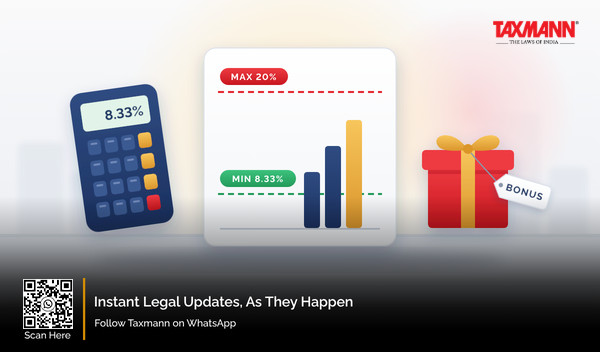
Table of Contents
- What is statutory bonus under the Code on Wages?
- Who is eligible for statutory bonus?
- What wage ceiling should payroll use for bonus eligibility?
- How does statutory bonus calculation work, step by step?
- What is the bonus calculation formula, and which wage base applies?
- How do joining, leaving and leave change the bonus?
- When can bonus be denied or reduced for misconduct?
- What are the minimum and maximum bonus rates?
- Can festival bonus, interim bonus, incentives or gift vouchers be adjusted?
- When must statutory bonus be paid, and what if it is not?
- Quick answers
1. What is statutory bonus under the Code on Wages?
It is the bonus payable under Chapter IV of the Code on Wages, 2019, and where the establishment is covered and the employee is eligible, the minimum bonus is a legal obligation rather than a goodwill payment (para 10.3). The Code consolidates four earlier central laws, one of them the Payment of Bonus Act, 1965, and section 69 repeals them. Bonus is now governed mainly by sections 26 to 41, with section 26 as the main provision.
Each function reads the word differently. HR usually thinks of bonus as an employee benefit, payroll as a payout and finance as a provision based on profitability, while employees often treat it as a right, especially where it has been paid in earlier years (para 27.1). The book’s diagnosis is that most bonus errors arise because bonus is treated only as a festival or year-end payment, when it is actually a statutory computation (para 27.40).
2. Who is eligible for statutory bonus?
An employee who draws wages not exceeding the amount notified by the appropriate Government and who has put in at least thirty days of work in the accounting year. The book reads section 26(1) as three conditions (para 10.6):
| Condition | Practical meaning |
|---|---|
| Employee | The person must be an employee under section 2(k) |
| Wage ceiling | The employee must fall within the wage limit notified by the appropriate Government |
| Minimum service | The employee must have worked at least thirty days in the accounting year |
Section 2(a) defines the accounting year as the year commencing on 1 April. The bonus provisions must also apply to the establishment, and the employee must not be excluded or disqualified under the Code.
Bonus is often missed for eligible employees, the book notes, because HR believes bonus is only for workers or not payable to white-collar employees, the appointment letter does not mention bonus, the employee resigned before the payout date, an annual incentive has been paid or the employer is loss-making (para 28.17). Section 2(k) covers managerial, administrative, technical and clerical work, so a manager is not excluded by designation (paras 10.4 and 10.12). Service establishments should examine applicability, since section 26 refers to rendering services, and minimum wage is not the bonus eligibility ceiling (paras 10.5 and 10.36).
An employee above the notified limit may not be statutorily eligible, although the employer may still pay a contractual, performance or discretionary bonus under its policy. Payroll should keep statutory bonus eligible employees and other bonus recipients as separate categories (para 10.7). Section 41 excludes specified categories, such as employees of the Life Insurance Corporation of India and of universities and educational institutions, but the book warns employers not to create their own exemption merely because the organisation is charitable, educational or service-oriented (para 10.29).
3. What wage ceiling should payroll use for bonus eligibility?
The amount notified by the appropriate Government for the establishment, read from the notification itself. The wage ceiling should not be assumed from old law or old payroll practice, and old figures should not be hard-coded in payroll without verifying current notifications (paras 10.6 and 10.8).
Two amounts are involved. Section 26(1) uses the notified wage amount for eligibility. Section 26(2) provides that where wages exceed the amount determined by notification, bonus is calculated as if the wage were that amount or the minimum wage fixed by the appropriate Government, whichever is higher (para 10.8). The book’s thirty worked examples use simplified assumptions, including both amounts (para 27.4):
| Item | Treatment in the book’s bonus examples |
|---|---|
| Accounting year | 1 April to 31 March |
| Notified eligibility wage ceiling | Assumed at Rs. 21,000 per month for illustration; the actual notification must be checked |
| Notified computation amount | Assumed at Rs. 21,000 per month for illustration; the actual notification must be checked |
| Minimum wage | Assumed at Rs. 18,200 per month unless an example states otherwise |
| Minimum bonus rate | 8.33% |
| Maximum bonus rate | 20% |
| Eligibility condition | At least 30 days worked in the accounting year |
| Payment mode | Bank credit |
| Annual performance incentive | Treated separately from statutory bonus |
| TDS and tax treatment | Not computed in detail |
The Rs. 21,000 and Rs. 18,200 figures are the book’s working assumptions for its examples only. The actual wage ceiling and computation amount must be checked from the applicable Government notification, and where the notified computation amount and the applicable minimum wage differ, the computation should follow the Code and the notification.
Crossing the ceiling mid-year needs legal and payroll review. In Example 27, wages rise from Rs. 19,000 to Rs. 23,000 a month in October, against an assumed ceiling of Rs. 21,000 (para 27.32). The book says possible approaches may differ with the notification and legal interpretation, and suggests an employee-wise review for the full accounting year with the basis documented, rather than automatic exclusion or inclusion. The legal question behind such a review can be put to Taxmann AI, a legal research and drafting assistant that answers questions against the law.
4. How does statutory bonus calculation work, step by step?
Statutory bonus calculation should follow a sequence that starts with coverage and eligibility and ends with records and bank proof. Para 27.5 lists fourteen questions for payroll to answer, in this order, before computing bonus:
| Step | Question |
|---|---|
| 1 | Is the establishment covered by bonus provisions? |
| 2 | What is the accounting year? |
| 3 | What is the notified wage ceiling for eligibility? |
| 4 | What is the employee’s wage for eligibility? |
| 5 | Has the employee worked at least 30 days in the accounting year? |
| 6 | Are deemed working days included? |
| 7 | Is the employee disqualified for statutory reasons? |
| 8 | What is the wage base for bonus calculation? |
| 9 | Is only minimum bonus payable, or higher bonus based on allocable surplus? |
| 10 | Has any customary, festival or interim bonus already been paid? |
| 11 | Is any financial loss recoverable from bonus under section 38? |
| 12 | What is the final net bonus payable? |
| 13 | Has the payment been made within the prescribed timeline? |
| 14 | Have records and bank proof been preserved? |
The rule behind the table is that bonus computation should not begin with only a percentage; it should begin with eligibility. Steps 3 to 7 decide whether the employee is eligible, and only then do the wage base, rate and adjustments in steps 8 to 12 matter. Chapter 10 sets out a nine-step version of the process, which should begin before year-end and be jointly owned by HR, payroll and finance (para 10.41).
Step 1 needs the exact wording of section 41 and the applicable notifications, and step 3 the wage ceiling notification itself. For that research, Taxmann.com | Premium brings Research, Practice and Learning under one search.
5. What is the bonus calculation formula, and which wage base applies?
Bonus is the bonus calculation wage for the accounting year multiplied by the rate, with a floor of 8.33 per cent of wages earned or Rs. 100, whichever is higher. Section 26(1) makes the minimum payable whether or not the employer has any allocable surplus during the previous accounting year, subject to the provisions of the Code (para 10.9). For payroll, the book names the wrong wage base as the key risk in statutory bonus calculation (para 27.45), and its first three examples show the three positions, each for a full year at the minimum rate:
| Example | Monthly wage in the example | Bonus calculation wage per month | Annual wage for bonus | Minimum bonus at 8.33% |
|---|---|---|---|---|
| Example 1, office assistant (para 27.6) | Rs. 18,000 | Rs. 18,000 | Rs. 2,16,000 | Rs. 17,993 |
| Example 2, senior cashier (para 27.7) | Rs. 25,000 | Rs. 21,000, the assumed notified computation amount | Rs. 2,52,000 | Rs. 20,992 |
| Example 3, skilled machine operator (para 27.8) | Rs. 24,000 | Rs. 23,400, the assumed minimum wage for the category, being higher than the assumed Rs. 21,000 computation amount | Rs. 2,80,800 | Rs. 23,391 |
Payroll should not blindly calculate bonus on an actual wage that exceeds the notified computation amount, and where the applicable minimum wage is higher, the higher base applies (paras 27.7 and 27.8). The book shows rounded figures, such as Rs. 18,000 for Rs. 17,993, as payable only if company policy permits rounding. The Example 2 employee earns more than the assumed Rs. 21,000 eligibility ceiling, and the book expressly assumes, for illustration, that the employee is still within the eligibility framework based on the applicable notification or a transitional interpretation, and says the actual notification must be checked.
Comparing CTC instead of wages is a common mistake (para 27.40); how section 2(y) defines wages is covered in definition of wages and the 50% rule.

6. How do joining, leaving and leave change the bonus?
Bonus follows the wages earned in the accounting year, so a part-year employee who meets the thirty-day and other eligibility conditions is paid on those wages, paid leave counts as days worked and unpaid leave reduces the wages earned. Section 28 deems certain days to be days worked, including days laid off under an agreement or as permitted by standing orders or applicable law, leave with salary or wages, absence due to temporary disablement caused by an accident arising out of and in the course of employment, and maternity leave with salary or wages (para 10.17). Under section 27, where an employee has not worked for all the working days, the minimum bonus, if higher than 8.33 per cent of the wages of the days worked, is proportionately reduced (para 10.18).
| Example | Facts | Wages earned in the year | Book’s result at 8.33% |
|---|---|---|---|
| Example 4 (para 27.9) | Temporary sales assistant, Rs. 18,000 a month, worked 24 days | Not computed | Not eligible: fewer than 30 days worked |
| Example 5 (para 27.10) | Joined on 1 October, Rs. 18,000 a month, 6 months worked | Rs. 1,08,000 | Rs. 8,996 |
| Example 6 (para 27.11) | Resigned on 31 December, Rs. 18,000 a month, 9 months worked | Rs. 1,62,000 | Rs. 13,495 |
| Example 21 (para 27.26) | Resigned on 31 August, Rs. 18,000 a month, 5 months worked | Rs. 90,000 | Rs. 7,497 |
| Example 22 (para 27.27) | Fixed-term employee engaged for 10 months, Rs. 20,000 a month | Rs. 2,00,000 | Rs. 16,660 |
| Example 7 (para 27.12) | Rs. 20,000 a month, 250 days worked physically and 20 days of paid leave | Rs. 2,40,000 | Rs. 19,992 |
| Example 8 (para 27.13) | Rs. 18,000 a month, 5 months worked, 6 months of maternity leave with wages, 1 month worked after return | Rs. 2,16,000 | Rs. 17,993 |
| Example 9 (para 27.14) | Rs. 20,000 a month, 60 days of unpaid leave | Rs. 2,00,000 | Rs. 16,660 |
The employee in Example 4 still belongs in the eligibility report, marked “not eligible due to less than 30 days”. The book calls excluding maternity leave cases from the bonus working “a serious HR error”. A resigned employee may still be eligible if the wage ceiling and thirty-day conditions are met and the employee is not disqualified, so bonus should not be prepared only from the active employee list as on 31 March or on the payout date (paras 27.11 and 27.26). Fixed-term employees are direct employees and belong in the working if they satisfy the conditions.
Where the full and final settlement closes first, the statement may show “statutory bonus, if eligible, payable as per statutory timeline”, and the payroll system should keep resigned employees active for bonus reporting (para 27.31). Para 17.15 adds a resigned employee bonus tracker. The exit side is covered in full and final settlement under the Code on Wages.
7. When can bonus be denied or reduced for misconduct?
Only in the cases the Code specifies: disqualification under section 29 and deduction of a misconduct loss under section 38. Section 29 disqualifies an employee dismissed from service for fraud, riotous or violent behaviour on the premises, theft, misappropriation or sabotage of establishment property, or conviction for sexual harassment (para 27.28). Mere allegation is not enough, and HR should preserve the domestic enquiry record, dismissal order and finding (para 10.19).
| Example | Facts | Book’s conclusion |
|---|---|---|
| Example 23 (para 27.28) | Dismissed for theft of company property after domestic enquiry and final order | Disqualified under section 29, subject to legal review; domestic enquiry and dismissal order required on record |
| Example 24 (para 27.29) | Terminated for business restructuring, no misconduct, 8 months worked at Rs. 18,000 a month | Not disqualified; minimum bonus of Rs. 11,995 on wages earned of Rs. 1,44,000 |
| Example 25 (para 27.30) | Guilty of misconduct causing financial loss of Rs. 8,000; statutory bonus payable Rs. 18,000 | Loss recoverable from bonus under section 38; net bonus payable Rs. 10,000 |
Termination by itself does not disqualify, so retrenchment, resignation and normal termination should still be reviewed for bonus eligibility (para 27.29). Section 38 is not a general recovery route either: the loss must arise from misconduct, the employee must be found guilty, and the deduction is limited to the bonus payable for that accounting year, so any balance may need a separate recovery process (para 10.25).
8. What are the minimum and maximum bonus rates?
The minimum is 8.33 per cent of wages earned or Rs. 100, whichever is higher, and the maximum is 20 per cent. Under section 26(3), where allocable surplus exceeds the minimum bonus payable, bonus is paid in proportion to wages earned during the accounting year, subject to that 20 per cent maximum (para 10.10). Section 31 requires bonus to be paid out of allocable surplus, which is 60 per cent of available surplus for a banking company and 67 per cent for other establishments (para 10.21). The finance working is covered in bonus, allocable surplus and set-on. Annexure 7 of the book shows how the result becomes a rate:
| Particular (Annexure 7 sample computation) | Amount |
|---|---|
| Bonus wage base of eligible employees | Rs. 2,00,00,000 |
| Minimum bonus at 8.33% | Rs. 16,66,000 |
| Maximum bonus at 20% | Rs. 40,00,000 |
| Allocable surplus | Rs. 30,00,000 |
| Bonus rate possible | 15% |
| Bonus payable | Rs. 30,00,000 |
Where the employer declares a rate above 8.33 per cent, it should be applied consistently to all eligible employees, unless there is a lawful and documented basis for different treatment (paras 27.16 and 27.34). At 20 per cent, bonus calculation wages of Rs. 2,52,000 give Rs. 50,400, and any additional payment should be separately classified as ex gratia, incentive or other benefit, based on facts and policy (para 27.17). A productivity bonus determined by agreement or settlement under section 26(5) sits inside the same cap (paras 10.15 and 27.35).
A loss does not automatically remove the minimum. In Example 13, with no allocable surplus, the store assistant is still owed Rs. 17,993, because loss by itself is not a reason to omit minimum bonus, except where the special provisions for new establishments apply (para 27.18). Allocable surplus above the maximum bonus may be carried forward as set-on, subject to the limits and period prescribed. Where allocable surplus falls short of the minimum, the minimum is still payable, subject to the Code, and the deficiency may be carried forward as set-off in the manner prescribed (paras 27.20 and 27.21).
New establishments have their own rule. In the first five accounting years following the year in which the employer first sells goods or renders services, bonus is payable only for a year in which the employer derives profit from the establishment, without applying section 36 on set-on and set-off. Rules 22 and 23 of the Wages (Central) Rules, 2026 set out the set-on and set-off calculation for the sixth and seventh accounting years (para 10.16). The book warns against assuming that every young business is automatically exempt (para 27.19).
9. Can festival bonus, interim bonus, incentives or gift vouchers be adjusted?
Festival, puja and interim bonus can be adjusted under section 37 where the records support it, but a performance incentive or a gift voucher does not replace statutory bonus by default. Section 37 permits adjustment of puja bonus, other customary bonus, or part of the bonus paid before the date on which bonus becomes payable, against the bonus payable under the Code for that accounting year (para 10.24).
| Payment already made | Treatment against statutory bonus in the book |
|---|---|
| Interim bonus of Rs. 5,000 paid in October, against statutory bonus of Rs. 18,000 | Adjustable under section 37; balance payable Rs. 13,000 (Example 17, para 27.22) |
| Diwali bonus of Rs. 4,000 that the employer intended as advance statutory bonus, against statutory bonus of Rs. 15,000 | Treated as adjustable; balance payable Rs. 11,000. The adjustment is safer where the payment communication clearly stated that the amount was interim or customary bonus adjustable against statutory bonus (Example 18, para 27.23) |
| Diwali amount clearly described as a gift or ex gratia unrelated to statutory bonus | Automatic adjustment may be disputed (para 27.23) |
| Annual performance incentive of Rs. 30,000, with statutory bonus of Rs. 18,000 payable | Statutory bonus remains a separate compliance payment; adjustment only if legally and contractually supportable (Example 19, para 27.24) |
| Gift voucher of Rs. 5,000 given to all employees in the festival season and treated as bonus | Risky; a gift voucher is a gift or welfare benefit, and a festival hamper is a gift (Example 20, para 27.25) |
| Food coupon | Remuneration in kind or benefit review (para 28.18) |
The book’s rule is to adjust only with documentation (para 27.44). An interim payment should be documented and coded properly, and a payment made as performance incentive should not be adjusted automatically unless the terms and records support it (para 27.22). The Additional FAQ dated 16 March 2026 clarifies that annual performance-based incentives do not form part of wages for computation under the Labour Codes, but the book’s point is that this clarification does not remove the employer’s obligation to compute statutory bonus for eligible employees (para 28.16).
The control suggested in para 28.16 is a separate payroll code for each kind of payment: STAT_BONUS for statutory bonus, PERF_INC, SALES_INC and PROD_INC for incentives, FEST_BONUS for festival or customary bonus, EXGRATIA for voluntary payments, and ESOP as an equity record outside payroll.
10. When must statutory bonus be paid, and what if it is not?
Within eight months from the close of the accounting year, by credit to the employee’s bank account, under section 39 of the Code (para 10.26):
| Situation | Time limit under section 39 |
|---|---|
| Accounting year ending 31 March | Normal deadline 30 November, eight months from the close of the year |
| Extension | The appropriate Government or specified authority may extend the period on the employer’s application for sufficient reasons; the total extension cannot exceed two years |
| Dispute pending before an authority | Within one month from the date the award becomes enforceable or the settlement comes into operation |
| Dispute about payment at a higher rate | 8.33% of wages earned still payable within eight months from the close of the year |
Cash payment and gift vouchers should be avoided, because bank payment gives better evidence (para 27.38). The bonus computation register in para 27.36 may contain, for each employee, the wage for eligibility and bonus calculation wage, days worked and deemed working days, disqualification status, rate, gross bonus, adjustments, net bonus, payment date and bank transaction ID. Annexure 7 gives a sample bonus working sheet with an eligibility control sheet, and the book’s seventeen internal audit questions are meant to be answered before bonus payment is approved (para 27.41).
Short or late payment can lead to claim and penalty exposure (paras 10.36, 10.37, 10.38 and 10.40):
| Provision | Effect, as the book describes it |
|---|---|
| Section 45 | Employees may file claims, and the authority may order payment of the claim amount and compensation |
| Rule 49 of the Central Rules (Central sphere) | Form II for claim applications, which includes a claim that employees have not been paid minimum bonus for the accounting year |
| Section 54 | Where an employer pays an employee less than the amount due under the Code, a fine that may extend to Rs. 50,000; for a repeat similar offence within five years, imprisonment up to three months, or a fine up to Rs. 1,00,000, or both, may apply |
| Section 49 and rule 50 (Form III) | An employer’s appeal against an order under section 45 is not admitted unless the claim amount is deposited with the appellate authority at the time of filing |
11. Quick answers
What is statutory bonus?
Statutory bonus is the bonus payable under Chapter IV of the Code on Wages, 2019. It is different from performance incentive, ex gratia, joining bonus, retention bonus or variable pay, and where the establishment is covered and the employee is eligible, the minimum bonus is a legal obligation.
Who is eligible for statutory bonus under the Code on Wages?
Under section 26(1) of the Code on Wages, 2019, an employee who draws wages not exceeding the amount notified by the appropriate Government and who has worked at least thirty days in the accounting year is eligible, unless excluded or disqualified under the Code. A managerial designation does not by itself exclude an employee.
How is statutory bonus calculated?
Eligibility under the Code on Wages, 2019 should be confirmed first. The bonus calculation wages earned in the accounting year are then multiplied by the bonus rate, which is at least 8.33 per cent and at most 20 per cent. Where wages exceed the notified amount, section 26(2) calculates bonus as if the wage were that amount or the minimum wage, whichever is higher.
What are the minimum and maximum bonus rates under the Code on Wages?
The minimum bonus is 8.33 per cent of wages earned or Rs. 100, whichever is higher, payable whether or not the employer has allocable surplus, subject to the provisions of the Code on Wages, 2019. Where allocable surplus exceeds the minimum bonus, bonus is payable in proportion to wages earned up to a maximum of 20 per cent.
Is a resigned employee eligible for statutory bonus?
A resigned employee may still be eligible for statutory bonus under the Code on Wages, 2019 if the wage ceiling and thirty-day conditions are met and the employee is not disqualified. Bonus is worked out on the wages earned in the accounting year, so resigned employees should stay in the bonus report and, if eligible, be paid within the statutory timeline.
Can a performance incentive or a gift voucher replace statutory bonus?
Not automatically. Annual performance incentive and statutory bonus under the Code on Wages, 2019 are different payments, and an adjustment is possible only if it is legally and contractually supportable. Gift vouchers, coupons and festival hampers should not be casually treated as statutory bonus.
Can festival or interim bonus be adjusted against statutory bonus?
Yes. Section 37 of the Code on Wages, 2019 permits puja bonus, other customary bonus or part of the bonus paid before it becomes payable to be adjusted against the statutory bonus for that accounting year. The adjustment is safer where the payment was communicated and recorded as adjustable against statutory bonus.
This article draws on Chapter 27 of Taxmann’s HR Guide to Code on Wages by CA Venugopal Gella (2026 Edition), which works through thirty bonus computation examples with a fourteen-step computation flow, a bonus computation register, an exception report, seventeen internal audit questions and a model bonus SOP clause, and on Chapter 10 and Annexure 7, which set out the bonus provisions of the Code and a sample bonus working sheet. Law stated as updated till August 2026.
Labour law Acts and Rules, case laws, circulars and notifications are available on Taxmann.com | Research under Labour Laws.
Related reading: bonus, allocable surplus and set-on · definition of wages and the 50% rule.
More in this series: full and final settlement under the Code on Wages · wage slip format under the Code on Wages · new labour code salary structure.
Disclaimer: The content/information published on the website is only for general information of the user and shall not be construed as legal advice. While the Taxmann has exercised reasonable efforts to ensure the veracity of information/content published, Taxmann shall be under no liability in any manner whatsoever for incorrect information, if any.

Taxmann Publications has a dedicated in-house Research & Editorial Team. This team consists of a team of Chartered Accountants, Company Secretaries, and Lawyers. This team works under the guidance and supervision of editor-in-chief Mr Rakesh Bhargava.
The Research and Editorial Team is responsible for developing reliable and accurate content for the readers. The team follows the six-sigma approach to achieve the benchmark of zero error in its publications and research platforms. The team ensures that the following publication guidelines are thoroughly followed while developing the content:
- The statutory material is obtained only from the authorized and reliable sources
- All the latest developments in the judicial and legislative fields are covered
- Prepare the analytical write-ups on current, controversial, and important issues to help the readers to understand the concept and its implications
- Every content published by Taxmann is complete, accurate and lucid
- All evidence-based statements are supported with proper reference to Section, Circular No., Notification No. or citations
- The golden rules of grammar, style and consistency are thoroughly followed
- Font and size that’s easy to read and remain consistent across all imprint and digital publications are applied
Everything on Tax and Corporate Laws of India
To subscribe to our weekly newsletter please log in/register on Taxmann.com









 CA | CS | CMA


