Taxability of Transferable Development Rights (TDR) Under GST
- Blog|GST & Customs|
- 15 Min Read
- By Taxmann
- |
- Last Updated on 15 May, 2026
Latest from Taxmann


Taxability of Transferable Development Rights (TDR) under GST refers to the levy of Goods and Services Tax on the transfer of development rights by a landowner to a developer, typically under a Joint Development Agreement (JDA). Under GST law, such transfer is generally treated as a supply of service, and its taxability depends upon the nature of the project, the date of the agreement, and applicable notifications. Over time, the GST framework has evolved to prescribe different mechanisms for residential, commercial, and plotted developments, including reverse charge liability in specified cases.
Table of Contents
Check out Taxmann's R.K. Jain's GST & Joint Development Agreements authored by CA. (Adv.) Sri Harsha, is a comprehensive, practice-oriented guide dedicated to the GST implications of Joint Development Agreements (JDAs) in India's real estate sector, with the law updated till 15th February 2026. Built on a proprietary T1–T4 transaction framework, the book systematically covers every taxable aspect of a JDA—such as the supply of Transferable Development Rights (TDRs), construction services between landowner and developer, and sale of flats, units, or plots to end customers—examining each transaction across three dimensions: taxability, value & rate, and time of supply. It offers separate, chapter-wise treatment for residential, commercial, and plotted development projects, enriched with practical case studies, worked-out numerical illustrations, input tax credit analyses, and references to landmark Supreme Court, High Court, and CESTAT rulings, along with key Notifications and Board Circulars. Tracing the complete legislative evolution—from the pre-GST Service Tax regime through the GST rollout (1st July 2017) to the rate restructuring (1st April 2019)—the book also addresses transitional issues for legacy JDAs, including the applicability of Section 142(11)(b) and (c) of the CGST Act.
1. Transferable Development Rights
There is a huge difference between TDR normally understood and in the GST context. The usage of expression ‘Transferable Development Right’ in the GST laws also increases the confusion, because, the same has a different understanding in the developer community. It is essential to understand the basic difference of said expression in the normal context and under GST laws.
1.1 TDRs Generally
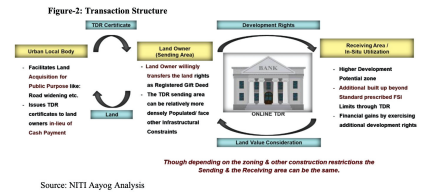
The normal TDR is generally given in form of a TDR Certificate/Development Right Certificate (DRC) to any person to compensate the land acquired by the Government for the public purpose. Generally, the surrendering land owner would be given a TDR Certificate/DRC which entitles him to construct in a receiving zone, additionally other than what he is permitted to build. The TDR Certificate/DRC can either be used by the developer or sell to another person, thereby realising the value of land which was taken over by the Government. The general structure of normal TDR can be understood from the following picture:
1.2 TDRs in GST
- However, under the GST laws, the usage of expression ‘transferable development right’ is completely different. The said expression has not been defined and it is to be understood that it includes the normal TDR as explained above along with the parting of development rights to the developer for construction of a project. In a typical JDA, there would only be transfer of development rights to the developer and the Government does not have any role as it would have in normal TDRs. Hence, this usage of same expression in GST laws heightens the confusion.
- The normal TDRs can be undoubtedly stated that, the same are a benefit arising out of land, because the land owner is entitled for such TDR Certificate/DRC because he owns the land in first place and the same was taken over by the Government for a public purpose and compensated by allotment of the TDR Certificate/DRC, making it a benefit arising from the land. However, how far, the same analogy can be used under the indirect taxation is a question that has to be answered by the courts in coming times.
- With the above aspects in place, let us proceed to understand the evolution of the tax under indirect taxation on such TDRs.
2. Applicability of Relevant Law
- First things First, the taxation of TDRs would primarily depend upon the time when they have been entered. If the JDA is signed prior to 1st July 2017, then the law prevailing prior to 1st July 2017 would be applicable. If the JDA is entered prior to 31st March 2018, then the law prevailing between 1st July 2017 to 31st March 2018 would be applicable. On similar lines, if the JDA is entered post 1st April 2019, then the law prevailing, post 1st April 2019 would be applicable. Hence, what assumes significance is the date of signing of JDA. The execution of supplementary agreement does not have any relevance for the applicability of tax on the TDRs. For example, a JDA would have been signed on 30th March 2019, then the law applicable till 31st March 2019, would be applicable and the amendments made with effective from 1st April 2019 would not be applicable qua such JDA dehors of the fact that supplementary agreement is entered post 1st April 2019.
- Hence, the primary goal in understanding the taxability of TDRs lies in understanding as to when the signing of JDA has taken place. Once the same is frozen, then the law prevailing at that point of time would be applicable, which includes the notifications, circulars or others, if any. One may apply the rationale of circulars/notifications prevailing at different point of time when compared to the JDAs in hand as per their convenience, but how far the courts would take them into consideration is doubtful. In this section, we shall understand the taxation of TDRs which are signed after 1st July 2017 and 1st April 2019. The significance of above dates will be evident from the discussion on evolution of taxability of TDRs as below.
3. Evolution of Tax on TDRs
- As discussed in the overall architecture at the beginning of this book, the first leg of the transaction in a JDA involves the land owner transferring the development right (involved in the land) in favour of the developer. The developer on receipt of such right, normally, initiates the process of obtaining the permission from the local authority. The taxation of TDRs is a quite interesting one because it has popped out from nowhere suddenly into the tax ambit. When the Board’s Circular 151 (Circular No. 151/2/2012-ST dated 10th February, 2012) was issued in 2012, dealing with various issues pertaining to real estate, this particular transaction has not surfaced. Only in 2018, after introduction of GST laws in the country, through another Notification, the time of supply for this transaction is provided, subtly stating that this particular transaction of transferring development rights to developer is also subjected to tax. Hence, this particular transaction has quite a mysterious entry into the tax arena.
- It was learned that the taxation of services provided among the land owner and the developer has an origin traced to the decision of Supreme Court in the case of Faqir Chand Gulati v. Uppal Agencies1. While dealing with a question under the Consumer Protection Act, 1986, the Court has held that the land owner can be called as ‘consumer’ and the developer as ‘service provider’. This would be a possible trigger to the proposal of taxation of services provided by the developer to the land owner and which has eventually lead to the taxation of the subject service, that is transfer of development rights to the developer.
- Before proceeding to the taxability of the TDRs in the GST laws it would be relevant to understand, the taxation of the said transaction prior to the introduction of GST laws in the country. The study should start from the advent of negative list of taxation because, prior to that, there was no separate entry providing for taxation of transferable development rights to the developer. Since, the negative list was introduced from 1st July 2012, the study of taxation from said date to till date would provide a holistic approach. Hence, we break the periods into different time zones between 1st July 2012 to 1st April 2019, whenever the law took a turn.
3.1 From 1st July 2012
- The concept of negative list was introduced vide the Finance Act, 1994. For the first time, the definition of ‘service’ was provided in the Act. Once an activity or transaction falls under the definition of ‘service’ and does not find entry in the negative list or exemption notification, the same would be subjected to tax. This change in the way the services were taxed has completely brought out various earlier unlisted services into the tax ambit. One such particular transaction is the transfer of development rights by the land owner.
- However, this was not free from ambiguity. There were lacunas in the legislatures everywhere making it tough for the tax authorities to put tax on this particular transaction. The first lacuna appeared in the form of definition of ‘service’. The said expression was defined vide section 65B(44) of Finance Act, 1994. Among others, it had an exclusion part, which stated that an activity which constitutes merely a transfer of title in immovable property, by way of sale, gift or any other manner would not fall under the ambit of ‘service’.
- The irony is that the Finance Act, 1994 has not defined the expression ‘immovable property’. This has left the tax payers and tax authorities at loggerheads. The tax authorities would argue that the plain transfer of immovable property is what is covered under the exclusion and transactions like the transfer of development rights would not be covered under the exclusion, thereby becoming taxable. On the other hand, the tax payers would argue that the expression ‘immovable property’ has to be understood from the General Clauses Act, 1897 (in absence of definition under the Finance Act, 1994), wherein the ‘immovable property’ vide section 3(26) includes the benefits arising out of land and since the TDRs are benefit arising out of land, it was stated that the transaction of transfer of development right falls under the exclusion to the definition of ‘service’ and accordingly stays out of the tax net.
- The second lacuna is more a subtle one. Just prior to few months of introduction of negative list, the Board has released a circular in 151 dealing with service tax on construction services. Among the various issues that it has tried to clarify, one was dealing with services between land owner and developer. Though the circular clarified taxability on the services provided by developer to the land owner, it had not even made a whisper about the taxation of services provided by land owner to developer. This would prove that there was never an intention to bring that particular transaction into tax net.
- Further, there are no direct judgments dealing with the taxation of TDRs for the subject period. A question has come up before the CESTAT Chandigarh in the matter of DLF Commercial Projects Corporation2. In the said matter, the facts were that DLF Limited, which was engaged in business of real estate development of integrated township and construction, has entered an agreement with DLF Commercial Projects Corporation, wherein the latter is appointed to purchase the land on their behalf and thereafter obtain certain permissions from various government departments and to handover the land to the former. Post obtaining such permissions and handover to DLF Limited, there would be a tri-partite agreement among the Land Owning Companies (LOC), the prospective buyers and DLF Limited. The authorities tried to tax DLF Commercial Projects Corporation on the amounts received from the DLF Limited stating that such amounts were received for transfer of development rights.
- The DLF Commercial Projects Corporation argued that they have not transferred any development rights to DLF Limited. All they have done is to pay amounts to LOCs for acquiring the lands and post obtaining approvals from appropriate authorities, handing over the same to DLF Limited for development. When the DLF Limited developed the properties, the LOCs were also made parties to the contract with the prospective buyers. The Tribunal stated that when the LOCs transfer development rights to the developers, the developers gets the right to not only to develop project on such land but also the right to sell such developed property along with undivided interest in the land underneath and to receive payments for such transfers from the buyers, to mean that what was transferred by LOCs is effectively the land itself. Since the DLF Commercial Projects Corporation has never owned the land (since LOCs continued to be the land owners even after acquisition of land), they would not have any rights to transfer to DLF Limited and accordingly the matter was set aside. The Tribunal has made an observation that there was nothing on record that the LOCs have transferred development rights to DLF Commercial Projects Corporation and if so, why are the land owners not issued show cause notice to bring them into tax net. The order of CESTAT was challenged before the Supreme Court in Commissioner of Service Tax, Gurugram v. DLF Commercial Projects Corporation3 and currently pending for hearing.
- From the facts of the matter before CESTAT Chandigarh in DLF Commercial Projects Corporation (supra), it is evident that the tax authorities have proceeded on a wrong foot without completely understanding the facts of the matter. Ideally, the tax has to be demanded on the LOCs, since they were actually transferring the development rights to DLF Limited. The reading of Tribunal that said transfer is akin to the sale of immovable property is a different story, but the tax was demanded from wrong person, taking the issue completely in different direction. Hence, the above judgment cannot be used for exposition of the law.
- However, in the same judgment, the Tribunal has referred to Chedda Housing Development Corporation v. Bibijan Shaik Farid4, Shadoday Builders Private Limited and Ors. v. Jt. Charity Commissioner and Ors5 and Bahadur and Others v. Sikandar and Others6 to hold that TDRs are benefit arising from the land to fall under the exclusion of the definition of service.
- Hence, the land owners who have parted with the development rights between 1st July 2012 to 30th June 2017 would have a strong case to be out of tax net. However, the tax authorities might try to squeeze tax by placing the above arguments, discussed earlier. The dispute has to be finally settled by the tribunals or courts. However, we believe that the taxpayer has a fair chance to win.
3.2 From 1st July 2017
- The tax landscape have completely undergone a change from 1st July 2017. By the time, tax payers got accustomed to change to the negative list from the positive list, the entire country was forced to take part in the historical tax change on indirect tax front in form of GST laws. The implementation of GST laws in a vast country like India has its own challenges and the taxpayers have seen the implementation of GST laws as a full length movie as compared to the negative list, which was just a teaser.
- Amidst the various challenges in implementation of the GST laws in the country, there was a Notification in 4/2018–CT (R) dated 25th January 2018, wherein it was stated that the time of supply for the registered persons who supply development rights to a developer, builder, construction company or any other registered person against consideration, wholly or partly, in the form of construction service of complex, building or civil structure, to be at the time when the said developer, builder, construction company or any other registered person, as the case may be, transfers possession or the rights in constructed complex, building or civil structure, to the person supplying the development rights by entering into a conveyance deed or similar instrument.
- By virtue of the above notification, the intention of the executive has for the first time, came to foreground. Till the issuance of above notification, the possibility of taxation of transfer of development rights was merely an academic postulation or at best a hypothetical situation. However, the notification busted out all the assumptions revolving around the taxation of the said transaction.
- The larger question, whether the said taxability has a blessing from the legislature is not evident. However, the tax authorities would argue that, since all activities and transactions would be subjected to tax unless they are specified either in Schedule III to the Central GST Act or expressly provided under exemption, and transfer of development rights finds no mention in both the places, it continues to be taxable and tax is to be paid in accordance with the point of time stipulated by Notification No. 4/2018 (supra).
- The defence available to the taxpayer appears to be bit narrow under the GST laws when compared to the position under the negative list. As discussed earlier, under the negative list, the argument that the tax payer had was the TDRs are equivalent to benefit arising from land and hence qualifies to be immovable property to be out of definition of ‘service’, would not come to rescue under GST laws for the reasons discussed below.
- Under the GST laws, the scheme of taxation is bit different when compared to the position that existed under the negative list. Once an activity or transaction falls under the ambit of ‘supply’ as laid out in Section 7(1) of Central GST Act, then, it shall be either supply of goods or supply of services or both as stated in Section 7(1A) read with Schedule II of Central GST Act. However, Section 7(2) carves out certain transactions or activities as neither supply of goods nor supply of services. One of the set of such transactions or activities are those mentioned in Schedule III. The other set of transactions or activities are such undertaken by Central Government, State Government, or any local authority in which they are engaged as public authorities, as may be notified by the Government.
- Hence, the broad scheme is that, in order to bring tax on a transaction or activity under the GST laws, primarily, said transaction or activity should qualify as ‘supply’ as per Section 7(1) and either supply of goods or services or both as per Section 7(1A) and should not fall under the exception carved out in Schedule III. There may be situations, where, there would not be any tax, dehors the fact that transaction or activity after satisfying the provisions of Section 7(1) and 7(1A), if such supplies fall under the exemption notifications issued under Section 11 of Central GST Act. Hence, in order to be not taxable under the GST laws, the transaction or activity should be either specified in Schedule III or services provided by Central/State Government or local authorities as notified by Government or such supplies covered by exemption.
- The one that is relevant to our current discussion finds its place under Schedule III. Entry 5 of Schedule III states that sale of land and, subject to Paragraph 5(b) of Schedule II, sale of building as an activity or transaction which shall be treated neither as a supply of goods nor supply of services. Hence, the activity or transaction of sale of land is covered under the Schedule III and any person engaged in sale simplicitor of land, then there would not be any tax on that particular transaction. Can taxpayer argue that transfer of development rights is akin to sale of land and claim shelter under Entry 5? We believe that such a view is not possible. The defence that was available to the taxpayer under the negative list is now not available, because of the usage of expression ‘land’ (under Schedule III in GST laws) as compared to ‘immovable property’ (in the negative list by way of exclusion to the definition of ‘service’). Hence, the entire argument of taking shelter from the General Clauses Act, 1897 to include the development rights as also immovable property is no longer available. Hence, on this count, it would be not possible for the tax payer to frame his arguments.
- The constitutional validity of Notification No. 4/2018 (supra) has been challenged before the Bombay High Court in Nirman Estate Developers Private Limited v. Union of India and Others7. The outcome of this judgment would also decide the taxation of TDRs under the post GST regime. The main contention of the petitioner in the above matter was that, the said Notification was trying to tax a particular transaction which is neither a supply of goods or services, which is the transfer of development rights. The said matter is yet to be heard by the time of rollout of this edition.
- So, till the matter is finally settled by the Courts, the question of taxability still persists, paving way for unnecessary litigations. Matters like this, in the majority of the cases, would be revenue neutral, since the developer would be eligible to take credit, if tax is charged by the land owner at the appropriate time. Lack of proper planning would lead land owners to situation like this and fate of the tax is left on the outcome of judgments by the Court.
3.3 From 1st April 2019
- With effective from 1st April 2019, there was a twist to the story, making it more interesting. The Government has brought in a new modus operandi for taxing this particular service. It appears that by taking clue from the decision of CESTAT Hyderabad in the matter of Vasantha Green Projects8, the Government has made amendments altering the tax positions for JDAs entered post 1st April 2019 (including the said date). The particular service was exempted in the hands of land owner subject to a condition that developer sells his entire share of carpet area prior to occupation/completion certificate or first occupation, as the case may be. The detailed architecture of the scheme and respective tax liabilities are detailed in a separate chapter.
- If at all there is a liability to pay tax on the supply of TDRs by land owner, for the reason, that the developer failed to sell his share of carpet area before the occupation/completion certificate or first occupation, as the case may be, then the developer is liable to pay tax under reverse charge mechanism (for more on this, please refer infra). Hence, with effective from 1st April 2019, the taxation on the TDRs have completely undergone a change.
- However, the above exemption is applicable only for residential projects (may not be for plots, for more on this, please refer infra). The commercial projects continue to be in the same position as it existed between 1st July 2017 to 31st March 2019, which would be detailed at more appropriate place (for more on this, please refer infra).
- From the above paragraphs, it is evident that the taxation of transfer of development rights was evolved over a period of time and not something which was abundantly clear from the day one. To be honest, the taxation is not free from ambiguity even today. The majority of the issues have been suppressed because of providing exemption to certain class of land owners. If the same was effective today, the real issue of taxability would be a major aspect for discussion.
4. Snapshot
Table Showing Tax Position and Obligation to Pay Tax on Supply of TDRs
| Period | Services Involved | Chances for Taxation | Obligation to Pay |
| From 1st July 2012 | Supply of TDRs | Low | Land Owner |
| From 1st July 2017 | Supply of TDRs | High | Land Owner |
| From 1st April 2019 | Supply of TDRs – Residential | High/Certain | Developer under Reverse Charge |
| From 1st April 2019 | Supply of TDRs – Plots | High/Certain | Land Owner |
| From 1st April 2019 | Supply of TDRs – Commercial | High/Certain | Land Owner |
Table Showing the Guiding Legislation for the Supply of TDRs
| Period | Services Involved | Valuation | Time of Supply |
| From 1st July 2012 | Supply of TDRs | No Prescription | No Prescription |
| From 1st July 2017 | Supply of TDRs | No Prescription | Notification No. 4/2018–CT (R) |
| From 1st April 2019 | Supply of TDRs – Residential | Notification No. 12/2017–CT (R) | Notification No. 6/2019–CT (R) |
| From 1st April 2019 | Supply of TDRs – Plots | No Prescription | No Prescription |
| From 1st April 2019 | Supply of TDRs – Commercial | No Prescription | Notification No. 6/2019–CT (R) |
- [2008] 15 STT 296 (SC)
- [2019] 105 taxmann.com 344 (Chd. – CESTAT)
- Civil Appeal Dairy No. 33820 of 2019, dated 7-11-2019 (SC) – SC Order
- 2007 (3) Mh.L.J 402
- 2011 SCC OnLine Bom 760 Writ Petition No. 4543 of 2010, dated 23-6-2011 (Bom. – HC)
- 1905 (1) TMI (1) – Allahabad High Court
- [2019] 101 taxmann.com 194 (Bom. – HC)
- [2018] 95 taxmann.com 317 (Hyd. – CESTAT).
Disclaimer: The content/information published on the website is only for general information of the user and shall not be construed as legal advice. While the Taxmann has exercised reasonable efforts to ensure the veracity of information/content published, Taxmann shall be under no liability in any manner whatsoever for incorrect information, if any.

Taxmann Publications has a dedicated in-house Research & Editorial Team. This team consists of a team of Chartered Accountants, Company Secretaries, and Lawyers. This team works under the guidance and supervision of editor-in-chief Mr Rakesh Bhargava.
The Research and Editorial Team is responsible for developing reliable and accurate content for the readers. The team follows the six-sigma approach to achieve the benchmark of zero error in its publications and research platforms. The team ensures that the following publication guidelines are thoroughly followed while developing the content:
- The statutory material is obtained only from the authorized and reliable sources
- All the latest developments in the judicial and legislative fields are covered
- Prepare the analytical write-ups on current, controversial, and important issues to help the readers to understand the concept and its implications
- Every content published by Taxmann is complete, accurate and lucid
- All evidence-based statements are supported with proper reference to Section, Circular No., Notification No. or citations
- The golden rules of grammar, style and consistency are thoroughly followed
- Font and size that’s easy to read and remain consistent across all imprint and digital publications are applied
Everything on Tax and Corporate Laws of India
To subscribe to our weekly newsletter please log in/register on Taxmann.com








 CA | CS | CMA


