No Estoppel Against Statute in India—Key Supreme Court Rulings
- Blog|Income Tax|
- 13 Min Read
- By Taxmann
- |
- Last Updated on 15 May, 2026
Latest from Taxmann


No Estoppel Against Statute is a legal principle under Indian law which means that no person, authority, or government can rely on the doctrine of estoppel or promissory estoppel to enforce a promise, representation, or conduct that is contrary to a statutory provision or prohibited by law. In other words, equity cannot override legislation, and neither the State nor an individual can be prevented from enforcing or complying with a statute on the ground of an earlier promise, assurance, or representation. The principle is based on the supremacy of law and has been consistently upheld by Indian courts, including the Supreme Court, in matters involving constitutional and statutory compliance.
Table of Contents
- Prologue
- Why does No Estoppel Lie Against the Statute?
- Evolution of the Law
- Development of the Law in India
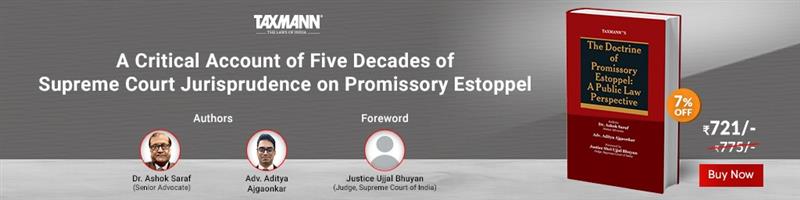
Check out Taxmann's The Doctrine of Promissory Estoppel: A Public Law Perspective authored by Dr Ashok Saraf (Senior Advocate) and Adv. Aditya Ajgaonkar, is the first dedicated public law treatise on one of Indian jurisprudence's most litigated yet least systematically examined doctrines. Moving decisively away from the conventional treatment of promissory estoppel as a contract law appendage, the work positions it as a mature principle of administrative and constitutional accountability—one that has been shaped, tested, and refined through landmark Supreme Court rulings from Indo-Afghan Agencies to Motilal Padampat, and applied across taxation, land reform, governmental incentives, and political promises. Across ten rigorously structured chapters, the book maps the doctrine's intellectual lineage from English equity, analyses its cardinal limitations, and delivers a nuanced comparative treatment of promissory estoppel and legitimate expectation that clarifies where each doctrine offers a stronger remedy against the State. The final chapter stands apart for its rare candour—raising pointed questions about judicial inconsistency, doctrinal conflation, and the pressing need for certainty in Indian public law.
“It is now well known, the rule of estoppel has no application where contention as regards a constitutional provision or a statute is raised. The right of the State to raise a question as regards its actions being invalid under the constitutional scheme of India is now well recognised. If by reason of a constitutional provision, its action cannot be supported or the State intends to withdraw or modify a policy decision, no exception thereto can be taken. It is, however, one thing to say that such an action is required to be judged having regard to the fundamental rights of a citizen but it is another thing to say that by applying the rule of estoppel, the State would not be permitted to raise the said question at all”.1
1. Prologue
Whatever one may say or opine about the principles of estoppel, especially that of the promissory type, there has been one basic golden rule—the rule that there can be no estoppel against the statute. Despite the obviously different directions that the two judgements went in, this is the one principle that both Motilal Padampat2 and Jit Ram3 agreed on. This principle is fundamental when it comes to invocation of equitable doctrines. This principle has been iterated and reiterated in various Supreme Court judgments and consequently has come to attain much significance. It is our hypothesis that in the Indian context, the roots of this principle, much like everything else, has a constitutional context and justification.
2. But Why does No Estoppel Lie Against the Statute?
In the spirit of inquiry, the most obvious question that may first arise is as to why the doctrine of promissory estoppel does not lend itself to be invoked against statutory provisions. The simplest answer is also the most obvious. This doctrine is of the ‘genus’ of equity. As such it operates in a statutory vacuum. Equity is a great placeholder in the legal process. It ensures that our Court system does not relegate our Courts to being merely Courts of law but also enables them to function as courts of Justice. Unlike in England where the Courts of Chancery were separate from the Common Law Courts, the Indian Courts are a one stop destination for both, law and equity.
Promissory estoppel could not have been and was not applied in a ‘as is where is manner’ in the Indian context by borrowing it from England. The promulgation of our Constitution signifies a conscious break for Indian jurisprudence from the English law though the Constitution was based on the Government of India Act, 1935, and Article 372 of the India Constitution itself provided for “all the law in force in India” to “continue in force” subject of course to the legislative intervention or the Constitution itself. This Article was a ‘grandfathering provision’. It leads to a sense of continuity and bridges the gap between two regimes and laws. It also provided for some certainty in the backdrop of what was a period of seismic change for India.
Speaking in the Constituent Assembly of India, on 25th November 1949, Pandit Balkrishna Sharma stated while defending the draft of the Indian Constitution presented by the drafting committee:
“With regard to the third argument that it is a copy of the Government of India Act and that it is un-Indian, all I can say is that it is to the credit of the Drafting Committee and Dr. Ambedkar and all those who have been associated with him, that they were not inspired by the spirit of narrowness. Here, after all, we are framing a Constitution and the modern tendencies, the modern difficulties, the modern problems that are facing us are there and we have to provide for them all in our Constitution, and if we have leaned on the Government of India Act for that matter, then I do not think that we have at all committed any sin.
As for the criticism that it is un-Indian in spirit, all that I can say is that we Indians have sat here, we have framed a Constitution. The phraseology of course is un-Indian, but then there are so many problems facing us today which are un-Indian in nature and therefore I say even though the phraseology is there even though the English phraseology is there, what of it? Let it be there, but is it un-Indian for that matter? Our difficulties are there in this Constitution and all those problems that we have to solve have been given in this Constitution and a certain line of conduct for the governance of this country has been laid down in the Constitution. Therefore, I say it is not un-Indian.”
The phrase ‘All the law in force in India’ is also wider in context than ‘all the legislation in force in India’. Article 372 would not only ‘grandfather’ the statues that were in force on the eve of India having its own constitution but would also ‘grandfather’ the unwritten conventions that constitute law. These could be in the form of customs, other common law practices or doctrines (in our case promissory estoppel). The Indian Constitution deliberately eschewed change for the sake of change. However, these laws, doctrines and customs in the Indian context now needed to stand up to the test of Indian Constitutional law ‘de hors’ the English Common law that birthed them. This is why the question as to why promissory estoppel would lie against the statute is particularly relevant in the Indian context. While the Parliament in England does legislate, the English law places great emphasis upon customs and practices where specific legislation doesn’t exist. The roots of promissory estoppel in India can be traced back to the law in England, and English common law is heavily based on judicial pronouncements, conventions and customs. The formal concepts of ‘justice, equity and good conscience’ in their western form came to India from the shores of England4. Indian law operates largely through specific enactments and is also largely codified. The legislation represents the will of the Parliament. This in turn purports to represent the will of the people. When a bill is enacted and given the backing of being ‘law’, it is given the sanction of ‘we the people’. The principles of equity must yield to law.
Equity, being a filler of gaps where no statute exists, cannot be invoked in the face of a statute. Though a lot of water may have flowed under the Yamuna since the Supreme Court—which is located very close to its banks—entrenched the doctrine of promissory estoppel in Indian jurisprudence, the fundamental concept is that the doctrine is born out of equity and therefore can only operate in a sphere where no law exists. The doctrine is also based on the concept of fairness. Laws are not judged on fairness but on the touchstone of constitutionality and manifest arbitrariness. It would therefore be strange to hold that there could be estoppel against the operation of a statute. The power of the Parliament in India to make laws in not unfettered. The laws have to adhere to the spirit and the words of the Constitution. We have the longest written Constitution in the world and myriad judgements of the Supreme Court and various High Courts that have given shape and volume to Indian Constitutional law. These have also resulted in robust checks and measures on the powers of the Legislature. Statutes have to be able to stand up to the scrutiny of constitutionalism by the Constitutional Courts. The Indian Parliament, though reflects the will of the people through a majority, is not a supreme body and is subject to checks and balances as prescribed by the Constitution of India. Though the power of legislation of the Parliament cannot be interfered with in any manner, the legislation that is passed by the two Houses and then receives the assent of the President of India must subsequently necessarily withstand the test of constitutionality if such a challenge is made before the Constitutional Courts.
The executive is not the same as the legislature. These are distinct organs of the constitutional scheme. The legislature has the primacy in making laws in the Republic of India. It is the executive that is tasked with the job of implementing these laws. It is therefore moot that a promise made by the executive or a statutory authority cannot override the will of the legislature. An illegal promise is not even enforceable under Indian contract law. It would be preposterous to think that something that is specifically barred by law would be allowed under the umbrella of equity by invoking the contours of promissory estoppel or legitimate expectation.
Infact the Constitution Bench of the Supreme Court in the Ram Janmabhumi case discussed an essential aspect of equity while referring to the work of Duncan Derret and observed that
“The correlation between law and justice was the defining factor in one sense, equity modifies the applicable law or ensures its suitability to address the particular circumstances before a Court to produce justice. The modification of general rules to the circumstances of the case is guided by equity, not in derogation or negation of positive law, but in addition to it. It supplements positive law but does not supplant it. In a second sense, however, where positive law is silent as to the applicable legal principles, equity assumes a primary role as the source of law itself. Equity steps in to fill the gaps that exist in positive law. Thus, where no positive law is discernible, Courts turn to equity as a source of the applicable law.5”
In many ways, promissory estoppel is the great equaliser and is one of the most powerful instruments to enforce equity when other measures fail. However, it does not operate in a vacuum. One of the most persistent questions that has time and again come up for consideration before the courts is whether fairness towards an individual gain primacy over the broader imperatives of governance? Would equity bind the court’s hand when a statute clearly dictates it to go in another direction?
The legislature, the executive, and the judiciary comprise of ‘the three organs of the State’. They offer natural checks and balances against each other. The legislature and the judiciary, however, are the biggest checks upon the executive. It is in the hands of the executive that most of the administrative and policy functions vest. The doctrine of promissory estoppel in the sphere of public law is invoked against administrative and executive actions and has also been sought to be invoked based on a speech of a minister be it in the Parliament or in a public meeting. It is important to note that the same minister, though he may be a member of the legislature, carries out an executive function when not participating in enacting laws on the floor of the Parliament/legislative assembly. The doctrine of promissory estoppel can be claimed against promises made by members of the executive, but the power to legislate vested in the hands of the Parliament is more fundamental. The Parliament does not make promises. It makes the law. The discussions and speeches made by various representatives of the House when the Parliament is in session are not made on behalf of the Parliament. It is the view of the individual, a group of people or a particular political party. The legislature is not the same as the executive. The law making power in the hands of the executive is limited to the power that is delegated by the legislature through enactments or by the issuance of ordinances. These ordinances also lapse if not ratified by the legislature within a prescribed time limit.
The legislature has almost unlimited power to not only make law but also to amend and repeal it. No express limits have been prescribed in the scheme of the Constitution on the power of the legislature. The amending power of the legislature is wide as to contain within it the power to amend the Constitution itself subject to certain restrictions. This gives the legislature primacy within the scheme of the three organs of the State. The legislature may do as it feels fit as it enjoys the mandate of the people in a democracy. This is as it should be in a democracy of the people, by the people and for the people.
A question has time and again been brought before the court – can the government be bound by its promise if doing so contradicts a statute? May a private party claim the benefit of a promise made by the government, even if honoring it would be detrimental to public welfare? The Courts’ answers have been consistent, yet nuanced: No for the former, not always for the latter.
3. Evolution of the Law
As explored in the previous chapters, the doctrine of promissory estoppel in India evolved following its development in English law. First discussed in Central London Property Trust Ltd. v. High Trees House Ltd,6 it was originally intended to operate in the realm of private law. It was further held that promissory estoppel can only be invoked as a defense (a ‘shield’) and cannot give rise to an independent cause of action by itself (a ‘sword’). However, the law evolved differently in India on these fronts.
The doctrine of promissory estoppel in India has time and again been applied against the State and thus in India also operates in the realm of public law. As Justice Bhagwati noted in Motilal Padampat, the doctrine is “an equitable principle evolved by the Courts for doing justice”7 and hence could also operate as a cause of action. The law as it currently stands, holds the State bound by a promise made by it, when the other party has altered their position to their detriment based on such a position. The Courts have not always agreed on how to define the contours of promissory estoppel. However, despite their disagreements, the judges have always been ad idem on the most fundamental limitation on the doctrine of promissory estoppel. It cannot operate in the existence of any statutory provisions. This is not merely a matter of technicality; it is a safeguard to ensure that promises made by the executive or its agents do not supersede democratically enacted laws. A promise made against the law is not an enforceable promise. Giving permission to enforce such promise would lead to chaos. Therefore, the doctrine of promissory estoppel can neither be used as a shield nor as a sword if the promise made is contrary to the law or illegal.
The position of the Indian law which states that promissory estoppel would not apply against the statute has drawn inspiration not only from English jurisprudence but also from works of American jurists. One of the earliest judgements to reply on works of American jurists was M. Ramanatha Pillai v. State of Kerala8. In this case while determining whether an estoppel would lie against the government for abolishing a post, which had been promised to the petitioner for a specified period of time, a five-judge Bench of the Supreme Court quoted American jurisprudence approvingly in the following
words:
“.. In American Jurisprudence 2d at p. 783 para 123 it is stated “Generally, a state is not subject to an estoppel to the same extent as in an individual or a private corporation. Otherwise, it might be rendered helpless to assert its powers in government. Therefore as a general rule the doctrine of estoppel will not be applied against the State in its governmental, public or sovereign capacity. An exception however arises in the application of estoppel to the State where it is necessary to prevent fraud or manifest injustice”.9 …….”
In the case of Excise Commr., U.P. v. Ram Kumar10, the Supreme Court considered whether the State could validly impose a sales tax on country liquor from April,1969, despite a previous 1959 notification exempting it. The Court held that the State Government was empowered under the U.P. Sales Tax Act to impose such tax, and the earlier exemption could not prevent it from doing so. To arrive at this conclusion, the Court relied on the American judgement in Federal Crop Ins Corporation v. Merrill11, and quoted the following approvingly:
“It is too late in the day to urge that the Government is just another private litigant, for purposes of charging it with liability, whenever it takes over a business theretofore conducted by private enterprise or engages in competition with private ventures…. Whatever the form in which the Government functions, anyone entering into an arrangement with the Government takes the risk of having accurately ascertained that he who purports to act for the Government stays within the bounds of his authority…. And this is so even though, as here, the agent himself may have been unaware of the limitations upon his authority…. ‘Men must turn square corners when they deal with the Government’, does not reflect a callous outlook. It merely expresses the duty of all Courts to observe the conditions defined by Congress for charging the public treasury”.12
In a later judgement in the case of Kasinka Trading v. Union of India13, the Supreme Court has relied on the works of the celebrated English scholar, Prof. S.A. de Smith while approvingly stating that:
“Prof. S.A. de Smith in his celebrated treatise Judicial Review of Administrative Action, 3rd Edn., at p. 279 sums up the position thus: “Contracts and covenants entered into by the Crown are not to be construed as being subject to implied terms that would exclude the exercise of general discretionary powers for the public good. On the contrary they are to be construed as incorporating an implied term that such powers remain exercisable. This is broadly true of other public authorities also. But the status and functions of the Crown in this regard are of a higher order. The Crown cannot be allowed to tie its hands completely by prior undertakings is as clear as the proposition that the Courts cannot allow the Crown to evade compliance with ostensibly binding obligations whenever it thinks fit. If a public authority lawfully repudiates or departs from the terms of a binding contract in order to have been bound in law by an ostensibly binding contract because the undertakings would improperly fetter its general discretionary powers the other party to the agreement has no right whatsoever to damages or compensation under the general law, no matter how serious the damages that party may have suffered”.14
The various judgments relied upon by the Courts in India and discussed in multiple chapters in this book have crystallised a steady position of law that there can be no estoppel against the statute. The underlying principle is as much about adherence to constitutional law as it is about practical governance. If the state’s legislative or statutory authority is curtailed by the operation of promissory estoppel, the government would be rendered powerless to carry out its duties. It would also place the executive and the administration on a pedestal from which it could take away the power of the elected representatives in a democracy to carry out their fundamental function: legislate. Therefore promissory estoppel cannot be invoked to force an authority to carry out an act that is illegal or to bind the legislature to the promises of the government or its officers.
4. Development of the Law in India
Judicial pronouncements in India have consistently affirmed the core principle that there can be no estoppel against a statute. The supremacy of a statute, subject to the test of constitutionality is beyond reproach. Though the factual circumstances of each case may vary, the ultimate rule remains the same. The legislature possesses an inherent sovereign authority to legislate in the interest of public welfare. When exercising this power, the legislature may modify or withdraw prior actions or amend legislations to align with contemporary objectives. No individual or entity can claim an equitable right or expectation that prevents the state from fulfilling its legal duties as mandated by the legislature or constitutional duties as mandated by the Indian Constitution. Indian Courts have repeatedly upheld this position as and when the opportunity arose.
- State of Bihar v. Project Uchcha Vidya, Sikshak Sangh (2006) 2 SCC 545
- Motilal Padampat Sugar Mills Ltd. v. State of U.PAIR 1979 2 SCC 409/1979 taxmann.com 210 (SC)
- Jit Ram Shiv Kumar & Ors. v. State of Haryana & Ors (1981) 1 SCC 11
- M. Siddiq (Ram Janmabhumi Temple) v. Suresh Das (2020) 1 SCC 1, 654/[2019] 11 taxmann.com 191 (SC)
- Ibid 653
- (1947) KB 130
- Motilal Padampat (n 2) 426
- (1973) 2 SCC 650
- Ibid 660
- (1976) 3 SCC 540
- 332 US 380 (1947)
- Ram Kumar (n 8) 547
- (1995) 1 SCC 274
- Ibid 285
Disclaimer: The content/information published on the website is only for general information of the user and shall not be construed as legal advice. While the Taxmann has exercised reasonable efforts to ensure the veracity of information/content published, Taxmann shall be under no liability in any manner whatsoever for incorrect information, if any.

Taxmann Publications has a dedicated in-house Research & Editorial Team. This team consists of a team of Chartered Accountants, Company Secretaries, and Lawyers. This team works under the guidance and supervision of editor-in-chief Mr Rakesh Bhargava.
The Research and Editorial Team is responsible for developing reliable and accurate content for the readers. The team follows the six-sigma approach to achieve the benchmark of zero error in its publications and research platforms. The team ensures that the following publication guidelines are thoroughly followed while developing the content:
- The statutory material is obtained only from the authorized and reliable sources
- All the latest developments in the judicial and legislative fields are covered
- Prepare the analytical write-ups on current, controversial, and important issues to help the readers to understand the concept and its implications
- Every content published by Taxmann is complete, accurate and lucid
- All evidence-based statements are supported with proper reference to Section, Circular No., Notification No. or citations
- The golden rules of grammar, style and consistency are thoroughly followed
- Font and size that’s easy to read and remain consistent across all imprint and digital publications are applied
Everything on Tax and Corporate Laws of India
To subscribe to our weekly newsletter please log in/register on Taxmann.com








 CA | CS | CMA


