[Analysis] What is Tax Year as per the Income-tax Act 2025 – Section 3 | New Business or New Source | Where the Assessment Year Went
- Blog|Income Tax|
- 10 Min Read
What is tax year as per Income-tax Act 2025? Section 3 makes it the 1 April to 31 March year, with a shorter first year for a new business or source.
- By Taxmann
- |
- Last Updated on 18 November, 2026
Latest from Taxmann

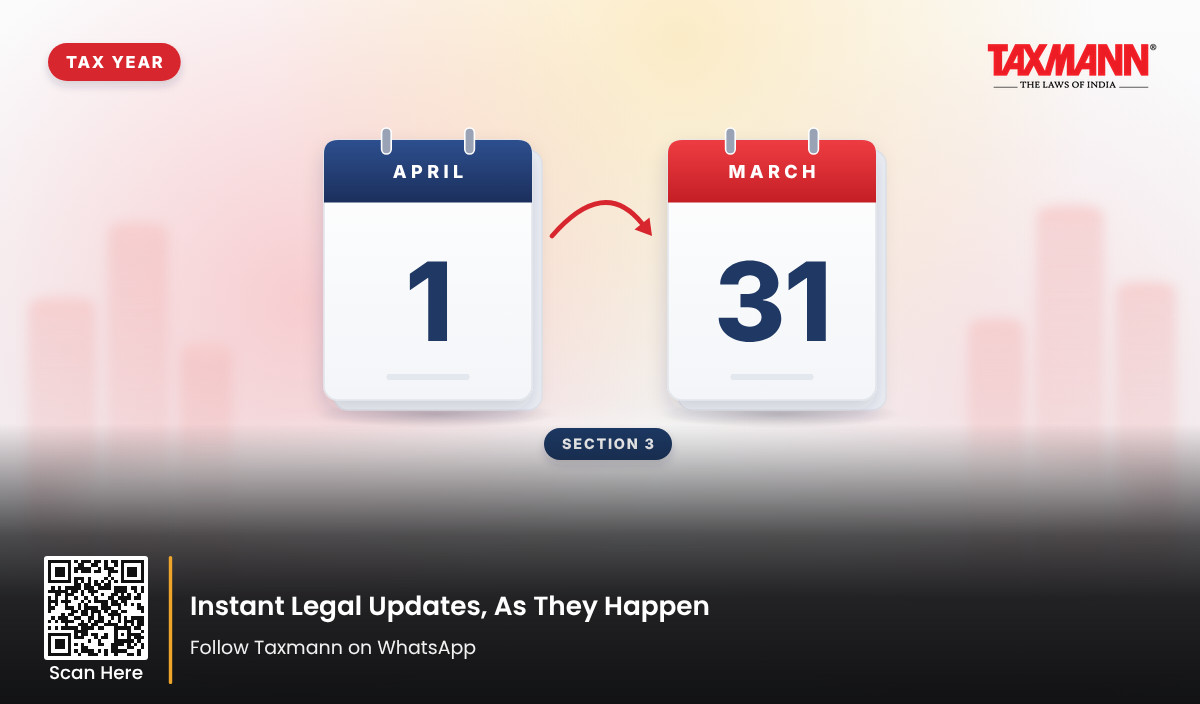
Table of Contents
- What is a tax year as per the Income-tax Act 2025?
- When does a tax year begin on a date other than 1 April?
- Why can the first tax year be shorter than 12 months but never longer?
- What replaced the assessment year?
- Which Income-tax Act applies to FY 2025-26, and which to tax year 2026-27?
- How is a reference to a tax year commencing on 1 April 2025 read?
- Quick answers
1. What is a tax year as per the Income-tax Act 2025?
A tax year is the financial year that begins on 1 April and ends on 31 March of the following year, except in the first year of a new business, profession or source of income; the income generated during it is taxed at the rates prescribed by the annual Finance Act. That is how Taxmann’s Direct Taxes Law & Practice reads section 3 of the Income-tax Act 2025, adding that the Income-tax Act 1961 called the same period the “previous year” (para 1).
Two principles frame the definition. Income-tax is an annual tax on income, and its rates are fixed by the annual Finance Act, not by the Income-tax Act (paras 4.1 and 4.2). What has changed is the vocabulary of the year. Having brought in the tax year in place of the previous year, the 2025 Act omits references to the “assessment year” as a consequence (para 0.64). One label now does the work of two.
The Finance Act 2026 shows both vocabularies at once: Part I of its First Schedule gives income-tax rates for assessment year 2026-27, and Part III gives advance tax rates for the financial year 2026-27, that is, for tax year 2026-27 (para 7.1). The tax year heads the book’s list of key changes made by the 2025 Act (para 0.64); the others are mapped in our analysis of the Income-tax Act 2025 vs Income-tax Act 1961.
2. When does a tax year begin on a date other than 1 April?
A tax year begins on a date other than 1 April only when a business or profession is newly set up, or a new source of income comes into existence, during a financial year. Section 3(2) (corresponding to the proviso to section 3 of the 1961 Act) then starts the tax year on the date of setting up, or on the date the source comes into existence, and ends it with that same financial year (para 1.1).
The book draws two conclusions. The first tax year is a period of 12 months or less. The second and every later tax year is always a financial year (para 1.1).
Problem 1.1-P1 applies the rule to an employee. X joins an Indian company on 18 February 2027, having had no employment and no other source of income before that date. His first tax year runs from 18 February 2027 to 31 March 2027, about six weeks; his second is the 12-month financial year commencing on 1 April 2027 (Problem 1.1-P1, para 1.1). In that example the new job is the new source, so section 3(2) is not a rule for traders and professionals alone.
3. Why can the first tax year be shorter than 12 months but never longer?
The first tax year can be shorter than 12 months but never longer because section 3(2) moves only its start date: the period opens on the date of setting up, or the date the new source comes into existence, but it always closes with the financial year in which that happens, on the following 31 March (para 1.1). No start date can stretch it further.
Problem 1.1-P2 shows the cap at work. X has property income of Rs. 14,20,000 every year. On 10 March 2028 he starts a computer hardware business, which earns Rs. 6,90,000 over the period from 10 March 2028 to 31 March 2029, of which Rs. 10,000 relates to the period ending 31 March 2028. The book’s solution splits the business income at 31 March 2028 (Problem 1.1-P2, para 1.1):
| Business income for the period | Amount (Rs.) | Falls in tax year | Total income of that tax year (Rs.) |
|---|---|---|---|
| 10 March 2028 to 31 March 2028 | 10,000 | 2027-28 | 14,30,000 |
| 1 April 2028 to 31 March 2029 | 6,80,000 | 2028-29 | 21,00,000 |
Tax year 2026-27, before the business existed, carries only the property income of Rs. 14,20,000. The new business does not open a separate year for X; its first few weeks of income join his tax year 2027-28, and a run of business income longer than 12 months is never taxed as one year. This is where first-year computations tend to slip. A stub of a few weeks is easy to fold into the next year’s figures, but section 3(2) closes the first tax year with the financial year in which the business or source began (para 1.1).
4. What replaced the assessment year?
The tax year did, for the years the Income-tax Act 2025 governs. The Act works with the “tax year” instead, a term that corresponds to the previous year of the 1961 Act rather than to its assessment year (para 277.1-2). The assessment year remains the label for the years still governed by the 1961 Act, assessment year 2026-27 and earlier (paras 0.64 and 733). The book carries this through to legacy provisions: for the deduction under section 138 (corresponding to section 80-IA of the 1961 Act), it substitutes “initial tax year” for the 1961 Act’s “initial assessment year”.
So the income of the financial year 2025-26 is, under the 1961 Act, the income of the previous year 2025-26, assessed as for assessment year 2026-27 (para 0.64). The income of the financial year 2026-27 is the income of tax year 2026-27, and the return is filed “for the tax year 2026-27” (paras 7.1 and 407). The return follows the end of the tax year, and so does the assessment that verifies it (para 1.2).
The exceptions are five cases in which the Assessing Officer may require the return, and complete the assessment, during the tax year itself: income of a non-resident from shipping, persons leaving India permanently or for a long period, bodies formed for a short duration, persons trying to alienate assets to avoid tax, and discontinued businesses. They fall under sections 316 to 320, corresponding to sections 172, 174, 174A, 175 and 176 of the 1961 Act (para 1.2).
The return due dates under section 263(1)(c) (corresponding to Explanation 2 to section 139(1) of the 1961 Act) make the shift visible, because the book sets the two years side by side (para 405.3):
| Case | Assessment year 2026-27 (1961 Act) | Tax year 2026-27 (2025 Act) |
|---|---|---|
| Report under section 172 (corresponding to section 92E of the 1961 Act) required for international or specified domestic transactions | 30 November 2026 | 30 November 2027 |
| Company; accounts required to be audited; partner in a firm whose accounts are required to be audited | 31 October 2026 | 31 October 2027 |
| Business or professional income, accounts not required to be audited | 31 August 2026 | 31 August 2027 |
| Any other case | 31 July 2026 | 31 July 2027 |
Other time limits also run from the end of the tax year. For tax year 2026-27, a belated return under section 263(4) (corresponding to section 139(4) of the 1961 Act) can be furnished up to 31 December 2027, or before completion of assessment if that is earlier (para 407). An updated return under section 263(6)(a) (corresponding to section 139(8A) of the 1961 Act) can be filed up to 31 March 2032, within 60 months from the end of that tax year (para 409.1).
The practical hazard is the bare label. “2026-27” on a file or an engagement letter can now mean assessment year 2026-27, the 1961 Act year for income of 2025-26, or tax year 2026-27, the 2025 Act year for income of 2026-27; their returns fall due a year apart. A practice system keyed to “2026-27” alone needs a second field recording the Act and the year of income.

5. Which Income-tax Act applies to FY 2025-26, and which to tax year 2026-27?
The Income-tax Act 1961 applies to the income of FY 2025-26, which continues to be assessed under its provisions as applicable for assessment year 2026-27; the Income-tax Act 2025, effective from 1 April 2026, applies to the income of tax year 2026-27 (paras 0.64 and 731).
The return for the income of 2025-26 is therefore a 1961 Act return: in the book’s illustration, a person with business income not subject to audit files it under section 139(1) of the 1961 Act by 31 August 2026 (para 408). Chapter 35 of the book shows how section 536 keeps the repealed Act working for the old years:
- Proceedings pending on 1 April 2026 continue under the 1961 Act, and proceedings started on or after that date for assessment year 2026-27 or earlier, including notices, assessments, reassessments, rectifications and appeals, follow its procedures (section 536(2)(c), para 733).
- Proceedings for a penalty relating to any assessment year up to 2026-27 may be initiated, and any such penalty is imposed under the 1961 Act, as if the 2025 Act had not been enacted (section 536(2)(d), para 734).
- Any proceeding pending on 1 April 2026 before an income-tax authority, the Appellate Tribunal or a court is continued and disposed of under the 1961 Act (section 536(2)(e), para 735).
Balances from the old years flow into tax year 2026-27. Losses brought forward up to assessment year 2026-27 are carried forward and set off against income computed under the 2025 Act as if the 1961 Act had not been repealed; a non-speculative business loss of the previous year 2024-25, for instance, may be set off up to tax year 2032-33 (section 536(2)(m), para 743). Unabsorbed depreciation up to assessment year 2026-27 is added to the depreciation allowance of tax year 2026-27 (section 536(2)(r), para 748). The full set of savings is covered in our note on section 536 repeal and savings.
The year also decides which provisions are cited. For 2025-26, a section 10 exemption is claimed under the 1961 Act; from tax year 2026-27, almost all of those exemptions continue, regrouped into the Schedules to the 2025 Act (paras 0.67 and 40), as our guide to exemptions under Schedules II to VIII explains. Until the old years are closed, both statutes stay in daily use (the two Acts and their Rules are on Taxmann.com | Research).
6. How is a reference to a tax year commencing on 1 April 2025 read?
A reference in the Income-tax Act 2025 to a tax year commencing on 1 April 2025, or to any earlier tax year, is read as a reference to the corresponding previous year under the repealed Income-tax Act 1961; that is the rule in section 536(3) (para 753).
The cut-off is the start of the financial year 2025-26, the last year whose income is still assessed under the 1961 Act (para 0.64). So the tax year commencing on 1 April 2025 means the previous year 2025-26, and each earlier tax year means the matching earlier previous year.
The 2025 Act contains references of this kind. In the case of a slump sale, the written down value formula in section 41(1)(c) (corresponding to section 43(6)(c)(ii) of the 1961 Act) reduces the actual cost of the asset by depreciation “actually allowed in respect of tax year commencing on April 1, 1986 or any earlier tax year” (para 670.2-1). Read with section 536(3), that phrase points to the previous year 1986-87 and earlier previous years; the book’s step-by-step version of the same rule speaks of “any financial year 1986-87 or any earlier year” (para 670.2).
Section 536(4) adds a backstop: without prejudice to section 536(2), section 6 of the General Clauses Act, 1897 applies to the effect of the repeal of the 1961 Act (para 754).
A working rule follows. When a question crosses 1 April 2026, state the year in both vocabularies, as the book does with “previous year 2025-26 (assessment year 2026-27)” (para 87), and set it against “tax year 2026-27”. That holds whether the question goes to a client, to the department or to a research assistant such as Taxmann AI. A year given in one vocabulary only invites an answer under the wrong Act.
7. Quick answers
What is tax year as per the Income-tax Act 2025?
Under section 3 of the Income-tax Act 2025, the tax year is the financial year beginning on 1 April and ending on 31 March of the following year, except for the first year of a newly set up business or profession or a new source of income. It takes the place of the “previous year” of the Income-tax Act 1961.
Is the first tax year of a new business always 12 months?
No. Under section 3(2), the first tax year of a newly set up business or profession, or of a new source of income, starts on the date of setting up or the date the source comes into existence, and ends on the following 31 March. It can be shorter than 12 months but never longer.
Is there an assessment year under the Income-tax Act 2025?
Not for the years it governs. Income is charged for the tax year, and the return for a tax year is ordinarily filed after that tax year ends. The assessment year remains the label for years still under the Income-tax Act 1961, up to assessment year 2026-27. For tax year 2026-27, the return due dates run from 31 July 2027 to 30 November 2027, depending on the case.
Which Income-tax Act applies to FY 2025-26?
The Income-tax Act 1961. Income of FY 2025-26 is assessed under the 1961 Act as for assessment year 2026-27, and proceedings for assessment year 2026-27 or earlier follow the 1961 Act’s procedures even if they start on or after 1 April 2026.
Which Income-tax Act applies to tax year 2026-27?
The Income-tax Act 2025, which came into force on 1 April 2026. Income of tax year 2026-27, the year from 1 April 2026 to 31 March 2027, is assessed under the 2025 Act.
How is a reference to a tax year commencing on 1 April 2025 read?
Under section 536(3) of the Income-tax Act 2025, a reference in that Act to a tax year commencing on 1 April 2025, or to any earlier tax year, is read as a reference to the corresponding previous year under the Income-tax Act 1961. The tax year commencing on 1 April 2025 therefore means the previous year 2025-26.
Can a 1961 Act business loss be set off in tax year 2026-27?
Yes. Under section 536(2)(m), losses brought forward up to assessment year 2026-27 are set off against income computed under the 2025 Act as if the 1961 Act had not been repealed. A non-speculative business loss of previous year 2024-25 can be set off up to tax year 2032-33.
This article draws on Chapters 1, 19 and 35 of Taxmann’s Direct Taxes Law & Practice | Professional Edition by Dr Vinod K. Singhania and Dr Kapil Singhania (74th Edition, 2026), which cover the basic concepts of income-tax starting with the tax year under section 3, the return of income and its due dates, and the repeal and savings rules that carry the 1961 Act into the 2025 Act. The law is stated as amended by the Finance Act 2026 and the Taxation & Other Laws (Amendment) Act 2026, updated up to 10 August 2026.
Income-tax Acts and Rules, case laws, circulars and notifications are available on Taxmann.com | Research under Income Tax.
More in this series: Section 536 repeal and savings · Exemptions under Schedules II to VIII · TDS on salary under section 392 · Lower or nil TDS certificate under section 395
Disclaimer: The content/information published on the website is only for general information of the user and shall not be construed as legal advice. While the Taxmann has exercised reasonable efforts to ensure the veracity of information/content published, Taxmann shall be under no liability in any manner whatsoever for incorrect information, if any.

Taxmann Publications has a dedicated in-house Research & Editorial Team. This team consists of a team of Chartered Accountants, Company Secretaries, and Lawyers. This team works under the guidance and supervision of editor-in-chief Mr Rakesh Bhargava.
The Research and Editorial Team is responsible for developing reliable and accurate content for the readers. The team follows the six-sigma approach to achieve the benchmark of zero error in its publications and research platforms. The team ensures that the following publication guidelines are thoroughly followed while developing the content:
- The statutory material is obtained only from the authorized and reliable sources
- All the latest developments in the judicial and legislative fields are covered
- Prepare the analytical write-ups on current, controversial, and important issues to help the readers to understand the concept and its implications
- Every content published by Taxmann is complete, accurate and lucid
- All evidence-based statements are supported with proper reference to Section, Circular No., Notification No. or citations
- The golden rules of grammar, style and consistency are thoroughly followed
- Font and size that’s easy to read and remain consistent across all imprint and digital publications are applied
Everything on Tax and Corporate Laws of India
To subscribe to our weekly newsletter please log in/register on Taxmann.com









 CA | CS | CMA


