Stock Market Index – Meaning | Types | Construction | Uses
- Blog|Company Law|
- 10 Min Read
- By Taxmann
- |
- Last Updated on 10 February, 2026
Latest from Taxmann

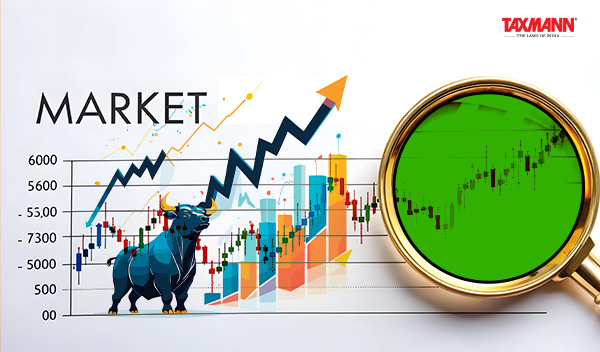
A stock market index is a statistical indicator designed to measure and represent the performance of a specific group of stocks that collectively reflect the behaviour of the overall market or a particular segment of it. It is constructed using a predefined methodology, such as market capitalisation–weighted, free-float–weighted, price-weighted, or equal-weighted methods, and is expressed relative to a base value set at a particular point in time. By tracking changes in stock prices, an index provides investors, policymakers, and market participants with a benchmark to assess market trends, compare portfolio performance, gauge economic conditions, and serve as the underlying for financial products such as index funds, exchange-traded funds (ETFs), and derivatives.
Table of Contents
- Introduction to an Index
- Significance of the Stock Index
- Types of Stock Market Indices
- Attributes of an Index
- Index Management
- Major Indices in India
- Application of Indices
Check out NISM X Taxmann's Equity Derivatives which offers an in-depth exploration of India's equity derivatives landscape, seamlessly combining foundational concepts, advanced trading strategies, and regulatory frameworks. Aligned with the NISM-Series-VIII Certification, it provides practical insights on hedging, speculation, and arbitrage through concise explanations and examples. Developed by the NISM, the workbook ensures readers comply with SEBI regulations while mastering key derivative instruments. Its structured design caters to a diverse audience, including aspiring professionals, brokers, risk managers, academics, and investors. By blending theoretical underpinnings with practical guidance, this resource is essential for anyone aiming to excel in India's equity derivatives markets.
1. Introduction to an Index
An index is a statistical indicator that measures changes in the economy in general or specific areas. In case of financial markets, an index is a portfolio of securities that represent a particular market or a portion of a market. Each index has its own calculation methodology and usually is expressed in terms of a change from a base value. The base value might be as recent as the previous day or many years in the past. Thus, the percentage change is more important than the actual numeric value. Financial indices are created to measure price movement of stocks, bonds, T-bills and other type of financial securities. More specifically, a stock index is created to provide market participants with the information regarding the average share price movement in the market. Broad indices are expected to capture the overall behaviour of equity market and need to represent the return obtained by typical portfolios in the country.
2. Significance of the Stock Index
- A stock index is an indicator of the performance of the overall market or a particular sector.
- It serves as a benchmark for portfolio performance – Managed portfolios, belonging either to individuals or mutual funds, use the stock index as a measure for evaluation of their performance.
- It is used as an underlying for financial application of derivatives – Various products in OTC and exchange traded markets are based on indices as the underlying asset.
3. Types of Stock Market Indices
Indices can be designed and constructed in various ways. Depending upon their methodology, they can be classified as under:
3.1 Market Capitalisation Weighted Index
In this method of calculation, each stock is given a weight according to its market capitalisation. So higher the market capitalisation of a constituent, higher is its weight in the index. Market capitalisation is the market value of a company, calculated by multiplying the total number of shares outstanding to its current market price. For example, ABC company with 5,00,00,000 shares outstanding and a share price of Rs. 120 per share will have market capitalisation of 5,00,00,000 × 120 = Rs. 6,00,00,00,000 i.e., 600 Crores.
Let us understand the concept with the help of an example – There are five stocks in an index. Base value of the index is set to 100 on the start date which is January 1, 1995. Calculate the current value of index based on following information:
|
Sr. No. |
Stock Name | Stock Price as on January 1, 1995 (in Rs.) | Number of Shares in Lakhs |
Today’s Stock Price (in Rs.) |
| 1 | AZ | 150 | 20 | 650 |
| 2 | BY | 300 | 12 | 450 |
| 3 | CX | 450 | 16 | 600 |
| 4 | DW | 100 | 30 | 350 |
| 5 | EU | 250 | 8 | 500 |
The market capitalisation of the index on January 1, 1995 is Rs. 18,800 which is the sum of the market price multiplied by the quantity of shares for each stock in the index. With the change in market prices, the market capitalisation of these stocks increases from Rs.18,800 lakhs to Rs.42,500 lakhs. The market capitalisation on January 1, 1995 is equated to 100. Hence, the new value of the index is calculated as (42500 lakhs/18800 lakhs) × 100, which works out to 226.06. Since the index has risen from a base of 100 to a new value of 226.06, the change in the index value is 126.06 per cent.
|
Stock Name |
Old Price (Rs.) | No. of Shares (in lakhs) | Old M.Cap. (in Rs. lakhs) | Old Weights | New Price (Rs.) | New M.Cap. (in Rs. lakhs) |
New Weights |
| AZ | 150 | 20 | 3000 | 0.16 | 650 | 13000 | 0.31 |
| BY | 300 | 12 | 3600 | 0.19 | 450 | 5400 | 0.13 |
| CX | 450 | 16 | 7200 | 0.38 | 600 | 9600 | 0.23 |
| DW | 100 | 30 | 3000 | 0.16 | 350 | 10500 | 0.25 |
| EU | 250 | 8 | 2000 | 0.11 | 500 | 4000 | 0.09 |
| 18800 | 1.00 | 42500 | 1.00 |
Popular indices in India, Sensex and Nifty, were earlier designed on market ccapitalisation weighted method.
3.2 Free-Float Market Capitalisation Index
In various businesses, equity holding is divided differently among various stakeholders – promoters, institutions, corporates, individuals, etc. The market has started to segregate this on the basis of what is readily available for trading and what is not. The one available for immediate trading is categorised as free float. And, if we compute the index based on weights of each security based on free float market cap, it is called free float market capitalisation index. A majority of the stock indices globally, over a period of time, have moved to free float basis, including the Indian equity indices – Sensex, Nifty and SX40.
3.3 Price-Weighted Index
This is a stock index in which each stock influences the index in proportion to its price. Stocks with a higher price will be given more weight and therefore, will have a greater influence over the performance of the Index.
Let us take the same data as above for calculation of the price-weighted index:
| Sr. No. | Stock Name | Stock Price as on January 1, 1995 (in Rs.) | Number of Shares in Lakhs | Today’s Stock Price (in Rs.) |
| 1 | AZ | 150 | 20 | 650 |
| 2 | BY | 300 | 12 | 450 |
| 3 | CX | 450 | 16 | 600 |
| 4 | DW | 100 | 30 | 350 |
| 5 | EU | 250 | 8 | 500 |
The formula for calculating the value of a price-weighted index is as follows:
Price index = (Sum of the prices of all stocks included in Index)/(No. of stocks in Index)
Hence, the price index on January 1, 1995 = (150 + 300 + 450 + 100 + 250)/5 = 250.
The current value of the index is the sum of the current prices of all stocks included in the index divided by the number of stocks. The current value of the index = (650 + 450 + 600 + 350 + 500)/5 = 510. Thus, the increase in the value of the index is (510 – 250)/250, i.e. 104%. This can be verified as follows:
| Stock Name | Price on Jan 1, 1995 | Weights | Current Price | Percent Change in Price | Percent Change in Price × Weight |
| AZ | 150 | 0.12 | 650 | 333.33% | 40.00% |
| BY | 300 | 0.24 | 450 | 50.00% | 12.00% |
| CX | 450 | 0.36 | 600 | 33.33% | 12.00% |
| DW | 100 | 0.08 | 350 | 250.00% | 20.00% |
| EU | 250 | 0.20 | 500 | 100.00% | 20.00% |
| 1250 | 1.00 | 2550 | 104.00% |
Dow Jones Industrial Average and Nikkei 225 are popular price-weighted indices.
3.4 Equal Weighted Index
An equal-weighted index is one in which all stocks included in the index have the same weightage. The number of shares of each stock is adjusted in such a way that the weight of each stock in the index is the same. Subsequently, if there is any change in the market price of each stock, the weight of each stock will change. To maintain the same equal weights as earlier, the fund manager needs to sell those stocks that have increased in price and buy the stocks that have fallen in price.
The following is an example of the computation of an equal weighted index:
| Stock Name | Price on Jan 1, 1995 | Quantity as on Jan 1, 1995 | Value as on Jan 1, 1995 | Weight on Jan 1, 1995 | Current Price | Current Value (= Qty × Price) | Price Change | Price Change × Old Weight |
| P | 100 | 300 | 30000 | 0.25 | 150 | 45000 | 50.00% | 12.50% |
| Q | 150 | 200 | 30000 | 0.25 | 130 | 26000 | -13.33% | -3.33% |
| R | 125 | 240 | 30000 | 0.25 | 200 | 48000 | 60.00% | 15.00% |
| S | 200 | 150 | 30000 | 0.25 | 180 | 27000 | -10.00% | -2.50% |
| 120000 | 1.00 | 146000 | 21.67% |
Consider an index constructed on January 1, 1995 with 4 stocks. The number of shares of each stock is adjusted in such a manner that the value of all stocks in the index is equal. Thus, each stock has the same weight in the index. With a change in the stock prices, the current value of the stocks in the index has changed from 120,000 to 146,000. If the old index value is equated to 100, the new index value will be 146000/120000×100, i.e. 121.67. As can be seen from the last column in the above table, this is simply the percentage change in the stock price multiplied by the original weight of each stock, which equals to a rise of 21.67%.
With the changed prices, stock P and stock R have a weight greater than 25% while stock Q and stock S have a weight lower than 25%. The fund manager will then have to rebalance the index to restore equal weights. This can be done by selling appropriate quantities of stocks P and R and buying required quantities of stocks Q and S.
4. Attributes of an Index
A good market index should have following attributes:
- It should reflect the market behaviour
- It should be computed by independent third party and be free from influence of any market participant.
- It should be professionally maintained.
4.1 Impact Cost
Liquidity in the context of stock market means a market where large orders are executed without moving the prices.
Let us understand this with help of an example. The order book of a stock at a point in time is as follows:
| Buy | Sell | ||||
| Sr. No. | Quantity | Price (in Rs.) | Price (in Rs.) | Quantity | Sr. No. |
| 1 | 1000 | 4.00 | 4.50 | 2000 | 5 |
| 2 | 1000 | 3.90 | 4.55 | 1000 | 6 |
| 3 | 2000 | 3.80 | 4.70 | 500 | 7 |
| 4 | 1000 | 3.70 | 4.75 | 100 | 8 |
In the order book given above, there are four buy orders and four sell orders. The difference between the best buy and the best sell orders is 0.50 – called bid-ask spread. If a person places a market buy order for 100 shares, it would be matched against the best available sell order at Rs. 4.50. He would buy 100 shares for Rs. 4.50. Similarly, if he places a market sell order for 100 shares, it would be matched against the best available buy order at Rs. 4 i.e. the shares would be sold at Rs. 4. Hence, if a person buys 100 shares and sells them immediately, he is poorer by the bid-ask spread i.e., a loss of Rs. 50. This spread is regarded as the transaction cost which the market charges for the privilege of trading (for a transaction size of 100 shares).
Now, suppose a person wants to buy and then sell 3000 shares. The sell order will hit the following buy orders:
| Sr. No. | Quantity | Price (in Rs.) |
| 1 | 1000 | 4.00 |
| 2 | 1000 | 3.90 |
| 3 | 1000 | 3.80 |
While the buy order will hit the following sell orders:
| Quantity | Price (in Rs.) | Sr. No. |
| 2000 | 4.50 | 5 |
| 1000 | 4.55 | 6 |
There is increase in the transaction cost for an order size of 3000 shares in comparison to the transaction cost for order for 100 shares. The “bid-ask spread” therefore conveys the transaction cost for a small trade.
Now, we come across a term called impact cost. We must start by defining the ideal price as the average of the best bid and offer price. In our example it is (4+4.50)/2, i.e., Rs. 4.25. In an infinitely liquid market, it would be possible to execute large transactions on both buy and sell at prices that are very close to the ideal price of Rs.4.25. However, while trading, you will pay more than Rs.4.25 per share while buying and will receive less than Rs.4.25 per share while selling. The percentage degradation, which is experienced vis-à-vis the ideal price, when shares are bought or sold, is called impact cost. Impact cost varies with transaction size. Also, it would be different for buy side and sell side.
| Buy Quantity | Buy Price (in Rs.) | Sell Price (in Rs.) | Sell Quantity |
| 1000 | 9.80 | 9.90 | 1000 |
| 2000 | 9.70 | 10.00 | 1500 |
| 3000 | 9.60 | 10.10 | 1000 |
To buy 1500 shares, Ideal price = (9.8+9.9)/2 = Rs.9.85
Actual buy price = [(1000×9.9)+(500×10.00)]/1500 = Rs.9.9333
Impact cost for (1500 shares) = {(9.9333 – 9.85)/9.85}×100 = 0.84 %
5. Index Management
Index construction, maintenance and revision process is generally done by specialised agencies. For instance, BSE indices are managed by Asia Index Pvt Ltd and NSE indices are managed by NSE Indices Limited.
Index construction is all about choosing the index stocks and deciding on the index calculation methodology. Maintenance means adjusting the index for corporate actions like bonus issue, rights issue, stock split, consolidation, mergers etc. Revision of an index deals with change in the composition of index as such i.e., replacing some existing stocks by the new ones because of a change in the trading paradigm of the stocks, or a shift in the interest of market participants.
5.1 Index Construction
A good index is a trade-off between diversification and liquidity. A well-diversified index reflects the behaviour of the overall market/economy. While diversification helps in reducing risk, it may not help beyond a point. Going from 10 stocks to 20 stocks leads to a sharp reduction in risk. Going from 50 stocks to 100 stocks enables very little reduction in risk. Going beyond 100 stocks causes almost zero decline in risk. Hence, there is little to gain by diversifying beyond a point.
Stocks in the index are chosen based on certain pre-determined qualitative and quantitative parameters, laid down by the Index Construction Managers. Once a stock satisfies the eligibility criteria, it is entitled for inclusion in the index. Generally, the final decision of inclusion or removal of a security from the index is taken by a specialised committee known as the Index Committee.
5.2 Index Maintenance and Index Revision
Maintenance and revision of the indices is done with the help of various mathematical formulae. In order to keep the index comparable across time, the index needs to take into account corporate actions such as stock splits, share issuance, dividends and restructuring events. While index maintenance issue gets triggered by a corporate action, index revision is a continuous exercise to ensure that the index captures the most vibrant lot of securities in the market and continues to correctly reflect the market.
6. Major Indices in India
These are some of the popular equity indices in India:
|
|
|
7. Application of Indices
Traditionally, indices were used as a measure to understand the overall direction of the stock market. However, a few applications have emerged in the investment field which are explained below:
7.1 Index Funds
These types of funds invest in a specific index with an objective to generate returns equivalent to the return on index. These funds invest in index stocks in the proportions in which these stocks exist in the index. For instance, Sensex index fund would get similar returns as that of Sensex index (except for a small “tracking error” which occurs due to fund management related expenses and cash holdings maintained to take care of redemptions). Since the Sensex has 30 shares, the fund will also invest in these 30 companies in the proportion in which they exist in the Sensex. Similarly, a Nifty index fund would invest in the 50 component companies of Nifty index in the same proportion in which they exist in the Nifty index and therefore generates similar returns as that of Nifty index (adjusted for tracking error).
7.2 Index Derivatives
Index Derivatives are derivative contracts which have the index as the underlying asset. Index Options and Index Futures are the most popular derivative contracts worldwide. Index derivatives are useful as a tool to hedge against the market risk.
7.3 Exchange Traded Funds
Exchange Traded Funds (ETFs) is basket of securities that trade like individual stocks, on an exchange. They have a number of advantages over other mutual funds as they can be bought and sold on the exchange. Since, ETFs are traded on exchanges, intraday transaction is possible. Further, ETFs can be used as basket trading in terms of the smaller denomination and low transaction cost.
Disclaimer: The content/information published on the website is only for general information of the user and shall not be construed as legal advice. While the Taxmann has exercised reasonable efforts to ensure the veracity of information/content published, Taxmann shall be under no liability in any manner whatsoever for incorrect information, if any.

Taxmann Publications has a dedicated in-house Research & Editorial Team. This team consists of a team of Chartered Accountants, Company Secretaries, and Lawyers. This team works under the guidance and supervision of editor-in-chief Mr Rakesh Bhargava.
The Research and Editorial Team is responsible for developing reliable and accurate content for the readers. The team follows the six-sigma approach to achieve the benchmark of zero error in its publications and research platforms. The team ensures that the following publication guidelines are thoroughly followed while developing the content:
- The statutory material is obtained only from the authorized and reliable sources
- All the latest developments in the judicial and legislative fields are covered
- Prepare the analytical write-ups on current, controversial, and important issues to help the readers to understand the concept and its implications
- Every content published by Taxmann is complete, accurate and lucid
- All evidence-based statements are supported with proper reference to Section, Circular No., Notification No. or citations
- The golden rules of grammar, style and consistency are thoroughly followed
- Font and size that’s easy to read and remain consistent across all imprint and digital publications are applied
Everything on Tax and Corporate Laws of India
To subscribe to our weekly newsletter please log in/register on Taxmann.com








 CA | CS | CMA


