[Analysis] SEBI Circulars – Finding the One in Force | What a Master Circular Does | Linking a Circular to Its Regulation
- Blog|Company Law|
- 3 Min Read
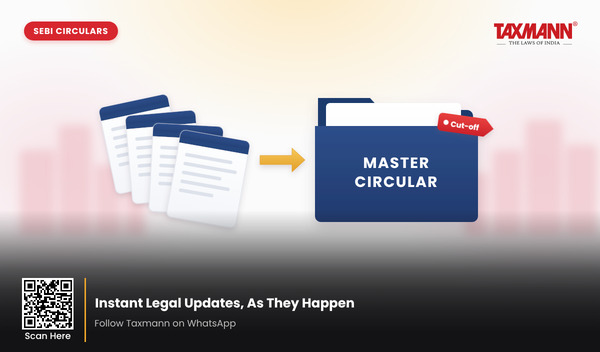
SEBI’s circulars change the rules, and its master circulars consolidate them up to a cut-off date. How to find the circular in force and link it to the regulation it changes.
- By Taxmann
- |
- Last Updated on 18 November, 2026
Latest from Taxmann

Law stated as on 18 November 2026.
Table of Contents
- Why one circular is rarely the whole answer
- What a master circular does, and does not, do
- How to find the circular in force
- Circulars linked to the sections they touch
- Frequently asked questions
1. Why one circular is rarely the whole answer
In company, securities, insolvency and competition law, the rules change by circular, and the Insolvency and Bankruptcy Code was amended again in 2026.
A SEBI circular may add to a regulation, explain it or set an operational detail, and a later circular may change it again. Read on its own, one circular can miss the change that matters.
2. What a master circular does, and does not, do
SEBI issues master circulars that consolidate its circulars on a subject into one document. The Master Circular for Research Analysts of 6 February 2026, for example, rescinds the circulars listed in its appendix, to the extent they relate to research analysts, and treats anything done under them as done under the master circular.
A master circular is a snapshot. The ICDR Master Circular of 9 February 2026 includes the relevant circulars issued up to 31 December 2025, so a circular issued after that date has to be read with it.
The Master Circular for Investment Advisers of 6 February 2026 likewise brought earlier circulars together into a single, updated framework.
3. How to find the circular in force
- Start from the regulation and the provision on your point.
- Find the latest master circular on the subject, and note its cut-off date.
- Look for circulars issued after that date on the same provision.
- Read SEBI’s informal guidance and the case laws on the point before you advise.
- Cite the circular by its number and date, so the reader finds the same text.
Where a provision is unclear, SEBI’s informal guidance can show how SEBI has read it, and the case laws show how tribunals and courts have.
4. Circulars linked to the sections they touch
Taxmann.com | Research links circulars to the sections they touch, checked by Taxmann’s editors.
- Company & SEBI Laws: 12,400+ case laws, 400+ SEBI Informal Guidance, and All About™ Companies Act and Securities Laws.
- Insolvency & Bankruptcy Code: 7,700+ case laws from the Supreme Court, High Courts, NCLAT and NCLT.
- FEMA, Banking & Insurance Laws: FEMA, banking, insurance, SARFAESI, IFSC and money-laundering laws, with 10,600+ RBI and IRDAI circulars.
- 20+ Ready Referencers in Company & SEBI Laws, including a compliance calendar and penalty tables.
Open Company & SEBI Laws, Informal Guidance: SEBI’s interpretive letters under the Informal Guidance Scheme, 2003.
5. Frequently asked questions
What is a SEBI master circular?
A single document that consolidates SEBI’s circulars on a subject. Each one carries the position up to its own cut-off date.
Does a master circular rescind the earlier circulars?
It can. The Master Circular for Research Analysts of 6 February 2026 rescinds the circulars listed in its appendix, to the extent they relate to research analysts, and treats anything done under them as done under the master circular.
What is SEBI informal guidance?
Guidance from SEBI under the SEBI (Informal Guidance) Scheme, 2003, given as a no-action letter or an interpretive letter.
Where can I see circulars with the sections they touch?
In Taxmann.com | Research, which links circulars to the sections they touch, checked by Taxmann’s editors.
Try Taxmann.com | Research free for 7 days
One trial per person in each product. Trial access is usually read-only, and printing and downloading may be off. A new trial is possible after 12 months.
Related reading: SEBI Updates ICDR Master Circular for Capital Issues · SEBI Master Circular 2026 for Research Analysts · SEBI Master Circular 2026 for Investment Advisers.
Disclaimer: The content/information published on the website is only for general information of the user and shall not be construed as legal advice. While the Taxmann has exercised reasonable efforts to ensure the veracity of information/content published, Taxmann shall be under no liability in any manner whatsoever for incorrect information, if any.

Taxmann Publications has a dedicated in-house Research & Editorial Team. This team consists of a team of Chartered Accountants, Company Secretaries, and Lawyers. This team works under the guidance and supervision of editor-in-chief Mr Rakesh Bhargava.
The Research and Editorial Team is responsible for developing reliable and accurate content for the readers. The team follows the six-sigma approach to achieve the benchmark of zero error in its publications and research platforms. The team ensures that the following publication guidelines are thoroughly followed while developing the content:
- The statutory material is obtained only from the authorized and reliable sources
- All the latest developments in the judicial and legislative fields are covered
- Prepare the analytical write-ups on current, controversial, and important issues to help the readers to understand the concept and its implications
- Every content published by Taxmann is complete, accurate and lucid
- All evidence-based statements are supported with proper reference to Section, Circular No., Notification No. or citations
- The golden rules of grammar, style and consistency are thoroughly followed
- Font and size that’s easy to read and remain consistent across all imprint and digital publications are applied
Everything on Tax and Corporate Laws of India
To subscribe to our weekly newsletter please log in/register on Taxmann.com









 CA | CS | CMA


