[Analysis] India–Singapore DTAA – Capital Gains on Shares after the 2016 Protocol | Comparing It with the Mauritius Treaty
- Blog|International Tax|
- 3 Min Read
The 2016 Third Protocol brought source-based taxation of gains on shares acquired from 1 April 2017 into the India–Singapore DTAA. What changed, how it lines up with the Mauritius treaty, and how to compare two treaties on one point.
- By Taxmann
- |
- Last Updated on 18 November, 2026
Latest from Taxmann

Law stated as on 18 November 2026.
Table of Contents
- What the 2016 Third Protocol changed
- How it lines up with the Mauritius treaty
- How to compare two treaties on one point
- Treaties, rulings and OECD guidance on your point, under both Acts
- Frequently asked questions
1. What the 2016 Third Protocol changed
The Third Protocol introduced source-based taxation of capital gains on shares acquired from 1 April 2017. Shares acquired before that date were grandfathered, subject to the Limitation of Benefits Article.
On shares acquired from 1 April 2017, gains arising up to 31 March 2019 could be taxed in the country where the company is resident at no more than 50% of the rate that applied there, subject to the Limitation of Benefits Article.
2. How it lines up with the Mauritius treaty
The release that announced the Third Protocol said it was in line with India’s treaty policy, as reflected in its recently revised treaties with Mauritius and Cyprus. The protocol amending the India–Mauritius treaty was signed on 10 May 2016.
So a question on gains from shares often means reading the capital gains article of more than one treaty (Article 13 in both), each with its protocols and the date each change took effect. It also means reading the rulings: in Tiger Global (January 2026), under the Mauritius treaty, the Supreme Court held that a tax residency certificate does not stop the tax department from examining whether the treaty is being abused.
The sections also moved under the Income-tax Act, 2025.
A treaty position is read with the domestic provisions it relies on, and those now carry 2025 numbers, so check the counterpart section too.
3. How to compare two treaties on one point
- Fix the point: the article and the income, such as capital gains on shares.
- Read each treaty with its protocols, and note when each change took effect.
- Set the articles side by side, so that a difference in one clause does not slip past.
- Then read the rulings on the article, and how later rulings treated them.
4. Treaties, rulings and OECD guidance on your point, under both Acts
A treaty position turns on the article, its protocol and how courts have read it.
Taxmann.com | Research brings the treaties, the rulings and the OECD guidance together, checked by Taxmann’s editors.
- 200+ tax treaties with protocols, and the OECD, UN and US model treaties.
- Treaty Comparison: pick the countries and the subject, and the treaties appear side by side.
- 5,100+ international tax and 7,500+ transfer pricing case laws, with Similar cases, which groups rulings on the same issue under one heading.
- All About™ International Taxation: the records linked to a treaty article, on one page.
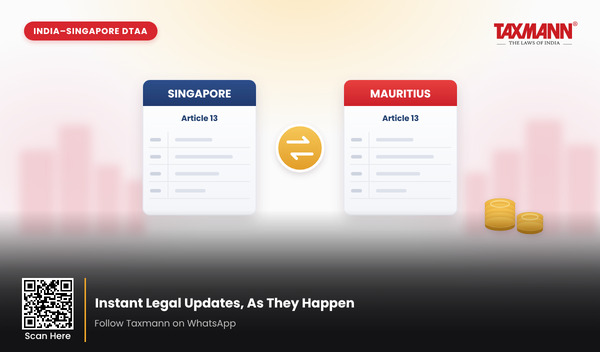
Open Tools, International Tax and Transfer Pricing, Treaties Comparison Tool. Select Singapore and Mauritius, choose the subject Capital Gains and generate the report: Article 13 of the India–Singapore and India–Mauritius treaties side by side.
5. Frequently asked questions
Are gains on shares bought before 1 April 2017 taxed in India under the India–Singapore DTAA?
Not for a Singapore resident who meets the conditions of the Limitation of Benefits Article: gains on shares acquired before 1 April 2017 are taxable only in the seller’s country of residence. Shares acquired from that date can be taxed where the company is resident.
What was the transition rate?
On shares acquired from 1 April 2017, gains arising up to 31 March 2019 could be taxed in the company’s country at no more than 50% of the rate that applied there, subject to the Limitation of Benefits Article.
How can I compare the same article in two treaties?
Set them side by side. In Taxmann.com | Research, Treaty Comparison does this: pick the countries and the subject, and the treaties appear side by side.
Where can I read a treaty with its protocols?
In Taxmann.com | Research: 200+ tax treaties with protocols, and the OECD, UN and US model treaties.
Try Taxmann.com | Research free for 7 days
One trial per person in each product. Trial access is usually read-only, and printing and downloading may be off. A new trial is possible after 12 months.
Related reading: Credit Rating Services Not Taxable as FTS Under India–Singapore DTAA · No Virtual Service PE Under India–Singapore DTAA · Do India’s 90-Plus DTAA Notifications Survive the ITA 2025 Repeal?
Disclaimer: The content/information published on the website is only for general information of the user and shall not be construed as legal advice. While the Taxmann has exercised reasonable efforts to ensure the veracity of information/content published, Taxmann shall be under no liability in any manner whatsoever for incorrect information, if any.

Taxmann Publications has a dedicated in-house Research & Editorial Team. This team consists of a team of Chartered Accountants, Company Secretaries, and Lawyers. This team works under the guidance and supervision of editor-in-chief Mr Rakesh Bhargava.
The Research and Editorial Team is responsible for developing reliable and accurate content for the readers. The team follows the six-sigma approach to achieve the benchmark of zero error in its publications and research platforms. The team ensures that the following publication guidelines are thoroughly followed while developing the content:
- The statutory material is obtained only from the authorized and reliable sources
- All the latest developments in the judicial and legislative fields are covered
- Prepare the analytical write-ups on current, controversial, and important issues to help the readers to understand the concept and its implications
- Every content published by Taxmann is complete, accurate and lucid
- All evidence-based statements are supported with proper reference to Section, Circular No., Notification No. or citations
- The golden rules of grammar, style and consistency are thoroughly followed
- Font and size that’s easy to read and remain consistent across all imprint and digital publications are applied
Everything on Tax and Corporate Laws of India
To subscribe to our weekly newsletter please log in/register on Taxmann.com









 CA | CS | CMA


