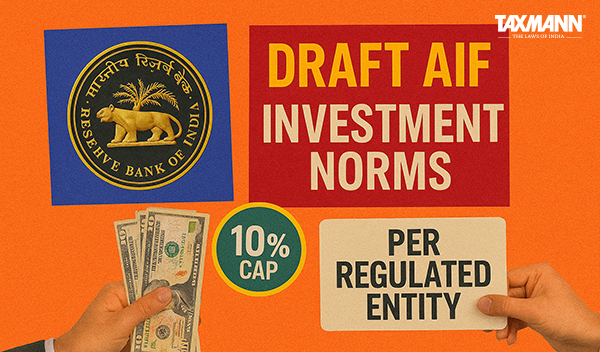
RBI Draft AIF Investment Norms – 10% Cap per Regulated Entity
- Blog|News|FEMA & Banking|
- 2 Min Read
- By Taxmann
- |
- Last Updated on 1 September, 2026
Latest from Taxmann

Press Release: 2025-2026/366, Dated 19.05.2025
1. Background & Regulatory Purpose
The Reserve Bank of India (RBI) released re-drafted Directions on 19 May 2025 governing investments by banks, NBFCs and other Regulated Entities (REs) in Alternative Investment Funds (AIFs). The revision follows RBI’s December 2023 ban (partly eased in March 2024) that sought to stop “evergreening”—the indirect rollover of stressed loans through AIF structures.
2. How the Provisioning Mechanism Works
Example – Bank X holds ₹120 cr (6 %) in Fund Alpha (₹2,000 cr corpus). Fund Alpha later buys ₹50 cr of NCDs issued by one of Bank X’s borrowers.
- Bank X’s proportional downstream debt exposure = 6 % × ₹50 cr = ₹3 cr.
- Under the draft rule, Bank X must make a ₹3 cr (100 %) provision in its books.
This “full-provision” requirement neutralises the benefit Bank X would gain by recycling credit risk through the AIF.
3. Immediate Compliance Considerations for REs
- Portfolio Scan – Map every AIF holding against borrower lists to identify exposure overlap.
- Capital Planning – Evaluate incremental provision hit if >5 % thresholds are breached.
- Investment Agreements – Insert look-through clauses requiring AIF manager to notify downstream debt investments in real time.
- Board Reporting – Update ALCO/risk committees on revised caps and provisioning triggers.
- Pipeline Pause – Defer fresh AIF commitments until the final Directions are issued.
4. Strategic Takeaways
- Risk-aligned liberalisation – The draft eases the earlier blanket prohibition but prices the risk via 100 % provisioning where evergreening concerns arise.
- Diversification push – The 10%/15% caps promote a broad investor mix, reducing contagion if a single RE faces stress.
- Coordination with SEBI – Combined with SEBI’s enhanced due diligence norms for AIFs, regulators are closing loopholes while still nurturing the AIF ecosystem.
- Capital discipline – Higher provisions could make >5 % exposures economically unattractive, nudging lenders to keep AIF stakes within the “free” band or shift to equity-only funds.
Click Here To Read The Full Press Release
Disclaimer: The content/information published on the website is only for general information of the user and shall not be construed as legal advice. While the Taxmann has exercised reasonable efforts to ensure the veracity of information/content published, Taxmann shall be under no liability in any manner whatsoever for incorrect information, if any.

Taxmann Publications has a dedicated in-house Research & Editorial Team. This team consists of a team of Chartered Accountants, Company Secretaries, and Lawyers. This team works under the guidance and supervision of editor-in-chief Mr Rakesh Bhargava.
The Research and Editorial Team is responsible for developing reliable and accurate content for the readers. The team follows the six-sigma approach to achieve the benchmark of zero error in its publications and research platforms. The team ensures that the following publication guidelines are thoroughly followed while developing the content:
- The statutory material is obtained only from the authorized and reliable sources
- All the latest developments in the judicial and legislative fields are covered
- Prepare the analytical write-ups on current, controversial, and important issues to help the readers to understand the concept and its implications
- Every content published by Taxmann is complete, accurate and lucid
- All evidence-based statements are supported with proper reference to Section, Circular No., Notification No. or citations
- The golden rules of grammar, style and consistency are thoroughly followed
- Font and size that’s easy to read and remain consistent across all imprint and digital publications are applied
Everything on Tax and Corporate Laws of India
To subscribe to our weekly newsletter please log in/register on Taxmann.com








 CA | CS | CMA


