HC Rules Cheque Liability Presumed Under Sec. 139
- News|Blog|FEMA & Banking|
- 2 Min Read
- By Taxmann
- |
- Last Updated on 25 September, 2025
Latest from Taxmann

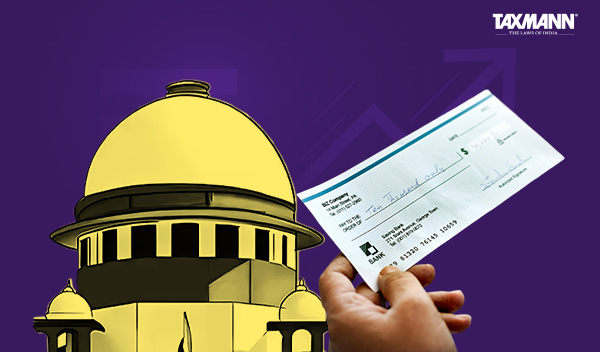
Case Details: Nouam Financial Consultants (P.) Ltd. vs. State (Govt. of NCT Delhi) - [2025] 178 taxmann.com 453 (Delhi)
Judiciary and Counsel Details
- DR. Swarana Kanta Sharma, J.
- Vikas Gupta, Ieshaan Gupta, Ayush Bhargav, Sohil Sharma & Ms. Aditi Saxena, Advs. for the Petitioner
- Manoj Pant, Chandrakant, Ms. Swati Jain, Rudra Pratap Singh, Shailendra Bhatnagar, Ms. Shivani Pal, Shreeyanshu Bhatnagar & Animesh, Advs. for the Respondent.
Facts of the Case
In the instant case, the respondent company was engaged in providing loan services to its customers. Petitioner No. 1 was in the business of lending money to prospective borrowers. Petitioner No. 1 and the respondent had entered into a transfer agreement to avail a loan amount equal to 33 per cent of the market value of shares, which were transferred into the Demat account of Petitioner No. 2. Petitioner No. 1 issued a cheque in favour of the respondent, allegedly as security for the concerned shares. However, when the respondent deposited the cheque for encashment, it was dishonoured with the remarks “payment stopped by drawer.”
The Respondent was thus constrained to file a complaint before the Trial Court. The Trial Court issued summons to the petitioners. Aggrieved, the petitioners filed the present petition seeking quashing of the summoning order and the consequent proceedings.
It was noted that Petitioner No. 2 did not dispute the issuance of the cheque, and admitted that a duly filled cheque had been issued to Respondent No. 2, but disputed the purpose of its issuance. Since the issuance of the cheque, including the filling of details and the signatures, was admitted by the petitioners, the presumption under Section 139 of the Negotiable Instruments Act squarely applied against them. In other words, it had to be presumed that the cheque pertained to a legally enforceable debt or liability.
High Court Held
The High Court observed that, as the presumption under Section 139 was prima facie attracted against the petitioners, and the only argument raised by them concerned the cheque not being issued for a legally enforceable debt or liability (a matter of trial), there was no ground to exercise power under Section 482 of the Cr.P.C. to quash the impugned summoning order and the proceedings arising therefrom.
List of Cases Referred to
- Dashrathbhai Trikambhai Patel v. Hitesh Mahendrabhai Patel [2022] 143 taxmann.com 144/[2023] 175 SCL 5 (SC) (para 7)
- Oriental Bank of Commerce v. Prabodh Kumar Tewari [2022] 141 taxmann.com 460/174 SCL 175 (SC) (para 8)
- M.M.T.C. Ltd. v. Medchl Chemicals & Pharma (P) Ltd. [2002] 39 SCL 270 (SC) (para 10)
- Rajeshbhai Muljibhai Patel v. State of Gujarat [2020] 116 taxmann.com 357 (SC) (para 11)
- Rathish Babu Unnikrishnan v. State (NCT of Delhi) [2022] 140 taxmann.com 26/172 SCL 666 (SC) (para 12).
Disclaimer: The content/information published on the website is only for general information of the user and shall not be construed as legal advice. While the Taxmann has exercised reasonable efforts to ensure the veracity of information/content published, Taxmann shall be under no liability in any manner whatsoever for incorrect information, if any.

Taxmann Publications has a dedicated in-house Research & Editorial Team. This team consists of a team of Chartered Accountants, Company Secretaries, and Lawyers. This team works under the guidance and supervision of editor-in-chief Mr Rakesh Bhargava.
The Research and Editorial Team is responsible for developing reliable and accurate content for the readers. The team follows the six-sigma approach to achieve the benchmark of zero error in its publications and research platforms. The team ensures that the following publication guidelines are thoroughly followed while developing the content:
- The statutory material is obtained only from the authorized and reliable sources
- All the latest developments in the judicial and legislative fields are covered
- Prepare the analytical write-ups on current, controversial, and important issues to help the readers to understand the concept and its implications
- Every content published by Taxmann is complete, accurate and lucid
- All evidence-based statements are supported with proper reference to Section, Circular No., Notification No. or citations
- The golden rules of grammar, style and consistency are thoroughly followed
- Font and size that’s easy to read and remain consistent across all imprint and digital publications are applied
Everything on Tax and Corporate Laws of India
To subscribe to our weekly newsletter please log in/register on Taxmann.com








 CA | CS | CMA


