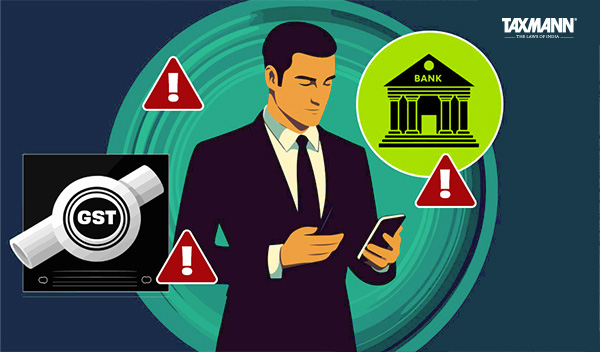
GSTN Enables Auto-Suspension of GST Registration for Missing Bank Details Under Rule 10A
- Blog|News|GST & Customs|
- 2 Min Read
- By Taxmann
- |
- Last Updated on 1 September, 2026
Latest from Taxmann

05 Dec 2025, GST News
1. Regulatory Background
Under Rule 10A of the CGST Rules, newly registered taxpayers are required to furnish their bank account details within a prescribed timeline. The GSTN has now operationalised an automated suspension mechanism for registrations where these details are not submitted on time. This initiative aims to streamline compliance monitoring and reduce administrative intervention.
2. Mandatory Furnishing of Bank Details
Except for specific categories, all taxpayers must provide their bank account information:
- Within 30 days of registration, or
- Before filing the first GSTR-1 or IFF,
whichever is earlier
This requirement applies to:
- Normal taxpayers
- Casual taxable persons
- SEZ units and developers
- Input Service Distributors (ISD)
- Non-core amendment cases involving bank detail updation
2.1 Exceptions
The following registrants are not required to furnish bank account details mandatorily:
- TCS entities
- TDS entities
- Suo-moto registrations
3. Automatic Suspension of Registration
If the taxpayer does not upload bank account details within the prescribed period, the GST system will:
- Automatically suspend the GST registration
- Prevent filing of returns and generation of certain compliance documents
- Flag the registration status on the GST portal until remedial action is taken
This automated suspension mechanism eliminates the need for field officer initiation or notice issuance.
4. Resolution Through Bank Detail Update
Once the taxpayer furnishes their bank information through a non-core amendment, the system will:
- Automatically drop any existing cancellation proceedings
- Restore the registration status to active, subject to back-end validation
If System Does Not Auto-Update
In some cases, suspension revocation may not reflect on the same day. Taxpayers may use the “Initiate Drop Proceedings” feature on the GST portal to manually trigger cancellation-drop workflow
This ensures timely revival of the active registration status without requiring departmental applications.
5. Special Clarification for OIDAR and NRTP
The advisory clarifies the applicability of Rule 10A in cross-border contexts:
Not Mandatory For
- OIDAR (Online Information and Database Access or Retrieval Service) taxpayers
- NRTP (Non-Resident Taxable Persons)
These entities are not obligated to furnish bank account details unless specifically required.
However where an OIDAR service provider appoints an authorised representative in India, furnishing bank details becomes mandatory.
6. Compliance Takeaways
Taxpayers should:
- Upload bank account details immediately after registration
- Avoid delays to prevent suspension or interruption in return filing
- Check portal status after amendment submission
- Use Initiate Drop Proceedings if automatic revival does not occur
Click Here To Read The Full Update
Disclaimer: The content/information published on the website is only for general information of the user and shall not be construed as legal advice. While the Taxmann has exercised reasonable efforts to ensure the veracity of information/content published, Taxmann shall be under no liability in any manner whatsoever for incorrect information, if any.

Taxmann Publications has a dedicated in-house Research & Editorial Team. This team consists of a team of Chartered Accountants, Company Secretaries, and Lawyers. This team works under the guidance and supervision of editor-in-chief Mr Rakesh Bhargava.
The Research and Editorial Team is responsible for developing reliable and accurate content for the readers. The team follows the six-sigma approach to achieve the benchmark of zero error in its publications and research platforms. The team ensures that the following publication guidelines are thoroughly followed while developing the content:
- The statutory material is obtained only from the authorized and reliable sources
- All the latest developments in the judicial and legislative fields are covered
- Prepare the analytical write-ups on current, controversial, and important issues to help the readers to understand the concept and its implications
- Every content published by Taxmann is complete, accurate and lucid
- All evidence-based statements are supported with proper reference to Section, Circular No., Notification No. or citations
- The golden rules of grammar, style and consistency are thoroughly followed
- Font and size that’s easy to read and remain consistent across all imprint and digital publications are applied
Everything on Tax and Corporate Laws of India
To subscribe to our weekly newsletter please log in/register on Taxmann.com








 CA | CS | CMA


