Going Concern Concept Under Ind AS 1 and SA 570
- Blog|News|Account & Audit|
- 3 Min Read
- By Taxmann
- |
- Last Updated on 14 January, 2026
Latest from Taxmann


1. Introduction
The Going Concern concept is just accounting’s way of putting the everyday hope into words. It assumes the businesses will run tomorrow, next month, and at least long enough to finish another audit cycle. Under the going concern basis of accounting the financial statements are prepared on the assumption that the entity is a going concern and will continue its operation for the foreseeable future. Thus,
“Going Concern means the show will continue even if the actors are tired, the script is confusing, and the lights are blinking”.
|
Auditors check if the company can continue for 12 months meanwhile the company is checking if auditors will continue for 12 months.
|
1.1 Now let’s start with what Going Concern is as per SA 570?
| The Going Concern principle assumes that an organization will continue to operate its business for the foreseeable future. The principal purports that every decision in a Company is taken with the objective in mind of running the business rather than that of liquidating it. |
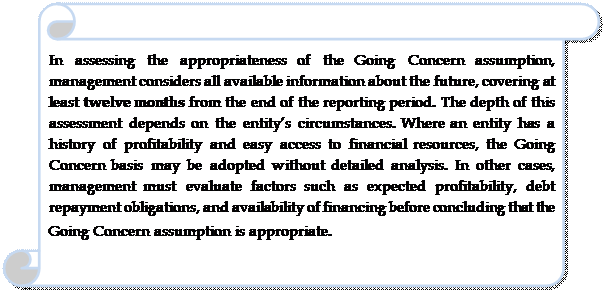
1.2 Is twelve months enough to assess Going Concern?
(a) While Ind AS 1 prescribes a minimum assessment period of twelve months, judicial interpretation and practical experience indicate that this period is often insufficient to assess the true financial viability of an entity. Significant risks such as long-term debt obligations, restructuring plans, regulatory actions, or revival measures usually extend beyond twelve months and cannot be properly evaluated within such a limited timeframe.
(b) It has been observed that Going Concern relates to the foreseeable future, not merely survival for the next year. Therefore, twelve months is only a starting point, and the assessment must extend further wherever facts and circumstances so require to reflect economic reality rather than mere technical compliance.
1.3 When a business makes us Wonder: “Is this still a going concern?”
Let us understand the concept of going concern with the help of some examples:
Case 1
A Company named “Amigo” was incorporated in March of 2015, it thought it would start its business and become a unicorn, but as it turns out, it had no sales, no purchases but incurs some maintenance expenses. The company took loans for business and had some FDRs and some other loans advanced which made them earn income, but their main business never really started. It’s been more than 10 years now, nothing was going on for them, it made the auditors confused if the company is actually a Going Concern or not, which leads us to our doubt
| “What if we just made a Company and did nothing? Will it still be considered a Going Concern? |
2. Conclusion
Well, the answer is not a simple one, as if we try to answer the above doubt with the help of Ind AS 1 or SA 570. Amigo will be considered a Going Concern if it has future projections of cash flows, sufficient funding, and is paying off their liabilities properly but what if they can’t, well in that case they will have material uncertainty over their existence and Going Concern will not be assumed.
To give a final answer, Amigo will be simply considered a Going Concern in reference to ICAI’s guidance note on SA 570, as stated, “A Company can still be considered a Going Concern even if it has no business activity if there are no negative indicators”
Click Here To Read The Full Story
Disclaimer: The content/information published on the website is only for general information of the user and shall not be construed as legal advice. While the Taxmann has exercised reasonable efforts to ensure the veracity of information/content published, Taxmann shall be under no liability in any manner whatsoever for incorrect information, if any.

Taxmann Publications has a dedicated in-house Research & Editorial Team. This team consists of a team of Chartered Accountants, Company Secretaries, and Lawyers. This team works under the guidance and supervision of editor-in-chief Mr Rakesh Bhargava.
The Research and Editorial Team is responsible for developing reliable and accurate content for the readers. The team follows the six-sigma approach to achieve the benchmark of zero error in its publications and research platforms. The team ensures that the following publication guidelines are thoroughly followed while developing the content:
- The statutory material is obtained only from the authorized and reliable sources
- All the latest developments in the judicial and legislative fields are covered
- Prepare the analytical write-ups on current, controversial, and important issues to help the readers to understand the concept and its implications
- Every content published by Taxmann is complete, accurate and lucid
- All evidence-based statements are supported with proper reference to Section, Circular No., Notification No. or citations
- The golden rules of grammar, style and consistency are thoroughly followed
- Font and size that’s easy to read and remain consistent across all imprint and digital publications are applied
Everything on Tax and Corporate Laws of India
To subscribe to our weekly newsletter please log in/register on Taxmann.com








 CA | CS | CMA


