[Global IDT Insights] Cross-Border E-Invoicing – US-EU Pact Boosts Inter-operability
- Blog|News|GST & Customs|
- 2 Min Read
- By Taxmann
- |
- Last Updated on 21 May, 2025
Latest from Taxmann

Editorial Team – [2025] 174 Taxmann.com 712
GlobalIDT Insights provides a weekly snippet of tax news specifically related to Indirect Taxes from around the globe.
1. United States and European Union collaborate to streamline crossborder E-invoicing
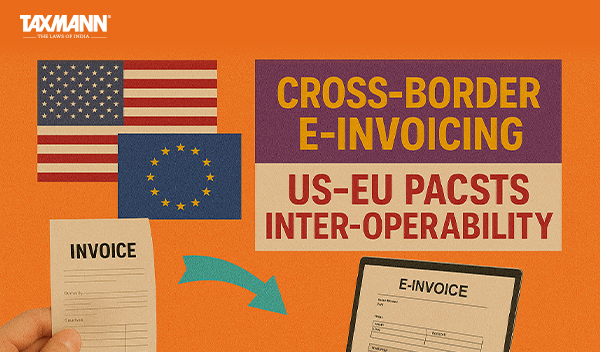
The United States and the European Union have jointly issued a declaration to bolster inter-operability in electronic invoicing (E-invoicing) as part of their collaboration under the Global Trade Challenges Working Group of the Trade and Technology Council. This initiative seeks to streamline cross-border transactions, reduce costs, and enhance cooperation between transatlantic partners by establishing a cohesive framework for the exchange of E-invoices.
E-invoicing is recognised as a transformative business tool that delivers efficiency, cost savings, and operational benefits in trade, customs, border procedures, payments, and fraud mitigation. The joint declaration underscores three shared principles: universal connectivity with all partners through a single integration, no roaming fees between Access Points (APs), and open systems allowing users the freedom to choose their access point provider.
Both regions are committed to advancing inter-operability through alignment of business processes and data models. The effort is being spearheaded by expert groups from respective governmental bodies.
The technical basis for inter-operability includes the use of common syntax standards. Despite this alignment, differences persist in technical specifications and service provider operations across markets. The joint initiative aims to resolve these differences through further standardisation and cooperation.
Specific areas identified for enhanced technical alignment include:
- Standardisation and flexibility within data structures to accommodate diverse legal and business requirements.
- Harmonisation of payloads in E-invoices to ensure business and technical compatibility.
- Development of roaming capabilities between service providers to ensure seamless interoperability.
The benefits of achieving E-invoicing interoperability are considerable. Faster invoice processing and reduced data translation contribute to improved liquidity and cash flow optimisation for businesses on both sides. Furthermore, reducing complexity and cost in cross-border transactions can significantly empower small and medium-sized enterprises (SMEs), enhancing their participation in international trade.
In summary, the joint declaration represents a significant step toward harmonising digital trade infrastructures between two of the world’s largest economies. Through cooperative technical and policy engagement, the United States and the European Union are laying the groundwork for a more efficient and innovative global trade environment.
Source : Official News
Click Here To Read The Full Article
Disclaimer: The content/information published on the website is only for general information of the user and shall not be construed as legal advice. While the Taxmann has exercised reasonable efforts to ensure the veracity of information/content published, Taxmann shall be under no liability in any manner whatsoever for incorrect information, if any.

Taxmann Publications has a dedicated in-house Research & Editorial Team. This team consists of a team of Chartered Accountants, Company Secretaries, and Lawyers. This team works under the guidance and supervision of editor-in-chief Mr Rakesh Bhargava.
The Research and Editorial Team is responsible for developing reliable and accurate content for the readers. The team follows the six-sigma approach to achieve the benchmark of zero error in its publications and research platforms. The team ensures that the following publication guidelines are thoroughly followed while developing the content:
- The statutory material is obtained only from the authorized and reliable sources
- All the latest developments in the judicial and legislative fields are covered
- Prepare the analytical write-ups on current, controversial, and important issues to help the readers to understand the concept and its implications
- Every content published by Taxmann is complete, accurate and lucid
- All evidence-based statements are supported with proper reference to Section, Circular No., Notification No. or citations
- The golden rules of grammar, style and consistency are thoroughly followed
- Font and size that’s easy to read and remain consistent across all imprint and digital publications are applied
Everything on Tax and Corporate Laws of India
To subscribe to our weekly newsletter please log in/register on Taxmann.com








 CA | CS | CMA


