Company Valuation Methods for M&A | Basics and Approach
- Blog|Company Law|
- 15 Min Read
- By Taxmann
- |
- Last Updated on 10 November, 2025
Latest from Taxmann


Company valuation methods for Mergers and Acquisitions (M&A) are the financial techniques used to estimate the fair value of a target company before it is acquired or merged. These methods help buyers and sellers determine what the business is truly worth, evaluate the deal, and negotiate pricing.
Table of Contents
- Introduction
- Factors Affecting Valuation
- Valuation Basics
- Asset Based Approach
- Dividend Based Approach
- Earnings Approach
- Cash Flow Approach
- Estimating the Value of the Target
Check out Taxmann's Mergers Acquisitions & Corporate Restructuring – Strategies & Practices which offers an in-depth, practice-oriented exploration of the entire M&A lifecycle—from strategic formulation and valuation to legal compliance, taxation, financing, integration, and governance. Thoroughly revised to reflect the latest updates under the Companies Act, SEBI Takeover Code, Competition Act, and IBC, this Edition also introduces an innovative chapter integrating Indian Knowledge System (IKS) principles into corporate governance, along with a data-driven analysis of market-reaction case studies. With structured summaries, self-assessment tools, and real-world examples, it bridges theory and practice—making it an indispensable resource for students, professionals, and corporate decision-makers.
1. Introduction
When an acquiring company decides to acquire a target company then, the next step is to estimate the value of the target company. After completion of the valuation process, the value of the target company is then used, along with a proposed financing scheme, to negotiate the transaction on a friendly or hostile basis. However, research findings on M&As indicates that in many cases, M&As tend to destroy value, to not return their cost of capital, to rarely achieve their planned synergies and so on.
In reality, these can all be linked back to saying that the buyer has over paid for the acquisition. However, even paying a great price for a target, M&A can go wrong if either the strategy underlying it, is not well thought out or if the buyer is not buying what it thinks of buying. While much attention is paid to the clearly important art of valuation, attention also need, to be paid to evaluate the deal. Several methods exist to arrive at the desired value of a target. Depending on the industry, type of company, stage of company growth, structure of deal proposed, strategic plans for the target, private or public status, and other considerations, different valuation techniques will be used. Numerous methods of valuation are available. However, the choice of a particular method depends on the parties involved in the process. Hence, several methods are typically used to provide a range of valuations, after which the parties often rationalise the choice of analysis that supports their intended objectives.
Further, business is based on expectations which are dynamic; valuation also tends to be dynamic and not a static process which means that the same transaction would be valued by the same players at different values at two different times.

2. Factors Affecting Valuation
Determining the realistic value of target firm is a complex process. It may be noted that the market price of a share of the target firm can be a good approximation to find out the value of the firm. Theoretically speaking, the market price of share reflects not only the current earnings of the firm, but also the investor’s expectation about future growth of the firm. However, the market price of the share cannot be relied in many cases or may not be available at all. For example, the target firm may be an unlisted firm or not being traded at the stock exchange at all and as a result the market price of the share of the target firm is not available. Even in the case of listed and often traded companies, a complete reliance in the market price of stock is not desirable as:
(a) the market price of that stock may be affected by insider trading
(b) sometimes, the market price does not fully reflect the company’s financial and profitability position, as complete and correct information about the firm is not available to the investors.
So, how do buyers and sellers arrive at a conclusion regarding valuation of a particular company?
The process of concluding the valuation process should include a detailed and comprehensive analysis which takes into account a range of factors including the past, present and most importantly, the future earnings prospects of the company, an analysis of its mix of physical and intangible assets and the general economic and industry conditions1.
3. Valuation Basics
Valuation is essential in M&As to ensure fair pricing and transparency. Market-based approaches like the Comparable Public Company Method and Comparable Transaction Analysis help assess a company’s worth.
3.1 Comparable Public Company Method
For the valuation of a company, public markets are very efficient. Stock prices are determined by the decisions of buyers and sellers all around the world. In this process, to value a private company, already existing similar public companies are used as a touchstone. The methodology of this process is to first select a group of publicly traded companies that can be considered as representatives of the company which is to be valued. This will help the investors to see the target company and the compared companies as the same. The financial or operating data of each comparable company, for example, EBITDA, or book value, is compared to their total market capitalisation to obtain a valuation multiple. The target company’s valuation is analysed by calculating the average of these multiples.
3.2 Comparable Transaction Analysis
This technique is quite the same as the comparable company analysis. The valuer in this method, to analyse the acquisition value of the target company, will take the help of recent acquisitions and takeovers. In this method, it is not necessary to value the takeover premium separately. It is a quite logical, simple, and straight forward approach. The analysis of recent acquisitions and takeovers gives fresh and recent values as they were recently finalised in the market. Unlike DCF analysis, this technique is not built on assumptions of various kinds. Since the valuation is established by the analysis of recent acquisitions, there is a very low possibility of legal disputes. In India, the valuation process of a company is to be done by a Registered Valuer (RV). It is to make sure of transparency and unbiased process for both the acquirer and the target entity. RV is a professional who determines the valuation of shares, both tangible and intangible assets, etc. of a company. In India, there is a requirement of training, 3 to 5 years of experience in the branch of valuation and a certificate of practice to be working as a Registered Valuer.
The Insolvency and Bankruptcy Board of India is a body that monitors the qualifications for a registered valuer. As per the guidelines, it is necessary for an RV to provide a valid certificate of practice and registration number when asked.
In the case of international transactions of M&A, the valuation is regulated by the Foreign Exchange Management Act, 1999 which prescribes that the valuation of these transactions shall be certified by a registered merchant banker with SEBI.
The tools of valuation can be classified into the following types:
(a) Asset based valuation: The asset based methods consider either the book value (assets net liabilities) or the net adjusted value (revalued net assets). If the company has intangible assets like brands, copyrights, intellectual property etc. these are valued independently and added to the net asset value to arrive at the business value. Sometimes, if the business were not to be acquired on a going concern basis, the liquidation value (or realisable value) is considered for the purpose of valuation.
(b) Market based valuation: The market value approach is based on the fundamental principle, that market valuation of company’s equity and debt reflect the true value. However, it is common to revalue a company based on the trading multiples of a group of similar companies. Because it is presumed that the market can misperceive the value of a company and that by looking at its competitors, you can find a more appropriate valuation. It is critical to find a peer group of firms that are direct competitors or in closely related industries and of comparable sizes and growth stages. The number often need to be adjusted for capital structures, growth rates, firm sizes and different fiscal year ends. General comparison practices include market capitalisation and enterprise value multiples revenues of and cash flows plus measures of price to earnings and price to earnings to growth rate ratios.
(c) Dividend based valuation: Since, dividends are distributed out of profits; the alternative to the payment of dividend is the retention of earnings/profits. The retained earnings constitute an easily accessible important source of financing the investment requirements of firms. There is, thus, a type of inverse relationship between retained earnings and cash dividends, larger retentions, lesser dividends and smaller retention, larger dividends. The valuation is based on the principle that value of a stock is the present value of expected dividends on it.
(d) Earnings based valuation: Earning and cash flows based valuation (DCF being the most common technique) takes into consideration the future earnings of the business and hence the appropriate value depends on projected revenues and costs in future, expected capital outflows, number of years of projection, discounting rate and terminal value of business.
Premiums and discounts are typically attached to a business valuation, based on the situation. The premiums or discounts are the form of market share premium, controlling stake premium, brand value premium and small player discount or unlisted company discount. Further, timing of sale is a very important factor in valuation. Timing is crucial keeping in mind economic cycles, stock market situation and global considerations. The valuation process may be based on following approaches.
4. Asset Based Approach
In most of the M&A cases, the acquiring company ‘eyes’ the target company and is ready to pay for the ‘Net worth’ of the target company. This ‘Net worth’ of the target company depends upon the valuation of tangible and intangible assets of the target company.
There are two approaches to find out the value of a company using this method.
4.1 Book Value Approach
In this approach, the values of the assets are ascertained from the latest balance sheet of the target company. From the total of the book value of all assets, the amount of external liabilities is deducted to find out the net worth.
BV = TA – EL
BV = Book Value
TA = Total Assets
EL = External liabilities
The book value so arrived is divided by number of equity shares to find out value per equity share.
The book value method suffers from some major shortcomings,
(i) It is based on the historical costs which may not be relevant at present.
(ii) Different companies follow different methods of accounting of depreciation reflecting subjective judgments which dilute objectivity.
(b) Realisable Value/Replacement Value Approach: In this case, the realisable value/replacement value of all the tangible and intangible assets of the firm are estimated and from this value, the expected external liabilities are deducted to find out the value of the firm. This approach is definitely a better approach over book value, as it gives a current and close approximation to the Net Worth of the target company.
Tobin’s Q: This approach is based on the relationship between the assets of a firm and its market value. Tobin’s Q is the ratio of the market value of a firm to the replacement cost of its assets.
Tobin’s Q = Market value of a firm/Replacement cost of its assets
The replacement cost of an asset is the cost of acquiring an asset of identical characteristics, such as the manufacturing unit. For example, if the market value of an enterprise is ₹ 500 crores and the replacement cost of its assets is ₹ 250 crores. Then, Tobin’s Q is 2. This signifies that the enterprise is in possession of certain intangible assets such as future growth opportunities. The excess market value of the enterprise may also affect those opportunities.
Thus, the value of an enterprise consists of two elements, i.e.
Value of Enterprise = Replacement Cost of Assets + Value of Growth Opportunities
If we continue with the above example and change the figure for market value of the firm to ₹ 200 crores. Then Tobin’s Q becomes < 1. This means the enterprise is undervalued. Thus, Tobin’s Q has been used in M&A context to spot undervalued companies. In the early 1980s, companies in the west were selling at Q value below one; that is at a discount to their assets at replacement cost. This discount was grabbed upon by many predators who bided for those undervalued companies.
Hence, Tobin’s Q can also be used as a valuation tool in the same context as P/E ratio. However, there are limitations in using Tobin’s Q for valuation :
(i) Selection of a cut off Q is very difficult as asset structures of firms could differ considerably even if; they are in the same business.
(ii) Further, evaluation of the underlying growth options is not easy. Growth opportunities for different firms in the future are not always identical.
(iii) Published accounts of companies show assets at historical costs, not at replacement cost. Although, frequent revaluations allow reported firm asset values to approximate to their replacement cost, this practice is not consistently followed by all firms.
5. Dividend Based Approach
Dividends refer to that portion of a firm’s net earnings which are paid out to the shareholders. Since dividends are distributed out of the profits, the alternative to the payment of dividends is the retention of earnings/profits. The retained earnings constitute an easily accessible important source of financing the investment requirements of firms. There is, thus, a type of inverse relationship between retained earnings and cash dividends: larger retentions, lesser dividends and smaller retentions, larger dividends. The basic model for valuing equity is the divided discount model where the value of a stock is the present value of expected dividends on it.
When investors buy stock, they generally expect to get two types of cash flows:
- Dividends during the period, they hold the stock and
- An expected price at the end of the holding period.
Since this expected price is itself determined by future dividends, the value of a stock is determined as follows.

where D1, D2, D3…. Dn _ Value of the stream of dividends over the lifetime n of the company.
ke = cost of equity of the company
Pn = Value of the share as and when sold in the future year n.
The rationale for the model lies in the present value concept i.e. the value of any asset is the present value of expected future cash flows, discounted at a rate appropriate to the riskiness of the cash flows being discounted.
Versions of the Model: Since projections of dividends cannot be made through infinity, several versions of the dividend discount mode have been developed based upon different assumptions about future growth. However, forecasting future varying dividends and risk adjusted discount rates are difficult. Hence, this model can be modified to include a constant dividend which is given below:

Where ‘g’ is the growth rate. This model assumes that the dividend’s growth is created through new investments financed by retained earnings. Further, it assumes that there will be a constant rate of dividend pay outs.
There are however, conflicting opinions regarding the impact of dividends on valuation of a firm. According to one approach, dividends are irrelevant so that the amount of dividends paid has no effect on the valuation of a firm. On the other hand, certain theories consider the dividend decision as relevant to the value of the firm measured in terms of the market price of the shares.
An analysis of some important theories representing these two schools of thought with a view to understand relationship between dividend policy and the valuation of a firm is given in the annexure 1.
6. Earnings Approach
The worth/value of the target company may be estimated by employing earnings approach. The basic logic behind this approach is that the buyer expects yearly income/return great or small, stable or fluctuating but nevertheless some return which is commensurate with the price paid for.
The earnings of the target are estimated after taking into account any changes which the acquirer plans to make to the operations and restructuring of the target in the post-acquisition period. Valuation based on the earnings approach takes into account the rate of return (ROR) on capital employed. Alternately, Price Earnings Ratio (P/E) is used instead of the Rate of Return (ROR). This expresses a relationship between a firm’s earnings for equity and its equity market capitalisation. The P/E ratio (P/E) of a listed company can be calculated by dividing the market price per share by earning per share. Therefore, the reciprocal of P/E ratio is called Earnings-Price ratio or Earning Yield.
PER = P/EPS
Where, P = Market price of share
EPS = Earnings per share
Thus, P = P/E × EPS
Here, the earnings of the firm can either be past profits or future expected profit. However, the future expected earnings may be chosen for obvious reasons. The acquiring company shows interest in taking over the target company for the expected synergistic growth of the company. The estimation of future earnings (based on past experience) carry synergistic element in it. Thus, the expected future earnings of the target company give a better valuation. However, the major limitations of this approach are:
(a) The estimation of earnings is accounting figures and based on past performance.
(b) There is no explicit recognition of the time pattern of earnings growth. This approach estimates the post acquisition earnings for the target company for a single period and assumes that this level will be maintained.
Considering a Benchmark P/E: Practitioners and Investment consultants generally used a benchmark P/E for valuation of M&A deals. The benchmark P/E in use could be industry average or it could be the result of negotiation between the acquirer and target. Generally, it is observed that the negotiated P/E is much higher than the Industry P/E which represents the premium for the target. When acquiring company intends to pay a huge premium for acquisition, it naturally expects additional value from the deal. Thus, the acquiring company needs to exercise caution while estimating the deal value.
7. Cash Flow Approach
This method of valuation takes into account future cash flows. These cash flows are then discounted at an appropriate rate of discount to find out the present value of the firm. This approach is also known as Discounted Cash Flow (DCF) analysis. In other words, this analysis consists of projecting the future cash inflows; find out the total present values of these cash flows by discounting at an appropriate rate with reference to time pattern.
A simple DCF model may be carried out in the following steps:
- Estimate the future cash inflows (i.e., profit after tax + non-cash expenses).
- Find out the total present value of these cash flows by discounting at an appropriate rate.
- If the acquiring firm is agreeing to take over the liabilities of the target firm, then these liabilities are deducted as cash out flows at time zero from the present value of future cash inflows.
- The resultant figure is the net present value (NPV) of the acquiring firm and may be considered as the maximum purchase price, which the acquiring firm should be ready to pay.
Symbolically,
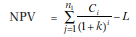
Where NPV = Net Present Value
Ci = Cash inflows over different years
L = Current value of liabilities
k = Appropriate discount rate.
The discount rate k is also referred as cost of capital. Here, the cost of capital is the weighted average cost of capital (WACC) which represents the return, expected by an owner of the company commensurate with the risk associated with the investing. It is estimated from the target company’s pre-acquisition cost of equity and debt.
Symbolically, K0 = Ke W1 + Kd W2 + Kp W3
Where, K0 = Weighted average cost of capital
Ke = Cost of equity capital
Kd = After tax cost of debt
Kp = Cost of preference shares
W1 = Proportion of equity capital in capital structure
W2 = Proportion of debt in capital structure
W3 = Proportion of preference capital in capital structure.
A company with little track record receives a higher discount rate than a company with a long history of growth and profitability and more obvious future prospects.
Estimation of cost of equity is the most challenging task in weighted average cost of capital. Shareholders and creditors expect to be compensated for the opportunity cost of investing their funds. The capital asset pricing model (CAPM) may be used to estimate the historic cost of equity for the target. The CAPM estimates the investor-required return as the sum of a risk-free rate and a risk premium based on the overall market risk premium and the risk of the stock in relation to the market. This risk is known as systematic risk and beta b is the measure for it,
Ke = Rf + b [E(Rm)-R1]
where Ke = Cost of equity
Rf = Risk free return, i.e. return on 90 day government treasury bills
E(Rm) = Expected return on the market portfolios
[E(Rm)-R1] = Market premium
b (beta) = Systematic risk2
The pre-acquisition expected return on equity for the target needs to be adjusted for a possible change in the target beta after the acquisition. This adjustment, necessitated by changes in the underlying operating characteristics of the target due to the acquisition is somewhat looking subjective. Another area of difficulty is estimating cost of debt. After estimating the individual components of the cost of capital, we then weight them by the proportion of each type of capital in the capital structure of the target.
8. Estimating the Value of the Target
Under this model, the value of the target’s free cash flows to the acquirer is—
Where TVA = Target value after acquisition
FCFt = Free cashflows of target in period t.
Vt = Terminal value of target at t.
k0 = Weighted average cost of capital.
Ke = Cost of equity
Table: Determinants of Free Cash Flow
| Sequence | Free Cashflows Components & Annual revenues |
| Less | Operating costs and expenses including marketing and administration |
| Equals | Earnings Before Depreciation, Interests and Taxes (EBDIT) |
| Less | Taxes on EBIT |
| Less | Change in deferred taxes |
| Equals | Net operating profit less adjusted taxes |
| Add | Depreciation and Amortisation |
| Equals | Capital expenditure |
| Less | Increase/decrease in net working capital and other assets |
| Equals | Free Cashflow from operations |
| Add | Non-operating Cashflows |
| Equals | Free Cashflow |
The terminal value is the value of the company’s expected cashflows beyond the explicit forecast period. An accurate estimation of terminal value is critical because it accounts for a large percentage of the total value of the company in a discounted cashflow valuation. There are three ways to estimate terminal value,
(i) Stable Perpetuity
Terminal value = Free cash flows/Weighted average cost of capital
(ii) Growing Perpetuity
Terminal value = FCF (1+g)/k0 – g
where FCF = Free cashflows
g = Growth rate
K0 = Weighted average cost of capital
(iii) Multiple Approach
(a) Multiple of Earnings Approach
Terminal value = FCFt+1 × P/E multiple of industry or comparable
(b) Multiple of Book Value Approach
Terminal value = Book value of capital × M/B rates where M/B is the market to book ratio. Normally, the current M/B ratio is taken as proxy for the future.
1. The Department of Company Affairs (Now, Ministry of Corporate Affairs) appointed an expert Committee in October 2002, to recommend comprehensive rule governing “Valuation of Corporate Assets and Shares” under the Companies Act. The Committee submitted its report in January 2003.
2. This is also taken as the sensitivity of the company’s share return to the market return. This represents an investment’s volatility relative to an appropriate asset class. The asset class is generally represented by the broad-based market indices like Sensex, Nifty, S&P 500 etc. the following formula is used for calculation of beta:

m = Rate of return of the asset class or market represented by stock market index
Cov = Covariance between returns of the stock and market
SD = Standard deviation of the market return.
Disclaimer: The content/information published on the website is only for general information of the user and shall not be construed as legal advice. While the Taxmann has exercised reasonable efforts to ensure the veracity of information/content published, Taxmann shall be under no liability in any manner whatsoever for incorrect information, if any.

Taxmann Publications has a dedicated in-house Research & Editorial Team. This team consists of a team of Chartered Accountants, Company Secretaries, and Lawyers. This team works under the guidance and supervision of editor-in-chief Mr Rakesh Bhargava.
The Research and Editorial Team is responsible for developing reliable and accurate content for the readers. The team follows the six-sigma approach to achieve the benchmark of zero error in its publications and research platforms. The team ensures that the following publication guidelines are thoroughly followed while developing the content:
- The statutory material is obtained only from the authorized and reliable sources
- All the latest developments in the judicial and legislative fields are covered
- Prepare the analytical write-ups on current, controversial, and important issues to help the readers to understand the concept and its implications
- Every content published by Taxmann is complete, accurate and lucid
- All evidence-based statements are supported with proper reference to Section, Circular No., Notification No. or citations
- The golden rules of grammar, style and consistency are thoroughly followed
- Font and size that’s easy to read and remain consistent across all imprint and digital publications are applied
Everything on Tax and Corporate Laws of India
To subscribe to our weekly newsletter please log in/register on Taxmann.com








 CA | CS | CMA


