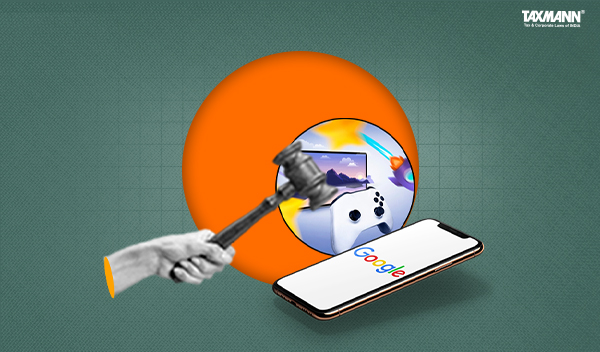
CCI Orders Probe into Google’s Alleged Abuse of Dominance for Denying Market Access to Gaming App Developers
- Blog|News|Competition Law|
- 2 Min Read
- By Taxmann
- |
- Last Updated on 4 December, 2024
Latest from Taxmann

Case Details: Winzo Games (P.) Ltd., In re - [2024] 168 taxmann.com 687 (CCI)
Judiciary and Counsel Details
- Ms Ravneet Kaur, Chairperson, Anil Agrawal, Ms Sweta Kakkad & Deepak Anurag, Member
-
Abhishek Malhotra, Ms Srishti Gupta, Ms Atmaja Tripathi, Ms Anukriti Trivedi & Ms Nishtha Chaturvedi, Advs. for the Petitioner.
-
Sajan Poovaya, Sr. Adv., Karan Singh Chandhiok, Avinash Amarnath, Rahul Rai, Ms Shivanghi Sukumar, Ms Raksha Agarwal, Palash Maheshwari, Ms Tarun Donadi, Uday Bali, Ms Aditi Gopalakrishnan & Ms Arunima Chatterjee, Representatives of Google, for the Respondent.
Facts of the Case
In the instant case, the Informant was a digital gaming and technology company that operated an online digital gaming platform under its trademark and brand name, ‘Winzo’. Google operated ‘Google Play,’ wherein third-party app developers made their apps available to users. The Informant filed instant information and made various allegations against Google, inter alia, in relation to its app store and advertisement policies.
It was noted that where Google updated its Developer Program Policies and Developer Distribution Policy under which it commenced a Pilot Program to test placement of only two types of real-money gaming (RMGs) in Google’s Play Store in India i.e., Daily Fantasy Sports (DFS) and Rummy, such direct access to end-users via dominant Play Store provides a significant competitive edge to DFS and Rummy apps, potentially disadvantaging other RMG applications.
CCI Held
The CCI held that this selective onboarding prima facie distorts the competitive landscape to the disadvantage of apps not covered in the Pilot. Further, Google had restricted its advertisements policy (modified ad policy) by only allowing DFS and Rummy app advertisers to host advertisements using Google Ads.
This selective onboarding of certain app categories (i.e., DFS and Rummy) appeared to distort the competitive landscape to the disadvantage of other RMG apps excluded from advertising on Google. Such practices were in violation of Section 4(2)(b) of the Competition Act, 2002.
Disclaimer: The content/information published on the website is only for general information of the user and shall not be construed as legal advice. While the Taxmann has exercised reasonable efforts to ensure the veracity of information/content published, Taxmann shall be under no liability in any manner whatsoever for incorrect information, if any.

Taxmann Publications has a dedicated in-house Research & Editorial Team. This team consists of a team of Chartered Accountants, Company Secretaries, and Lawyers. This team works under the guidance and supervision of editor-in-chief Mr Rakesh Bhargava.
The Research and Editorial Team is responsible for developing reliable and accurate content for the readers. The team follows the six-sigma approach to achieve the benchmark of zero error in its publications and research platforms. The team ensures that the following publication guidelines are thoroughly followed while developing the content:
- The statutory material is obtained only from the authorized and reliable sources
- All the latest developments in the judicial and legislative fields are covered
- Prepare the analytical write-ups on current, controversial, and important issues to help the readers to understand the concept and its implications
- Every content published by Taxmann is complete, accurate and lucid
- All evidence-based statements are supported with proper reference to Section, Circular No., Notification No. or citations
- The golden rules of grammar, style and consistency are thoroughly followed
- Font and size that’s easy to read and remain consistent across all imprint and digital publications are applied
Everything on Tax and Corporate Laws of India
To subscribe to our weekly newsletter please log in/register on Taxmann.com








 CA | CS | CMA


