[Analysis] Bare Acts Online – Checking the Current Text | Amendment History | The Act as First Enacted
- Blog|Indian Acts|
- 3 Min Read
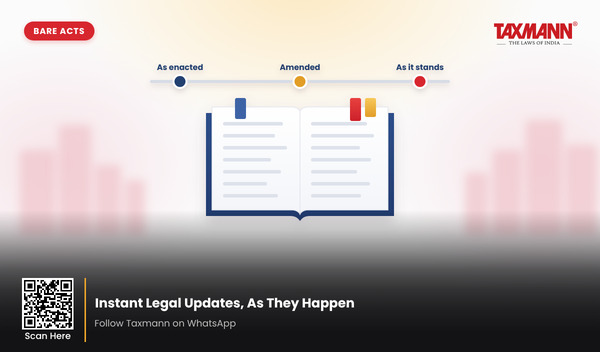
A bare act is only as good as its last amendment. How to check you have the current text, trace a section’s amendment history and find the Act as first enacted.
- By Taxmann
- |
- Last Updated on 18 November, 2026
Latest from Taxmann

Law stated as on 18 November 2026.
Table of Contents
- Why the current text is harder to find than it looks
- How to check you have the current text
- When you need the Act as first enacted
- Central Acts as amended, and as first enacted
- Frequently asked questions
1. Why the current text is harder to find than it looks
When a matter turns on the text of a law, you need the current version and the earlier ones.
Parliament amends a principal Act through amending Acts, including Finance Acts, so the text in force is the principal Act with each later change worked in. A copy printed or saved before the last amendment will not show it.
2. How to check you have the current text
- Note the date of your copy, and check for amending Acts passed since.
- Check the amendment history of the section you rely on, not just the Act’s title page.
- If the date of an event matters, find the text as it stood on that date.
- For a recent change, read the amending Act itself, as published in the Gazette of India.
- Keep the Rules in view: a change to the Rules or to a statutory form can matter as much as a change to the Act.
3. When you need the Act as first enacted
Some questions turn on the original words: how a provision read before an amendment, or what Parliament first enacted. For those, you need the Act as first enacted and each amending Act in turn.
Repealed Acts matter too: a matter that arose before a repeal may still turn on the repealed text.
4. Central Acts as amended, and as first enacted
Taxmann.com | Research keeps Central Acts as amended and as first enacted, checked by Taxmann’s editors.
- 385+ Central Acts and State GST Acts, with amendment history, and 1,250+ Rules with their statutory forms.
- Acts of Parliament since 1950, with their gazetted copies.
- Bills since 2015, Ordinances since 2013, and Finance Bills and Acts since 1961.
- 80+ repealed Acts and 280+ repealed Rules.
- The Act & Rule Comparator: sections of two Acts or Rules side by side.
Open Indian Acts & Rules, Acts Of Parliament, year 2026: the Insolvency and Bankruptcy Code (Amendment) Act, 2026 [6 of 2026] opens as its Gazette of India copy.
5. Frequently asked questions
What is a bare act?
The text of an Act on its own, without commentary or notes.
How do I know a bare act is up to date?
Check its date against the amending Acts passed since, and check the amendment history of the section you rely on.
Where can I find an Act as first enacted?
In its gazetted copy. In Taxmann.com | Research, Acts of Parliament since 1950 come with their gazetted copies.
Can I compare sections of two Acts side by side?
Use a comparator. In Taxmann.com | Research, the Act & Rule Comparator sets sections of two Acts or Rules side by side.
Try Taxmann.com | Research free for 7 days
One trial per person in each product. Trial access is usually read-only, and printing and downloading may be off. A new trial is possible after 12 months.
Related reading: Bare Acts for AIBE 2026.
Disclaimer: The content/information published on the website is only for general information of the user and shall not be construed as legal advice. While the Taxmann has exercised reasonable efforts to ensure the veracity of information/content published, Taxmann shall be under no liability in any manner whatsoever for incorrect information, if any.

Taxmann Publications has a dedicated in-house Research & Editorial Team. This team consists of a team of Chartered Accountants, Company Secretaries, and Lawyers. This team works under the guidance and supervision of editor-in-chief Mr Rakesh Bhargava.
The Research and Editorial Team is responsible for developing reliable and accurate content for the readers. The team follows the six-sigma approach to achieve the benchmark of zero error in its publications and research platforms. The team ensures that the following publication guidelines are thoroughly followed while developing the content:
- The statutory material is obtained only from the authorized and reliable sources
- All the latest developments in the judicial and legislative fields are covered
- Prepare the analytical write-ups on current, controversial, and important issues to help the readers to understand the concept and its implications
- Every content published by Taxmann is complete, accurate and lucid
- All evidence-based statements are supported with proper reference to Section, Circular No., Notification No. or citations
- The golden rules of grammar, style and consistency are thoroughly followed
- Font and size that’s easy to read and remain consistent across all imprint and digital publications are applied
Everything on Tax and Corporate Laws of India
To subscribe to our weekly newsletter please log in/register on Taxmann.com









 CA | CS | CMA


