Audit Evidence and Audit Sampling | Complete Guide to SA 500 & SA 530
- Blog|Account & Audit|
- 12 Min Read
- By Taxmann
- |
- Last Updated on 4 July, 2026
Latest from Taxmann


Audit evidence and audit sampling are fundamental concepts that enable auditors to form reliable and independent opinions on an entity's financial statements. Obtaining sufficient and appropriate audit evidence is essential for assessing financial accuracy, identifying material misstatements, and ensuring compliance with auditing standards. Equally important, audit sampling allows auditors to examine representative transactions efficiently while maintaining audit quality. This guide explains the principles of audit evidence, audit procedures, sampling techniques, and Standards on Auditing (SA 500 and SA 530) to help students and professionals strengthen their understanding of the audit process.
Table of content
- Significance of audit evidence
- Audit Evidence – SA 500
- Test checking/selective verification
- Audit Sampling
1. Significance of audit evidence
Audit evidence is a fundamental constituent of an audit process. It is defined as any document, record or information which is available to substantiate any assertion made in financial statements or transactions recorded in the books of account. The auditor applies his professional judgment to the evidence gathered and obtained during the audit process. He forms his opinion as to the truthfulness and fairness of financial statements on the basis of review of such evidence and expresses his opinion through an audit report.
2. Audit Evidence – SA 500
SA 500, Audit Evidence, issued by the ICAI deals with the basic principles relating to audit evidence.
2.1 Objective
The primary objective of SA 500 is to ensure that auditors design and perform audit procedures to obtain sufficient appropriate audit evidence to draw reasonable conclusions on which to base the auditor’s opinion.
2.2 Sufficiency and appropriateness of audit evidence
‘Sufficiency’ refers to the quantum of audit evidence obtained. For example, the auditor of a computer software company would sample more items of inventory for obsolescence than the auditor of a tyre manufacturing company. Similarly, plant asset additions for a manufacturing entity will be audited more intensely than miscellaneous expenses.
‘Appropriateness’ relates to relevance and reliability of such evidence. For
example, the auditor may compare inventory levels for the current year to that of prior years by doing ration analysis. In case it is substantially higher for the year under audit, he may seek management representation and obtain confirmations directly from consignees and parties to whom goods have been sold on approval basis. Such evidence will help the auditor to detect misstatements of inventory and assess the possibility of inventory obsolescence and will constitute appropriate evidence.
2.3 Audit procedures to obtain audit evidence:
These procedures can be broadly classified into three main categories: risk assessment procedures, tests of controls, and substantive procedures.
(i) Risk assessment procedures
These procedures help the auditor understand the entity and its environment, including its internal control to identify and assess the risks of material misstatement.
(ii) Tests of controls/Compliance procedures
The compliance procedures are audit tests designed to obtain a reasonable assurance as to reliability of internal control system. They seek to test:
(a) that the internal control exists, i.e., existence,
(b) that the internal control is operating effectively, i.e., effectiveness and
(c) that the internal control has so operated throughout the period under audit i.e., continuity.
(iii) Substantive procedures
The substantive procedures are audit tests designed to obtain evidence to verify balance of an account or a specific financial statement assertion. In other words, they test the validity and propriety of the accounting treatment of transactions. They can be classified as either test of details of transactions and balances or as analytical review procedures. They seek to test:
(a) that an asset or a liability exists at a given date i.e., existence,
(b) that an asset is a right of the entity and a liability is an obligation of the entity at a given date i.e., rights and obligations,
(c) that a transaction or event occurred and pertains to the entity during the relevant period i.e., occurrence,
(d) that there are no unrecorded assets, liabilities or transactions i.e., completeness,
(e) that asset or liability is recorded at an appropriate carrying value i.e., valuation,
(f) that a transaction is recorded at the proper amount and revenue or expense is allocated to the proper period i.e., measurement, and
(g) an item is disclosed, classified and described in accordance with recognised accounting policies and practices and relevant statutory requirements, if any i.e., presentation and disclosure.
2.4 Compliance procedures vs. Substantive procedures
(i) Compliance procedures are used to assess the reliability of internal control system while substantive procedures are designed to assess the validity and propriety of accounting treatment of transactions.
(ii) Compliance procedures provide evidence as to whether misstatement is likely while substantive procedures provide evidence about whether misstatement actually exists.
Example : Compliance procedures reveal that the internal control system with regards to credit sales is weak, the auditor may conclude that credit sales may not be correctly stated in the profit and loss account. However, after conducting substantive procedures (tracing sales invoices to the accounting records; comparison of credit sales figures with that of last year’s; confirmation from debtors; etc.) the auditor can conclude that misstatement exists and the financial statements need adjustments.
(iii) The extent of substantive procedures is dependent upon the results of compliance procedures. For example, if the compliance procedures in the above example indicate that the internal control system as to credit sales is strong and is operated as per plan, then related substantive tests can be reduced, but not eliminated.
2.5 Reliability of audit evidence
The reliability of audit evidence depends on its source, nature and the circumstances in which it is obtained. However, the following generalisations may be useful for assessing the reliability of evidence obtained through compliance and substantive procedures:
(i) Evidence obtained by the auditor himself through physical examination, observation, inspection and mathematical computations is more reliable than that obtained through the entity.
(ii) External evidence is usually more reliable than internal evidence. External evidence is the evidence obtained directly from independent sources. Internal evidence refers to documents that originate and are stored within the client’s information system. For example, a bank’s confirmation of secured loan obtained by the client (external evidence) is more reliable than the answers obtained from enquiries of the client.
(iii) Documentary evidence is usually more reliable than oral represen-
tations.
However, different categories of documentary evidence provide different degree of reliability.
(iv) Reliability of internal evidence depends upon the strength of related internal control system. Evidence derived from a well-controlled information system is more reliable than a poorly controlled information system. In some cases e.g. for estimating warranty liabilities the auditor has to rely on information that resides internally in the information system.
2.6 Techniques of obtaining evidence
The techniques used for gathering evidence are given below:
(i) Inspection: Inspection refers to the examination of records and of documentary evidence such as lease deeds, investment certificates, whether originating from the third parties or the entity and held by either. It also indicates physical examination of tangible assets to ensure their actual existence. The various records and documents provide evidence of varying degree of reliability depending on their nature and source and effectiveness of internal controls over their processing.
(ii) Observation: Observation refers to witnessing a process or procedure being performed by others. For example, if an auditor observes a physical count of inventory, he would be able to assess whether obsolete or damaged inventory is identified properly by the staff of the client. Similarly, observation of client’s personnel performing accounting tasks would help the auditor in determining whether each employee is performing the assigned task.
(iii) Enquiry: Enquiry consists of seeking appropriate written or oral
information from the client or his staff or third parties having knowledge about a particular item or a phase of client’s operations. For example, questions asked to credit manager of the client about realisability of receivables or to store room supervisor about obsolete inventory items or externally to a lawyer about the probable outcome of litigation.
(iv) Confirmation: Confirmation refers to substantiation by a knowledge-
able third party, in response to specific enquiry/request by the auditor, of financial information contained in accounting records. An illustrative list of items that are frequently confirmed is given in Table 5.1
Table 5.1 : Information Frequently Confirmed
| Information | Source |
| Assets | |
| Cash in bank | Bank |
| Accounts receivable | Debtor |
| Owned inventory out on consignment | Consignee |
| Liabilities | |
| Accounts payable | Creditor |
| Advances from customers | Customer |
| Owners equity | |
| Shares outstanding | Registrar and broker |
| Other information | |
| Insurance coverage | Insurance company |
| Contingent liabilities | Banker, lender and others |
Source: Adapted from Arens, Alvin A. and James K. Loebbecke, “Auditing An Integrated Approach”, Prentice Hall 6th ed., pg. 173.
(v) Computation: Computation involves either checking the arithmetical accuracy of source documents and accounting records by the auditor or making independent calculations of important items of financial statements
(1) Footing: Adding a column of figures to verify the correctness of client’s total.
(2) Cross-footing: Checking the arrangement of the cross addition of a number of columns of figures that sum to a grand total. To take an example, the sum of net sales and sales discount should equal total sales.
(3) Tests of extensions: Recomputing items involving calculation e.g. multiplying cost of finished goods as per cost records by quantity to arrive at cost per inventory item.
(4) Recalculation: Recalculating an estimate based on a formula e.g. recalculation of provision for bad debts based on a formula related to the age of the debtors.
(5) Analytical review procedures: Analytical review procedures consist of studying significant ratios and trends for investigating unusual fluctuations and items. These are different from computations. The former involves the analysis of relationship among different variables of financial data whereas the latter simply checks arithmetical accuracy. A comparison of debtors’ turnover ratio for the current year to that of prior years would help the auditor in assessing the accuracy of the amount of debtors stated in the balance sheet. This is an example of an analytical procedure and checking the total of debtors’ accounts is an example of computation.
3. Test checking/selective verification
3.1 Concept
Test checking has been defined by Megis as, “means to select and examine a representative sample from a large number of similar items.”
Thus, test checking implies selecting a few transactions on the basis of auditor’s judgment and examining them. The opinion formed by the auditor after such checking is extended to the whole set of transactions, which is referred to as population/universe and portion of universe selected and examined is called sample. The universe is composed of all items of similar nature.
3.2 Importance
Test checking is extensively applied by auditor. For example, arithmetical
accuracy checks are undertaken and debtor’s confirmations are obtained usually on test check basis. But the use and extent of test checking is dependent upon the system of internal check in operation for the business. More efficient the internal check system, lesser the extent of test checking.
3.3 Safeguards for the application of test checking
Test checking should be carried out intelligently and carefully, otherwise it may lead to dangerous consequences. Certain safeguards should be taken to ensure reliability of results of test checking. These are mentioned below:
(i) Representativeness of the sample: The sample selected should be representative in character i.e., work of almost all clerks of the client and transactions from all of the books should be included in it. Moreover, universe from where sample is being selected should be homogeneous in nature.
(ii) Random selection: The selection of sample must be done on a random basis. The auditor may use random tables and various computer programmes for this purpose.
(iii) Complete examination: Some transactions like opening and closing
entries, depreciation entries and non-recurring or exceptional transactions e.g. related party transactions or overseas sales should not be subject to test check. Cash book and, pass book should also be thoroughly checked.
(iv) Ensure complete coverage of transactions: Test checking is normally conducted in such a way that the audit programmes for three to five years cover all types of transactions for the whole year. For example, in year 2020-2021, transactions relating to January, June and December are checked in year 2021-2022, transactions covering the months of February, May and July are checked in year 2022-2033 transactions were selected from the months of March, August and November and so on.
(v) Study the processing of a transaction in detail- Procedures for processing a transaction right from the beginning to the end must be studied in a sequential order for transactions selected for test checking. Not only the procedures should be studied, but also the objective of each check at any point in the transaction cycle should be clearly understood by the audit staff. For example, every purchase of goods should be properly requisitioned and ordered, goods received should be in a good condition and the amount paid for them should match the amount on vendor invoice.
3.4 Advantages
(i) Test checking saves time and energy.
(ii) It helps in reducing the cost of audit.
3.5 Disadvantages
(i) All errors or frauds may not be detected: Test checking is based on the selection of representative sample of transaction. The possibility of detection of all errors or frauds is, therefore, reduced.
(ii) Difficulty in determining the sample size: It does not provide for any scientific technique for determining the size of the sample to be selected. Hence, the sample selected may not be representative.
(iii) Does not measure the risk element in checking: There should always be a measure of risk (called confidence level) associated with results drawn on the basis of a sample and extended to universe. But in test checking the risk element in checking cannot be measured.
(iv) Unsuitable for small businesses: Test checking is unsuitable for small businesses because the sample selected may not be representative.
4. Audit Sampling
4.1 Meaning and objective
Audit sampling is the process of applying audit procedures to less than hundred per cent of a population in order to estimate some characteristic about population for audit purposes. According to SA 530, “all sampling units have a chance of selection.” Sampling units are individual auditable elements, as defined by the auditor, that constitute the population.
The objective of using audit sampling is to provide a reasonable basis for drawing conclusions about the population from which the sample is drawn.
4.2 Approaches to audit sampling
There are two approaches to audit sampling: non-statistical (or judgmental) and statistical approach.
In non-statistical (or judgmental) approach, the auditor considers the sampling risk, when evaluating the results of an audit sample, without using statistical theory to measure sampling risk.
In statistical sample approach, the auditor uses the laws of probability to select and evaluate the results of an audit sample. This enables the auditor to quantify the sampling risk to reach a conclusion about population.
| Characteristic | Non-statistical sampling | Statistical sampling |
| Concept | Does not use statistical theory to measure sampling risk | Combines the theory of probability and statistical inference to calculate sampling risk |
| Sample Size | Determined only on the basis of auditor’s judgment | Auditor’s judgement is quantified and laws of probability used |
| Sample selection | Haphazard or random selection done by the auditor. He selects items which he thinks are representative | Random selection using random tables |
| Evaluation | Based on auditor’s judgement | Statistical inference is used to assist auditor judgement |
When should they be used – Whether to use statistical or non- statistical sampling is a cost/benefit decision by the auditor. He should assess the relative merits and demerits of both techniques.
Merits and demerits of Both Sampling Approaches
| Merits | Demerits | |
| Non-statistical sampling | (i) Statistical sampling knowledge not required
(ii) Takes less time to plan, select and evaluate the sample as complicated calculations are not to be done |
(i) Determination of sample size being critical to evaluation of results depends entirely on auditor’s judgment
(ii) Does not provide an objective way to control and measure sampling risk (iii) Test results cannot be precisely quantified |
| Statistical sampling | (i) As the sample is determined scientifically it is more objective
(ii) Even when auditor does not have extensive statistical knowledge, he can use statistical tables to determine sample size and evaluate results (iii) Tests results can be quantified and hence can be extrapolated (iv) Helps auditor to know whether they have obtained sufficient evidence to support their audit conclusion at the chosen level of sampling risk |
(i) Knowledge of statistical sampling is required and it involves training cost
(ii) Takes more time to plan, select and |
4.3 Designing the sample
Three important considerations are:
(a) Audit objectives
(b) Population
(c) Sample size
(i) Audit objectives
Define audit objective to select audit procedures.
Example: In testing the valuation assertion regarding inventory, the auditor may take a sample of inventory items to test cost, but he may also use analytical procedures such as turnover analysis to identify the obsolete inventory, if any.
Assist in defining the population and the conditions which will be regarded as errors/deviations.
(ii) Population
The auditor should determine that the data population from which the sample is drawn will achieve specific audit objective.
Example: In the above example, the relevant data population is the list inventory items (audit object-valuation). If the audit objective is completeness, he would select a sample from supporting documents such as purchase orders, receiving reports, purchase invoices, etc.
Define sampling units and assess the need for stratification.
Example 1: In case of tests of control, the audit objective might be to test whether disbursements are duly authorised. The
sampling unit might be a voucher which is a summary form attached to documents supporting purchases. Many a times one voucher may be used to pay several invoices from the same vendor. The sampling unit might be defined as a line item on the voucher.
Example 2: A sampling unit for confirming the accounts receivable could be the individual customer’s balance, individual unpaid invoices or a combination of these two. Some customers are asked to confirm one unpaid invoice rather than verifying the correctness of an entire account balance.
Stratification involves dividing a population into appropriate homogeneous state or layers, each of which may be subjected to a separate testing. It is most appropriate for debtor’s confirmation. Debtors’ account balance may, for example, be stratified according to size and/or age. Balances exceeding limit may be subjected to hundred per cent testing. It is also used for audit areas of stock and plant and machinery.
(iii) Sample size: Factors affecting the sample size are- sampling risk, tolerable error and expected error. ·
(a) Sampling risk
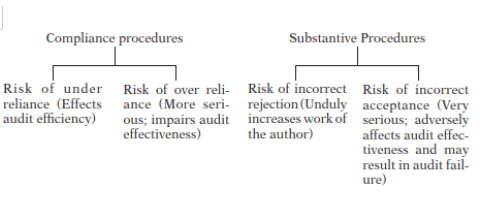
Risk of under reliance is associated with a situation where the sample results may show that the auditor should not rely on a particular internal control whereas the actual position might have indicated such reliance. He would extend his substantive tests even though this additional work is not required.
Risk of over reliance implies a situation where, on the basis of sample results, the auditor relies on a control while it should not have been relied upon and accordingly reduces the extent of substantive testing.
Risk of incorrect rejection is the risk that sample results support the conclusion that the recorded account balance is materially misstated when it is, in fact, not materially misstated.
Risk of incorrect acceptance is the risk that the sample results support the conclusion that the recorded account balance is not materially misstated when it is, in fact, materially misstated.
LOWER THE SAMPLING RISK, THE AUDITOR IS WILLING TO ACCEPT, GREATER THE SAMPLE SIZE.
Example: A ten per cent level of risk of incorrect acceptance requires a smaller sample to achieve the same results than does a five per cent level of risk. If the auditor has assessed control risk at lower than the maximum for a given assertion, he can accept a larger risk of incorrect acceptance for the substantive test related to the assertion.
(b) Tolerable error – is a planning measure:
- for substantive tests, it is expressed as a monetary amount;
- for compliance tests, it is maximum rate of deviation from internal control.
SMALLER THE TOLERABLE ERROR, GREATER THE SAMPLE SIZE
(c) Expected error: usually based on prior experience or a pilot sample.
LOWER THE EXPECTED ERROR, SMALLER THE SAMPLE SIZE
4.4 Sample selection
Three methods of sample selection have been mentioned under SA 530. These
are :
- Random selection
- Systematic random sampling
- Haphazard Selection
(i) Random selection
Random sampling is a method of sampling in which sample is selected at random i.e. in a manner that ensures each element in the population has an equal chance of being selected, for example, by use of random number tables.
Disclaimer: The content/information published on the website is only for general information of the user and shall not be construed as legal advice. While the Taxmann has exercised reasonable efforts to ensure the veracity of information/content published, Taxmann shall be under no liability in any manner whatsoever for incorrect information, if any.

Taxmann Publications has a dedicated in-house Research & Editorial Team. This team consists of a team of Chartered Accountants, Company Secretaries, and Lawyers. This team works under the guidance and supervision of editor-in-chief Mr Rakesh Bhargava.
The Research and Editorial Team is responsible for developing reliable and accurate content for the readers. The team follows the six-sigma approach to achieve the benchmark of zero error in its publications and research platforms. The team ensures that the following publication guidelines are thoroughly followed while developing the content:
- The statutory material is obtained only from the authorized and reliable sources
- All the latest developments in the judicial and legislative fields are covered
- Prepare the analytical write-ups on current, controversial, and important issues to help the readers to understand the concept and its implications
- Every content published by Taxmann is complete, accurate and lucid
- All evidence-based statements are supported with proper reference to Section, Circular No., Notification No. or citations
- The golden rules of grammar, style and consistency are thoroughly followed
- Font and size that’s easy to read and remain consistent across all imprint and digital publications are applied
Everything on Tax and Corporate Laws of India
To subscribe to our weekly newsletter please log in/register on Taxmann.com








 CA | CS | CMA


