Anti-Profiteering and Consumer Rights under GST—FAQs
- Blog|GST & Customs|
- 10 Min Read
- By Taxmann
- |
- Last Updated on 31 October, 2025
Latest from Taxmann


Consumer Rights under GST refer to the legal protections granted to consumers to ensure they receive the full benefit of tax reforms under the Goods and Services Tax (GST) regime. The core principle, enshrined in Section 171 of the CGST Act, 2017, mandates that any reduction in the rate of tax or benefit of input tax credit must be passed on to consumers through a commensurate reduction in prices. This ensures that businesses do not unjustly enrich themselves by retaining tax benefits meant for the end consumer.
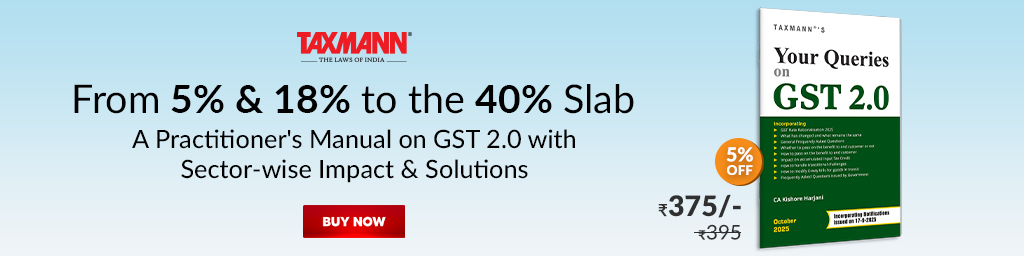
Check out Taxmann's Your Queries on GST 2.0 which is a hands-on guide to the 2025 GST rate rationalisation and compliance reset. Written in an FAQ style, it distils the 56th GST Council decisions into practical steps on pricing, documentation, ITC, transitions, and consumer obligations. The book explains the shift to a two-tier structure, with rates of 5% and 18%, and a special 40% slab for demerit goods/services. It illustrates the sectoral impact, ranging from FMCG and healthcare to autos, e-commerce, and gaming. Combining statutes, case law, circulars, and worked examples, it helps professionals move seamlessly from 'what changed' to 'how to implement.'
FAQ 1. Whether businesses are obliged to pass on the benefit of rate reductions to consumers?
One of the most debated issues under GST 2.0 is whether businesses are still obliged to pass on the benefit of rate reductions to consumers. Historically, the answer has been ‘Yes’.
Under the GST framework, companies were required to reduce prices when GST rates were lowered or input tax credit benefits were available. This was enforced by the National Anti-Profiteering Authority (NAPA).
The anti-profiteering provisions under GST are governed by Section 171 of the Central Goods and Services Tax Act, 2017 (‘CGST Act’) which provides that, ‘any reduction in rate of tax on any supply of goods or services or the benefit of input tax credit shall be passed on to the recipient by way of commensurate reduction in prices’.
Example – If GST rate on a chocolate bar decreases from 18% to 5%, the manufacturer should revise the MRP immediately to ensure that the benefit of rate reduction is passed on to the customer by way of reduction in price.
That said, due to insertion of sun-set clause and release of notification notifying April 1, 2025 as the date post which no new applications can be entertained by the NAPA, one may argue, that as law stands, there is no legal obligation to pass on the benefits to consumers by way of reduction in prices.
Having said the above, judicial precedents under GST framework have reinforced that anti-profiteering is not merely a compliance obligation but a consumer welfare measure. Also, the issue of FAQs, circular dated September 09, 2025 by Department of Consumer Affairs, Finance Minister’s speech, advisories and memorandums issued by the Government seems to suggest that even if anti-profiteering provisions lapse under the sunset clause, the broader legal principle of consumer welfare continues to bind businesses to pass on the necessary benefit to the end consumer. Thus, businesses required to pass on the benefit of GST rate reduction to end customers.
FAQ 2. If a company does not reduce the price of goods and or services post the GST reduction, whether the same can be considered as violation under Consumer Protection Act, 2019?
The Consumer Protection Act, 2019 (CPA, 2019) is enacted to safeguard the interests of consumers and ensure fair trade practices in the marketplace. The CPA, 2019 broadly covers consumer rights, including protection against unfair trade practices, misleading advertisements, and supply of defective goods or deficient services.
Under Section 2(47) of the CPA, 2019, businesses are expressly prohibited from engaging in unfair trade practices, one of which is overcharging consumers i.e., charging a price in excess of that fixed by law, displayed on goods, or agreed upon.
In parallel, the anti-profiteering provisions under Section 171 of the CGST Act, 2017 mandate that any reduction in the rate of GST or benefit of input tax credit must be passed on to the recipient by way of commensurate reduction in prices. Failure to do so effectively results in the consumer being charged more than what is legally permissible.
Accordingly, where a business does not pass on the benefit of GST rate reduction or benefits due to incremental credits, such conduct may amount not only to profiteering under GST law, but also to an unfair trade practice under CPA, 2019, since it constitutes denial of statutory benefits and overcharging of consumers.
Example – If a retailer sells goods at old prices after a GST rate reduction, it can be considered an unfair trade practice and a violation under the CPA, 2019.
FAQ 3. If a company does not reduce the price of goods and or services post the GST reduction, whether the same can be considered as violation under Competition Act, 2002?
The Competition Act, 2002 is an Act designed, keeping in view of the economic development of the country, for the establishment of a Commission to prevent practices having adverse effect on competition, to promote and sustain competition in markets, to protect the interests of consumers and to ensure freedom of trade carried on by other participants in markets, in India, and for matters connected therewith or incidental thereto. The Competition Act, 2002 addresses cases of unjust enrichment or abuse of dominance in the market.
Under the GST framework, initially, the National Anti-profiteering Authority (NAPA) was constituted under Section 171 of the CGST Act, 2017, to ensure that the benefits of reduced tax rates or input tax credit were passed on to consumers. The NAPA, along with the Directorate General of Anti-profiteering (DGAP), Standing Committee, and State-level Screening Committees, formed the institutional framework for anti-profiteering.
A significant shift occurred with effect from December 1, 2022. The Central Government, acting on the recommendations of the GST Council and exercising its powers under Section 171(2) of the CGST Act, 2017, explicitly empowered the Competition Commission of India (CCI) to examine whether input tax credits availed or reduction in tax rates had actually resulted in a commensurate reduction in the price of goods or services. This empowerment was formalised through Notification No. 23/2022-Central Tax. During this period (December 1, 2022, to September 30, 2024), the CCI effectively took over the role of the anti-profiteering authority, applying the provisions of Section 171 of the CGST Act. This meant that the CCI, an existing statutory body under the Competition Act, 2002, was entrusted with the responsibility of enforcing GST anti-profiteering measures.
Therefore, the Competition Act, 2002, was not applied in its entirety for GST anti-profiteering matters. However, the Competition Commission of India (CCI), an authority established under the Competition Act, 2002, was indeed designated and empowered by the Central Government to act as the anti-profiteering authority under Section 171 of the CGST Act, 2017, for the period from December 1, 2022, to September 30, 2024. During this time, the CCI was responsible for examining and enforcing the anti-profiteering provisions of the GST law.
FAQ 4. Do the anti-profiteering provisions apply in a situation where company is already supplying the goods and/or services at losses due to market conditions such as penetration in new market or competition?
Section 171(1) of the CGST Act, 2017, explicitly states that “any reduction in the rate of tax on any supply of goods or services or both or the benefit of input tax credit shall be passed on to the recipient by way of a commensurate reduction in prices.” The use of “any supply” signifies a broad and universal application across all taxable goods and services.
The core principle of anti-profiteering is to ensure that tax benefits are transferred to the end consumer, not to regulate the overall profitability of a business. The Explanation to Section 171(3A) (renumbered as Explanation 1 by Finance (No. 2) Act, 2024) defines “profiteered” as
“the amount determined on account of not passing the benefit of reduction in rate of tax on supply of goods or services or both or the benefit of input tax credit to the recipient by way of commensurate reduction in the price of the goods or services or both.”
This definition focuses solely on the failure to pass on the tax benefit, without considering the supplier’s profit margins or whether they are incurring a loss.
The National Anti-Profiteering Authority (NAPA) has consistently held that the obligation to pass on benefits is absolute and does not depend on the supplier’s profitability. In the case of I. P. Saji, Inox Leisure (P.) Ltd. [2021] 125 taxmann.com 292 (NAA), it was unequivocally stated that
“Section 171 has not been framed to ensure profit of the Respondent as the benefit has to be passed irrespective of the fact whether he is in profit or loss. The Respondent cannot misappropriate it against his profit at the expense of voiceless, unorganised and vulnerable public.”
The intent is to ensure that the tax foregone by the government (through rate reduction or ITC) is passed to the consumer, not retained by the business. This is distinct from a business’s commercial decision to price its products, which may result in a profit or loss. The anti-profiteering mechanism does not interfere with a business’s right to fix prices or profit margins, but it mandates that any tax-related benefit must be reflected in a lower price.
Therefore, the anti-profiteering provisions under Section 171 of the CGST Act, 2017, apply to all goods and services. The obligation to pass on the benefit of tax rate reduction or input tax credit by way of a commensurate reduction in prices is a strict liability. A supplier’s overall financial health, including whether they are selling at a loss, is generally not a mitigating factor in determining whether profiteering has occurred. The focus remains squarely on whether the specific tax benefit has been passed on to the recipient.
FAQ 5. What is the reasonable period for initiating anti-profiteering proceedings? What alternative remedies are available to consumers for price manipulation after April 1, 2025, if the anti-profiteering provisions have ceased?
The CGST Act, 2017, specifically Section 171, did not prescribe a fixed statutory timeline for initiating anti-profiteering proceedings from the date the alleged profiteering event occurred.
This means there was no explicit time limit within which a consumer or interested party had to file a complaint after experiencing profiteering.
The most critical development impacting the initiation period is the legislative decision to cease the anti-profiteering provisions. As per Notification No. 19/2024-CT dated September 30, 2024, no new applications or requests for examination concerning anti-profiteering cases were to be admitted after April 1, 2025.
This means that while there was no backward-looking limitation, there is a forward-looking cessation date. Any alleged act of profiteering occurring on or after April 1, 2025, or any complaint filed after this date, would not be entertained under the anti-profiteering framework of the CGST Act.
Alternative Remedies for Consumers Post-April 1, 2025
- Competition Commission of India (CCI) – The functions of handling new anti-profiteering cases were formally entrusted to the Competition Commission of India (CCI) effective December 1, 2022, following the abolition of the National Anti-Profiteering Authority (NAPA). This means that for any new instances of price manipulation or non-passing of GST benefits that occur after April 1, 2025, consumers should approach the CCI.
- Consumer Protection Act, 2019 – Consumers can file complaints before the District, State, or National Consumer Disputes Redressal Commissions (commonly known as Consumer Courts) under the Consumer Protection Act, 2019. This Act provides a robust framework for addressing unfair trade practices, deceptive pricing, and deficiency in goods or services. Price manipulation, where a seller charges an exorbitant price or fails to pass on benefits, could be construed as an unfair trade practice or a deficiency, allowing consumers to seek redressal.
- Consumer Welfare Fund (CWF) – While not a direct enforcement body for new complaints, the Consumer Welfare Fund (CWF), established under Section 57 of the CGST Act, 2017, and governed by Rule 97 of the CGST Rules, 2017, continues to play a crucial supportive role for consumer protection. Rule 97(8)(c) allows the Standing Committee of the CWF to recommend grants for reimbursing legal expenses incurred by complainants in consumer disputes after their final adjudication. This means if a consumer pursues a case against price manipulation in a Consumer Court or before the CCI, and incurs legal costs, they may be eligible for reimbursement from the CWF.
FAQ 6. Is upward revision of MRP permissible when GST rates increase?
Section 171(1) of the CGST Act, 2017, explicitly states that ‘Any reduction in rate of tax on any supply of goods or services or the benefit of input tax credit shall be passed on to the recipient by way of commensurate reduction in prices.’ This provision forms the bedrock of the anti-profiteering mechanism. Its primary objective is to ensure that any financial advantage accruing to a supplier due to a reduction in the tax rate applicable to their goods or services, or an increase in the input tax credit they can avail, is compulsorily translated into lower prices for the end consumer.
The legislative logic behind this is to prevent businesses from unjustly enriching themselves by retaining these benefits, thereby curbing inflationary tendencies and ensuring that the benefits of tax reforms reach the public.
The Explanation to sub-section (3A) further clarifies the term ‘profiteered.’ It defines ‘profiteered’ as the amount determined on account of not passing the benefit of reduction in rate of tax on supply of goods or services or both or the benefit of input tax credit to the recipient by way of commensurate reduction in the price of the goods or services or both. This definition unequivocally limits the scope of profiteering to situations where benefits from tax reductions or increased ITC are withheld from consumers. It does not encompass situations where prices are increased due to an increase in the underlying tax rate.
The anti-profiteering framework is a one-way street, designed to ensure benefits are passed on, not to control price increases stemming from higher tax liabilities.
The determination of the Maximum Retail Price (MRP) of any product or service is a purely commercial decision and is not governed by GST law. Therefore, there is no restriction on upward revision of MRP when GST rate increases.
FAQ 7. Is anti-profiteering mechanism applicable only to goods or does it apply to services as well?
The anti-profiteering mechanism under Section 171 of the Central Goods and Services Tax (CGST) Act, 2017, is comprehensively applicable to both goods and services. The legislative intent and the explicit wording of the statute clearly extend its scope beyond just goods to include all forms of supply under the GST regime.
FAQ 8. How is ‘commensurate reduction in price’ calculated? Is there any formula provided in the law?
Section 171(1) of the CGST Act, 2017, unequivocally states that “Any reduction in rate of tax on any supply of goods or services or the benefit of input tax credit shall be passed on to the recipient by way of commensurate reduction in prices.” The term “profiteered” is defined as the amount determined on account of not passing this benefit to the recipient through a commensurate reduction in price. The legislative intent is to ensure that the end consumer benefits from tax reforms and not just the suppliers.
A critical aspect highlighted by judicial pronouncements is the absence of a fixed or uniform method for determining “commensurate reduction.”
Case-by-Case Approach – The Delhi High Court, in Reckitt Benckiser India (P.) Ltd. v. Union of India [2024] 158 taxmann.com 675, explicitly ruled that
“No fixed/uniform method or mathematical formula can be laid down for determining profiteering.”
It further clarified that the erstwhile National Anti-profiteering Authority (NAPA) (now the Appellate Tribunal) “has to determine the appropriate methodology on a case to case basis keeping in view the peculiar facts and circumstances of each case.” This position has been consistently upheld by the NAPA in various orders, such as in Vishwanath Builders [2022] 143 taxmann.com 345.
Mathematical Exercise – Despite the lack of a fixed formula, the determination is considered a “purely mathematical exercise.” This involves comparing the pre- and post-tax rate reduction scenarios, taking into account the existing base price (price without GST) and the quantum of tax reduction or additional Input Tax Credit (ITC) available. This exercise is expected to vary from product to product or service to service.
Factors Considered and Disregarded in Determination
The authorities, primarily the Director General of Anti-profiteering (DGAP) during investigation and the Appellate Tribunal during adjudication, consider specific factors while largely disregarding others:
- Focus on Tax Component – The determination primarily focuses on the impact of tax rate reduction or ITC benefit on the price. The Delhi High Court in Reckitt Benckiser India (P.) Ltd. [2024] 158 taxmann.com 675 noted that Section 171
“only relates to the indirect-tax component of the price of goods and services and does not impinge upon the freedom of suppliers to fix their own prices keeping in view relevant commercial and economic factors.”
Disclaimer: The content/information published on the website is only for general information of the user and shall not be construed as legal advice. While the Taxmann has exercised reasonable efforts to ensure the veracity of information/content published, Taxmann shall be under no liability in any manner whatsoever for incorrect information, if any.

Taxmann Publications has a dedicated in-house Research & Editorial Team. This team consists of a team of Chartered Accountants, Company Secretaries, and Lawyers. This team works under the guidance and supervision of editor-in-chief Mr Rakesh Bhargava.
The Research and Editorial Team is responsible for developing reliable and accurate content for the readers. The team follows the six-sigma approach to achieve the benchmark of zero error in its publications and research platforms. The team ensures that the following publication guidelines are thoroughly followed while developing the content:
- The statutory material is obtained only from the authorized and reliable sources
- All the latest developments in the judicial and legislative fields are covered
- Prepare the analytical write-ups on current, controversial, and important issues to help the readers to understand the concept and its implications
- Every content published by Taxmann is complete, accurate and lucid
- All evidence-based statements are supported with proper reference to Section, Circular No., Notification No. or citations
- The golden rules of grammar, style and consistency are thoroughly followed
- Font and size that’s easy to read and remain consistent across all imprint and digital publications are applied
Everything on Tax and Corporate Laws of India
To subscribe to our weekly newsletter please log in/register on Taxmann.com








 CA | CS | CMA


