IBC Resolution Plan Extinguishes All Non-Included Claims | NCLT
- Blog|News|Insolvency and Bankruptcy Code|
- 2 Min Read
- By Taxmann
- |
- Last Updated on 23 March, 2026
Latest from Taxmann

Case Details: Stressed Assets Stabilization Fund vs. Krystal Stone Exports Limited [2026] 184 taxmann.com 166 (NCLT-Mum.)
Judiciary and Counsel Details
- Sushil Mahadeorao Kochey, Judicial Member & Prabhat Kumar, Technical Member
-
Pulkit Sharma, Rehan Agarwal & Tejas Madhavi, Advs. for the Applicant.
-
Mily Ghoshal, Kamal Deep Tyagi, Advs. & Shweta Thanekar, Ld. Counsel for the Respondent.
Facts of the Case
In the instant case, the CIRP was initiated against the corporate debtor. The CoC approved the resolution plan submitted by SRA. The RP filed an application for the approval of the resolution plan.
It was noted that RP had complied with requirement of Code in terms of Section 30(2)(a) to 30(2)(f) of the IBC and Regulations 38(1), 38(1)(a), 38(2)(a), 38(2)(b), 38(2)(c) & 38(3) of CIRP Regulations. Further, SRA was not hit by any of the disqualifications under Section 29A of the IBC.
NCLT Held
The NCLT observed that since the commercial wisdom of CoC in approving a Resolution Plan has been consistently held to be non-justiciable, save and except to a limited extent provided under Section 30(2) and Section 31, SRA not presently being in business could not, by itself, be a ground to reject the Resolution Plan.
Further, the NCLT observed that since the Resolution Plan had been approved by the CoC with the requisite majority after due consideration of feasibility and viability, the same was to be approved.
The NCLT held that the approval of the Resolution Plan would not be construed as a waiver of any statutory obligations/liabilities of the Corporate Applicant, and that the appropriate Authorities would deal with such matters in accordance with the law.
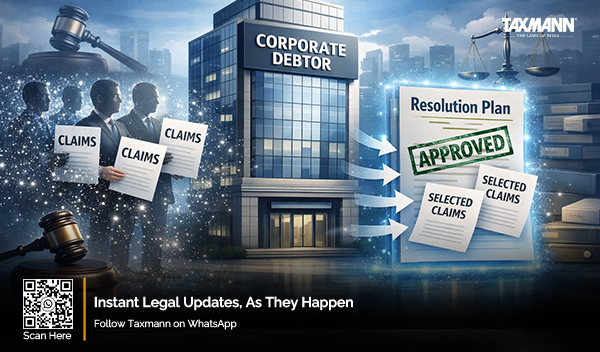
Further, the NCLT held that, on the date of approval of the resolution plan by the Adjudicating Authority, all such claims, which were not a part of the resolution plan, would stand extinguished and no person would be entitled to initiate or continue any proceedings in respect to a claim, which was not part of the resolution plan.
Consequently, all dues, including statutory dues owed to the Central Government, any State Government or any local authority, if not part of the resolution plan, would stand extinguished, and no proceedings in respect of such dues for the period prior to the date on which the Adjudicating Authority grants its approval under Section 31 of the IBC could be continued.
List of Cases Reviewed
- Ghanashyam Mishra & Sons (P.) Ltd. v. Edelweiss Asset Reconstruction Co. Ltd. [2021] 126 taxmann.com 132 (SC)/[2021] 166 SCL 237 (SC)
- Municipal Corporation of Greater Mumbai (MCGM) v. Abhilash Lal [2019] 111 taxmann.com 405 (SC)/[2020] 157 SCL 477 (SC) (para 28) followed
List of Cases Referred to
- Arcelormittal India (P.) Ltd. v. Satish Kumar Gupta [2018] 98 taxmann.com 99 (SC)/[2018] 150 SCL 354 (SC) (para 25)
- Ghanashyam Mishra & Sons (P.) Ltd. v. Edelweiss Asset Reconstruction Co. Ltd. [2021] 126 taxmann.com 132 (SC)/[2021] 166 SCL 237 (SC) (para 28)
- Municipal Corporation of Greater Mumbai (MCGM) v. Abhilash Lal [2019] 111 taxmann.com 405 (SC)/[2020] 157 SCL 477 (SC) (para 28)
- K. Sashidhar v. Indian Overseas Bank [2019] 102 taxmann.com 139 (SC)/[2019] 152 SCL 312 (SC) (para 29).
Disclaimer: The content/information published on the website is only for general information of the user and shall not be construed as legal advice. While the Taxmann has exercised reasonable efforts to ensure the veracity of information/content published, Taxmann shall be under no liability in any manner whatsoever for incorrect information, if any.

Taxmann Publications has a dedicated in-house Research & Editorial Team. This team consists of a team of Chartered Accountants, Company Secretaries, and Lawyers. This team works under the guidance and supervision of editor-in-chief Mr Rakesh Bhargava.
The Research and Editorial Team is responsible for developing reliable and accurate content for the readers. The team follows the six-sigma approach to achieve the benchmark of zero error in its publications and research platforms. The team ensures that the following publication guidelines are thoroughly followed while developing the content:
- The statutory material is obtained only from the authorized and reliable sources
- All the latest developments in the judicial and legislative fields are covered
- Prepare the analytical write-ups on current, controversial, and important issues to help the readers to understand the concept and its implications
- Every content published by Taxmann is complete, accurate and lucid
- All evidence-based statements are supported with proper reference to Section, Circular No., Notification No. or citations
- The golden rules of grammar, style and consistency are thoroughly followed
- Font and size that’s easy to read and remain consistent across all imprint and digital publications are applied
Everything on Tax and Corporate Laws of India
To subscribe to our weekly newsletter please log in/register on Taxmann.com








 CA | CS | CMA


