[Analysis] Ban on Online Money Games in India – Highlights of Online Gaming Bill 2025
- Blog|Advisory|Company Law|
- 7 Min Read
- By Taxmann
- |
- Last Updated on 18 September, 2025
Latest from Taxmann

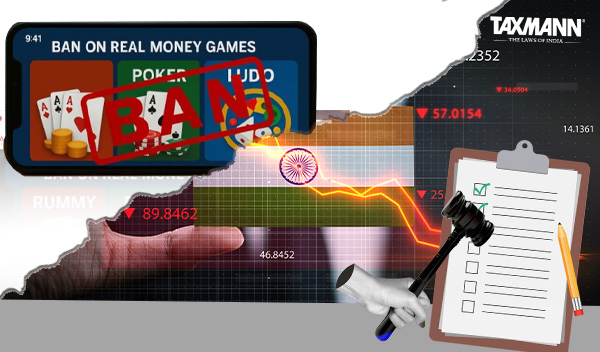
The Online Gaming Regulation Bill 2025 creates a legal framework to regulate the fast-growing online gaming industry. It takes a dual approach—promoting e-sports and social or educational games for innovation, skill development, and employment, while imposing a complete ban on online money games to protect citizens from financial loss, addiction, and mental health issues. The Bill also prohibits advertising of money gaming, blocks financial transactions to such platforms, and establishes a central authority to regulate the sector, ensuring a safe and responsible digital gaming environment.
Table of Contents
1. Introduction
India’s online gaming sector has grown rapidly in recent years, driven by low-cost internet, widespread smartphone use, and increasing digital participation. While e-sports and educational games provide opportunities for innovation, skill development, and employment, the unchecked rise of online money gaming has created serious challenges.
Reports have linked money gaming platforms to financial losses, debt traps, addiction, and mental health issues, particularly among youth and vulnerable groups. Many of these platforms operate from offshore jurisdictions, making it difficult for Indian authorities to regulate them. They have also been connected with fraud, tax evasion, money laundering, and even national security concerns.
To address this dual reality, ‘The Promotion and Regulation of Online Gaming Bill, 2025’ is proposed to create a structured legal framework for India’s rapidly growing online gaming industry. It takes a dual approach: on one hand, it aims to promote and develop legitimate sectors like e-sports and social gaming. On the other, it seeks to completely prohibit online money games to protect citizens, especially the youth, from their documented social, financial, and psychological harms.
Here is a detailed breakdown of the Bill’s 15 key provisions.
1.1 Two-Sided Approach – Promote & Prohibit
The Bill is not a blanket ban but a strategic framework for the entire online gaming ecosystem. On one side, it encourages growth of the creative and skill-based segments of the industry, recognizing their potential for innovation, employment, and economic growth. On the other, it imposes a strict prohibition on online money games, which are seen as a threat to public health and financial security. This two-way approach reflects the government’s intent to create a responsible digital environment while promoting innovation and economic growth.
1.2 A Proposed Law with Nationwide & Global Reach
The law extends to the whole of India, ensuring a uniform national policy. Remarkably, the regulations also cover any online money gaming service accessible to people within India, even if the operator is based outside the country. This provision is designed to close a significant loophole used by offshore operators, who often bypass domestic laws and present major enforcement challenges for Indian authorities.
1.3 Categories in the Online Gaming Landscape
To ensure clear and fair regulation, the Bill establishes three distinct definitions for online games.
- E-Sport
Esport means an online game played as part of multi-sport events through organised competitions between individuals or teams in multiplayer formats with predefined rules. It must be officially recognised under the National Sports Governance Act, 2025, and registered with the relevant authority.
The outcome depends only on players’ physical skill, mental agility, or strategic thinking. Participation may involve registration or entry fees to cover competition costs, and players may receive performance-based prize money. However, e-sports do not allow any form of betting, wagering, or staking by participants or others. - Online Social Games
A game played for entertainment or skill development that may require a subscription or one-time fee for access but does not involve staking money with the expectation of monetary gain. It is different from an online money game or an e-sport. - Online Money Games
This is broadly defined as any online game where a user pays or stakes money with the expectation of winning a monetary return, explicitly including games based on skill, chance, or both. It does not include e-sports.
1.4 Recognising & Promoting E-Sports
The Central Government will take concrete steps to officially recognize and promote e-sports as a legitimate form of competitive sport in India. These measures may include establishing official guidelines and standards for events, creating training academies and research centers, and introducing incentive schemes to encourage innovation in e-sport technology platforms. The ultimate goal is to integrate e-sports into the country’s broader sporting policy initiatives.

1.5 Support for Social & Educational Games
The Bill also facilitates the development and availability of online social games for recreational and educational purposes. The government will create mechanisms for registering these games to ensure they are safe and appropriate for users. It will also support initiatives aimed at increasing public access to high-quality social gaming content and will undertake awareness programs to highlight the positive uses of these games for skill development and digital literacy.
1.6 A Complete Ban on Online Money Games
The law imposes a strict and unambiguous prohibition on online money games. It states that no person shall offer, aid, abet, or in any way engage in the business of providing online money games or their related services. This ban is comprehensive and applies to all games that fit the definition, regardless of whether they are marketed as games of “skill” or “chance”. This measure is a direct response to the serious social, financial, and public health harms linked to these platforms.
1.7 Prohibition on Advertising of Money Gaming
To curb the widespread influence of money gaming platforms, the Bill prohibits any form of advertisement that promotes them. This ban covers all media, including digital and electronic communications, and targets aggressive marketing campaigns that often use celebrity and influencer endorsements. The primary objective is to reduce the visibility and appeal of these games, thereby protecting the youth and other vulnerable populations from being induced to play.
1.8 Cutting Off the Money Flow from Banks & FIs to Illegal Gaming Platforms
A key enforcement strategy in the Bill is to disrupt the financial operations of illegal gaming platforms. It explicitly prohibits banks, financial institutions, and any other payment facilitators from engaging in or permitting any transaction or authorization of funds directed towards an online money gaming service. This financial blockade is designed to make it impossible for these services to accept deposits from users or pay out winnings, effectively crippling their business model.
1.9 Introducing a New ‘Watchdog’ for Online Gaming
The Bill proposes the establishment of a central “Authority” to oversee and regulate the online gaming. This new regulatory body will be empowered to recognize, categorize, and register legitimate online games like e-sports and social games. Critically, it will also have the power to investigate and determine, either on its own initiative or upon receiving an application, whether a particular online game falls under the prohibited category of an “online money game”.
1.10 Heavy Penalties for Violations
The legislation outlines severe penalties to ensure compliance.
- Anyone offering an online money gaming service faces imprisonment for a term up to three years, a fine up to Rs. 1 crore, or both.
- Anyone advertising such a service can be punished with imprisonment for up to two years, a fine up to Rs. 50 lakh, or both.
- Anyone facilitating financial transactions for these services is subject to imprisonment up to three years, a fine up to Rs. 1 crore, or both.
1.11 Even Stricter Punishment for Repeat Offenders
To deter habitual offenders, the Bill specifies significantly harsher penalties for second and subsequent convictions. A person convicted a second time for offering an online money game or facilitating its finances will face a minimum prison term of three years (extendable to five) and a fine of not less than Rs. 1 crore (extendable to Rs. 2 crore). For repeat advertising offenses, the punishment is a minimum of two years in prison (extendable to three) and a fine of not less than Rs 50 lakhs (extendable to Rs. 1 crore).
1.12 Accountability of Companies & Directors
The Bill ensures that corporate leaders cannot evade accountability. If a company commits an offense, the law holds not only the company but also every person who was in charge of and responsible for the company’s business at that time liable for prosecution. This includes directors, managers, and other key officers, who can be punished accordingly unless they can prove the offense occurred without their knowledge or that they exercised all due diligence to prevent it.
1.13 Power to Block Websites & Apps
The Central Government is granted the authority to take down illegal gaming platforms swiftly. In the event of non-compliance with the prohibitions, any information related to an online money gaming service that is generated, transmitted, or hosted on any computer resource is liable to be blocked for public access. This power, aligned with Section 69A of the Information Technology Act, 2000, allows the government to effectively remove offending websites and applications from the internet in India.
1.14 Broad Powers for Investigators
The Bill grants robust enforcement powers to authorized officers to ensure the law can be effectively implemented. The Central Government can authorize specific officers to investigate offenses under the Act. These officers are empowered to enter any physical or digital place for search and can arrest any person without a warrant if there is a reasonable suspicion that they have committed, are committing, or are about to commit an offense under the Act.
1.15 Protecting the Youth & Vulnerable
At its core, the Bill is a measure for public and consumer protection. A primary stated objective is to shield individuals, particularly the youth and other vulnerable groups, from the adverse social, economic, and psychological impacts of online money games. The legislation is a response to growing concerns about financial ruin, compulsive behavior, and mental health issues associated with these platforms, aiming to create a safer digital space for all citizens.

2. Author’s Comment
What stands out about this Bill is not just the ban on money gaming but the attempt to draw a line between what India wants to encourage and what it wants to weed out completely. Most discussions online focus only on the prohibition part, but the recognition of e-sports and social games shows the government is also thinking about the future of gaming as an industry. The challenge, however, will lie in enforcement. Especially when offshore operators and fast-evolving digital platforms are involved.
Disclaimer: The content/information published on the website is only for general information of the user and shall not be construed as legal advice. While the Taxmann has exercised reasonable efforts to ensure the veracity of information/content published, Taxmann shall be under no liability in any manner whatsoever for incorrect information, if any.

Taxmann Publications has a dedicated in-house Research & Editorial Team. This team consists of a team of Chartered Accountants, Company Secretaries, and Lawyers. This team works under the guidance and supervision of editor-in-chief Mr Rakesh Bhargava.
The Research and Editorial Team is responsible for developing reliable and accurate content for the readers. The team follows the six-sigma approach to achieve the benchmark of zero error in its publications and research platforms. The team ensures that the following publication guidelines are thoroughly followed while developing the content:
- The statutory material is obtained only from the authorized and reliable sources
- All the latest developments in the judicial and legislative fields are covered
- Prepare the analytical write-ups on current, controversial, and important issues to help the readers to understand the concept and its implications
- Every content published by Taxmann is complete, accurate and lucid
- All evidence-based statements are supported with proper reference to Section, Circular No., Notification No. or citations
- The golden rules of grammar, style and consistency are thoroughly followed
- Font and size that’s easy to read and remain consistent across all imprint and digital publications are applied
Everything on Tax and Corporate Laws of India
To subscribe to our weekly newsletter please log in/register on Taxmann.com








 CA | CS | CMA


